
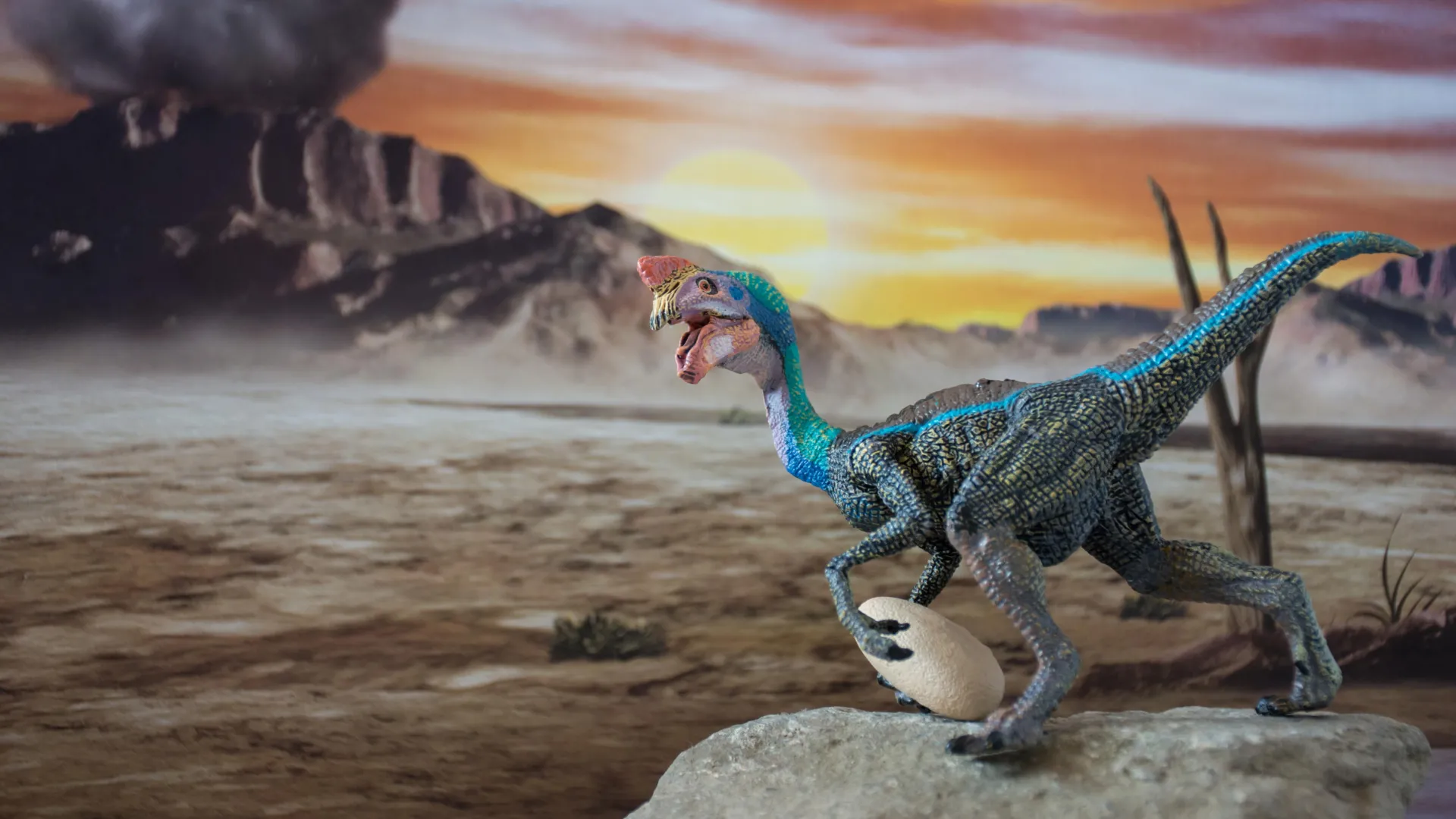
For generations, the reproductive habits of non-avian dinosaurs have remained one of paleontology’s most captivating enigmas. Chief among these mysteries are the oviraptors—a group of distinctive, feathered, bird-like dinosaurs that roamed the earth during the Late Cretaceous Period, roughly 100 to 66 million years ago. While paleontologists have long established that these creatures brooded their clutches in open or semi-open nests rather than burying them like modern crocodiles and turtles, the exact mechanics of how they brought their young into the world have sparked intense scientific debate. Could these flightless animals incubate their eggs with the precision of modern birds, or did they rely more heavily on external, environmental heat sources?
A groundbreaking study recently published in the scientific journal Frontiers in Ecology and Evolution offers a compelling new window into this ancient world. Spearheaded by researchers in Taiwan, the study bridges the gap between physical reality and digital simulation, utilizing a life-sized model of an oviraptor and meticulously crafted artificial nests. The findings not only challenge long-held assumptions regarding prehistoric parental care but also illuminate a fascinating transitional phase in the evolutionary journey from reptiles to modern birds.
Recreating an Ancient Nursery: Physical Models Meet Digital Simulations
To tackle the complexities of oviraptor brooding, the research team focused their efforts on Heyuannia huangi, a well-documented oviraptor species that inhabited what is now China between 70 and 66 million years ago. Adult specimens of this species typically measured roughly 1.5 meters in length, tipped the scales at approximately 20 kilograms, and constructed intricate, multi-layered, semi-open nests featuring distinct rings of elongated eggs.
Reconstructing this prehistoric scene required an ingenious blend of low-tech craftsmanship and high-tech analysis. Because oviraptor eggs are morphologically unique, bearing little resemblance to the eggs of any living species, the researchers had to custom-build their experimental materials. They cast artificial eggs out of specialized resin, arranging them in the characteristic double rings discovered in fossilized nesting sites.
To simulate the brooding adult, the team constructed a life-sized torso using a sturdy wooden framework combined with lightweight polystyrene foam. To mimic the thermal insulation properties of living tissue, they integrated layers of cotton, cloth, and bubble paper into the model. Once constructed, this physical model was subjected to a battery of controlled tests designed to measure how heat transferred from the "parent" to the clutch under varying environmental conditions. By coupling these physical experiments with advanced computer simulations, the team could meticulously track temperature distribution across individual eggs within the nest—a feat virtually impossible to achieve using static fossil records alone.
The Role of Sunlight and Ambient Heat in Prehistoric Incubation
One of the most significant revelations of the study centers on the interplay between parental body heat and environmental factors, particularly ambient sunlight. The experiments demonstrated that the position of the brooding adult relative to the nest played a critical role in thermal regulation, but this system operated quite differently depending on the surrounding climate.
Under cooler simulated environmental conditions, eggs situated in the outer ring of the nest experienced pronounced temperature discrepancies, registering variations of up to 6 degrees Celsius compared to inner eggs. In biological terms, such significant thermal gradients would likely have induced asynchronous hatching, meaning that certain embryos within the same clutch developed and hatched much faster than others.
Conversely, when the researchers simulated warmer environmental conditions, the temperature gap between the inner and outer rings dropped dramatically to just 0.6 degrees Celsius. This observation strongly indicates that oviraptors inhabiting warmer regions during the Late Cretaceous relied heavily on sunlight as a supplementary, co-equal source of incubation heat.
"It’s unlikely that large dinosaurs sat atop their clutches. Supposedly, they used the heat of the sun or soil to hatch their eggs, like turtles," explained Dr. Tzu-Ruei Yang, senior author of the study and an associate curator of vertebrate paleontology at Taiwan’s National Museum of Natural Science. "Since oviraptor clutches are open to the air, heat from the sun likely mattered much more than heat from the soil."
A Cooperative Strategy: Oviraptors Versus Modern Birds
To contextualize their findings, the research team directly compared oviraptor incubation mechanics with the methods utilized by modern avian species. Extant birds rely primarily on what biologists call thermoregulatory contact incubation, or TCI. This specialized strategy requires three distinct criteria: the incubating parent must maintain direct physical contact with every individual egg, serve as the absolute primary source of thermal energy, and maintain the entire clutch within a tightly controlled, narrow temperature range.
The physical constraints of the oviraptor nest design, however, suggest that these feathered dinosaurs could not fulfill all the requirements of modern TCI. Their anatomical structure and the sprawling layout of their multi-ringed nests prevented adults from achieving simultaneous, direct contact with every egg in the clutch.
Consequently, the researchers concluded that oviraptors and ambient sunlight acted as co-incubators. While this dual-source method yielded lower overall thermal efficiency compared to modern avian brooding, the researchers caution against viewing this difference through a lens of evolutionary superiority or inferiority.
"Moreover, we obtained an estimate of the incubation efficiency of oviraptors, which is much lower than that of modern birds," noted first author Chun-Yu Su, who was a student at Washington High School in Taichung when the research was conducted.
Echoing this sentiment, Dr. Yang emphasized that evolutionary adaptations must be evaluated within their specific ecological context rather than as milestones in a linear competition. "Modern birds aren’t ‘better’ at hatching eggs," Yang pointed out. "Instead, birds living today and oviraptors have a very different way of incubation or, more specifically, brooding. Nothing is better or worse. It just depends on the environment."
Contextualizing Oviraptors in the Avian Transition
To fully appreciate the implications of this study, it is helpful to examine the historical and biological framework surrounding oviraptors. First discovered in the rich fossil beds of Mongolia and China, these creatures were initially misnamed due to a historical misunderstanding. Early paleontologists unearthed the first oviraptor fossil directly atop a nest of fossilized eggs, prompting the genus name Oviraptor, which translates directly to "egg thief."
Decades of subsequent fossil discoveries eventually overturned this predatory narrative. Scientists realized that the dinosaur was not raiding the nest to consume the eggs, but rather perching upon them in a protective, brooding posture to safeguard its own progeny. These findings revolutionized our understanding of dinosaur behavior, proving that complex parental care—long thought to be an exclusive hallmark of mammals and birds—actually originated deep within the dinosaur lineage.
Oviraptors occupy a crucial branch on the evolutionary tree, sitting comfortably in the transitional space between non-avian dinosaurs and true modern birds. Their anatomical traits—including sophisticated feather coverings, beak-like jaws, distinct cranial crests, and advanced nesting habits—demonstrate that many behavioral and physiological characteristics once believed to be unique to birds actually evolved millions of years earlier.
Implications and Future Horizons for Paleontological Research
While the new study provides unprecedented quantitative data regarding dinosaur brooding behavior, the authors are careful to acknowledge its limitations. The physical models and simulations are inherently tied to the specific architectural layout of the Heyuannia huangi nest reconstruction. Furthermore, global climate conditions during the Late Cretaceous Period featured significantly higher baseline temperatures and atmospheric compositions compared to the modern Earth, variables that would have directly influenced thermal dynamics in prehistoric environments. Additionally, biological estimates suggest that oviraptors likely endured significantly longer total incubation periods than their modern avian descendants.
Despite these variables, the methodological framework introduced by the Taiwanese research team marks a significant leap forward for paleontology. By successfully merging physical reconstructions with advanced thermodynamic modeling, the study demonstrates how scientists can bypass the static limitations of the fossil record to answer dynamic biological questions.
Beyond its academic contributions, the research also carries a powerful symbolic resonance within the global scientific community. Because Taiwan lacks significant native dinosaur fossil deposits, local students and researchers have historically faced unique geographical hurdles in entering the field of vertebrate paleontology. The success of this project—partially conducted by a high school student—serves as a testament to the borderless nature of modern scientific inquiry.
"It also truly is an encouragement for all students, especially in Taiwan," Dr. Yang concluded. "There are no dinosaur fossils in Taiwan, but that does not mean that we cannot do dinosaur studies."
As researchers continue to refine these multidisciplinary techniques, the ancient veil shrouding the Mesozoic era continues to lift. Through creative experimentation and rigorous analysis, science is steadily reconstructing not just the skeletal frames of extinct giants, but the intricate, living behaviors that allowed them to thrive millions of years before the dawn of human history.
