
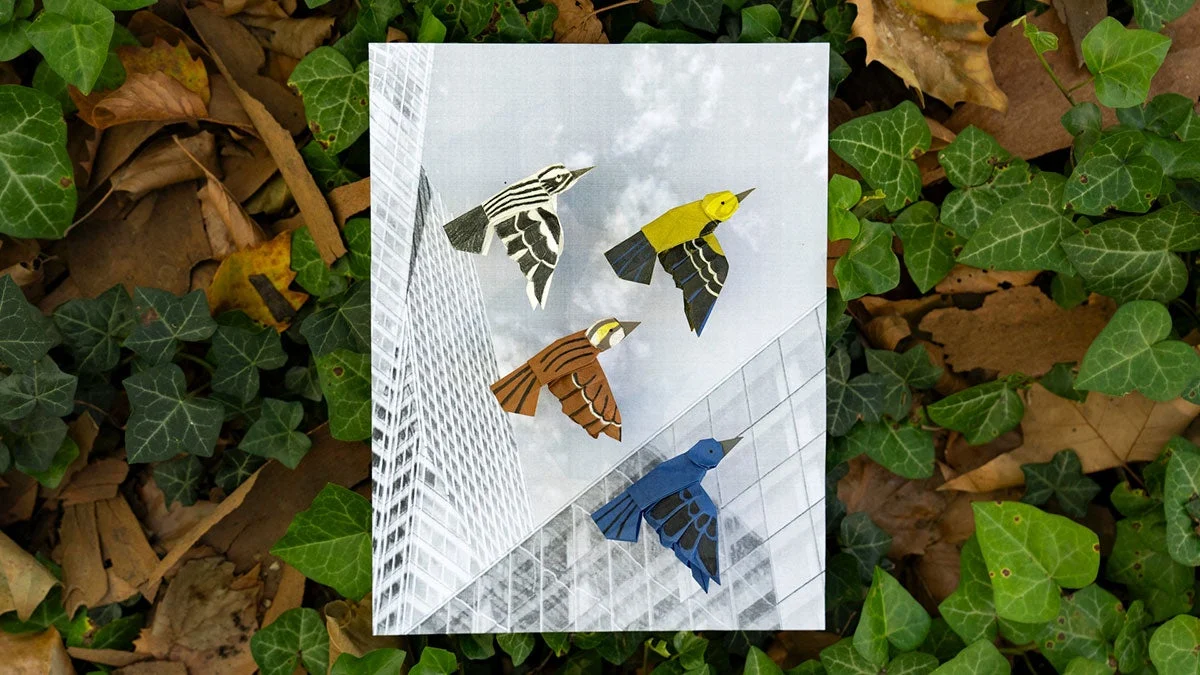
The glassy canyons of Manhattan, while architectural marvels, represent a significant, lethal hazard for the millions of migratory birds that traverse the Atlantic Flyway twice annually. For 14-year-old Miles Wu, a dedicated volunteer with the New York City Bird Alliance’s Project Safe Flight, these skyscrapers are no longer just symbols of urban progress; they are the backdrop of a sobering ecological reality. By marrying the delicate, meditative art of origami with the grim documentation of bird-strike mortality, Wu has created a unique medium for environmental advocacy, turning the tragedy of avian collisions into a poignant call for legislative and structural reform.
The Catalyst: A Moment of Impact
The intersection of Wu’s dual passions—ornithology and paper folding—occurred on a crisp morning this past May. While patrolling the perimeter of a Manhattan office building as part of his volunteer duties, Wu experienced a visceral encounter that would define his artistic mission. A brilliant Indigo Bunting, a bird known for its striking, iridescent blue plumage, struck the reflective glass of a tower. The bird fell instantly to the pavement.
"It was shocking and sad," Wu reflects on the experience. "But it was also really beautiful." This duality—the aesthetic wonder of the avian subject versus the harshness of the urban environment—became the genesis of his latest project. The resulting art installation features four species he discovered during his spring monitoring: the Indigo Bunting, a Black-and-white Warbler, a Black-throated Green Warbler, and a White-throated Sparrow. By painstakingly recreating these creatures in paper, Wu is not merely memorializing the dead; he is forcing a public conversation about the invisible toll of city architecture on local and migratory wildlife.
A Chronology of Advocacy
Wu’s involvement in bird conservation is the culmination of a decade-long interest in nature, paired with a seven-year commitment to origami. His journey began in elementary school, initially folding simple geometric shapes before transitioning to the intricate, complex patterns he designs today.
By age 12, Wu was already an established birder in Central Park, learning to identify species by sight and song. His transition to becoming a collision monitor for Project Safe Flight occurred two years ago, motivated by a desire to act rather than merely observe. The program, which operates during the peak migration months of spring and fall, requires volunteers to patrol designated urban corridors before 7 a.m.
The protocol for these monitors is rigorous. When a bird is found, the volunteer assesses its condition. If alive, the specimen is transported to the Wild Bird Fund, the city’s premier rehabilitation facility for urban wildlife. If the bird has succumbed to its injuries, it is cataloged and donated to the American Museum of Natural History’s ornithology collection. This data is critical, as it feeds into a broader longitudinal study regarding the impact of light pollution and reflective glass on avian navigation.
The Scale of the Crisis
The data collected by volunteers like Wu serves as the backbone for the NYC Bird Alliance’s conservation strategy. According to the organization’s estimates, between 90,000 and 230,000 birds are killed annually in New York City due to window collisions. These collisions occur because birds, particularly migratory species, are unable to perceive glass as a solid barrier. Instead, they see the reflection of trees, sky, and vegetation, which lures them into high-velocity impacts.
The problem is exacerbated by artificial light at night (ALAN). Migratory birds, which often navigate by starlight and magnetic fields, are frequently drawn into the city’s "light traps." Once inside the urban core, they become disoriented by the glare of skyscrapers, circling until they are exhausted or collide with glass surfaces. The exhaustion of these birds, having flown hundreds or even thousands of miles, leaves them with zero margin for error when navigating the gauntlet of a major metropolis.
Artistic Technique as Scientific Documentation
Wu’s origami work is characterized by a high degree of technical precision. Starting with a standard "bird base," he utilizes a five-flap configuration—one for the torso, and four for the appendages (head, tail, and wings). His background in geometry and paper engineering allows him to tweak these folds to mimic the specific morphological features of each species.
For his memorial piece, Wu moved beyond standard construction paper, selecting thicker stock that could be manipulated to simulate the texture of feathers. He utilized colored pencils to capture the nuanced plumage of the warblers and the deep cobalt of the bunting. By mounting these figures against a photographic backdrop of the very buildings he monitors at Bryant Park, he creates a jarring, hyper-realistic installation that bridges the gap between art and forensic evidence.
Broader Implications and Official Responses
The implications of Wu’s work extend far beyond the artistic community. The advocacy surrounding bird-safe architecture has gained significant momentum in recent years. Policies such as Local Law 15, which mandates bird-friendly materials for new construction and significant renovations in New York City, represent a major shift in how the city approaches urban planning.
Proponents of these changes argue that the solutions are relatively straightforward. Simple interventions—such as applying window films, installing exterior netting, or implementing "lights-out" policies during peak migration—can reduce collision rates by up to 90 percent. Organizations like the NYC Bird Alliance continue to lobby building owners to adopt these measures voluntarily, using the data collected by volunteers as a leverage point to demonstrate the severity of the issue.
"A lot of them were lifers, even though they were dead," Wu says, referring to the bittersweet experience of seeing rare species for the first time only after they have collided with a building. This statement highlights the moral weight carried by young conservationists who see the beauty of nature’s diversity through a lens of urban destruction.
The Role of Youth in Modern Conservation
Miles Wu’s trajectory is indicative of a broader trend in environmental activism: the rise of youth-led data collection and creative advocacy. By providing a tangible, visual representation of the bird-strike crisis, Wu is reaching audiences who might otherwise ignore scientific reports or abstract statistics.
His work suggests that conservation, when coupled with personal narrative, becomes more effective. As cities continue to grow and the risks to migratory species increase, the efforts of citizen scientists become increasingly vital. The American Museum of Natural History, which accepts the specimens recovered by monitors, notes that these donations allow researchers to study everything from migratory health to the evolution of urban-adapted species.
As Wu prepares for future migration cycles, he views his origami not just as a hobby, but as a commitment. "I thought this piece would be like a tribute to all the birds from Project Safe Flight," he says. By memorializing the victims, he ensures that their lives—and their deaths—continue to serve a purpose: the preservation of the countless birds that will pass through the city in the years to come.
The story of the Indigo Bunting and the young artist who folded its likeness serves as a reminder that the health of our urban ecosystems depends on the vigilance of those willing to look at the pavement, the reflection of the glass, and the small, often overlooked, lives that inhabit our shared skyline. Through the quiet, repetitive, and deliberate process of folding paper, Miles Wu is contributing to a much larger movement, one that seeks to ensure that the city’s skyline is no longer a graveyard for the world’s winged travelers.
