
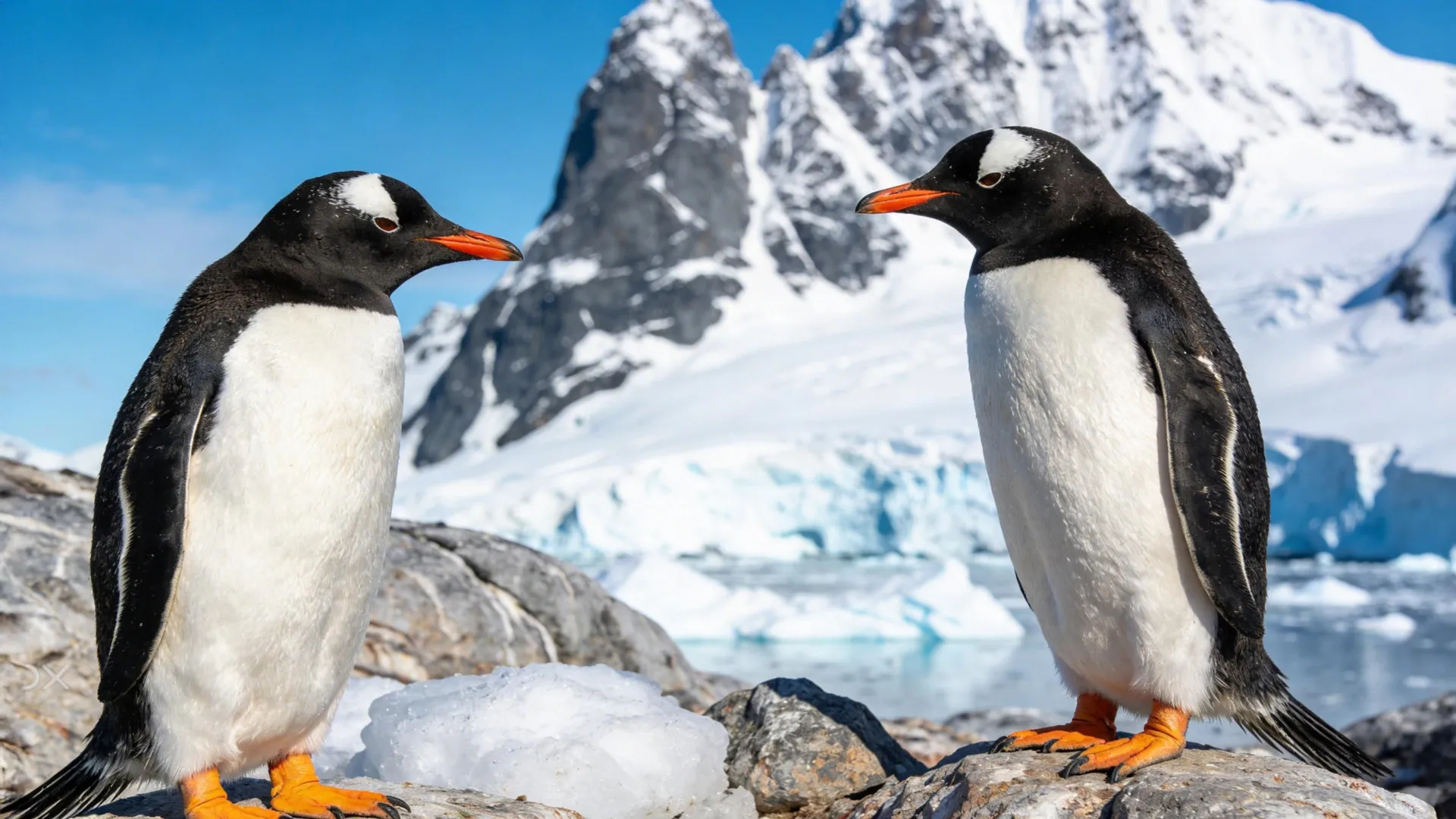
For over a century, the gentoo penguin (Pygoscelis papua) has been widely recognized by naturalists and the general public alike as a single, cohesive species distributed across the remote expanses of the Southern Hemisphere. However, a landmark international genomic study published in the journal Communications Biology has fundamentally reshaped this long-held scientific consensus. By analyzing whole-genome sequences from colonies spanning the entirety of the gentoo’s geographic range, an international consortium of researchers led by scientists in Chile and the University of California, Berkeley, has determined that what was once classified as one species is actually four distinct species.
Among these is a previously unrecognized cryptic species inhabiting the rugged, storm-swept Kerguelen Islands in the Indian Ocean—marking the first time in more than a century that a brand-new penguin species has been formally named and classified. This discovery not only resolves a hundred-year taxonomic debate but also introduces urgent conservation challenges as researchers model the potential impacts of global climate change on these newly delineated populations.
A Century of Taxonomic Debate and Genomic Resolution
The classification of gentoo penguins has historically been a source of intense scientific friction. Prior to this comprehensive study, researchers had proposed as many as six distinct subspecies based primarily on localized morphological variations, such as subtle differences in body size, bill coloration, and vocalizations. Yet, without comprehensive genetic sampling from across the birds’ fragmented habitats, a universally accepted taxonomy remained out of reach.
To settle these decades of disagreement, an international team of biologists—including researchers from Australia, Spain, Venezuela, South Africa, the United Kingdom, France, Argentina, Monaco, and Brazil—joined forces. Co-senior authors Juliana Vianna, a professor of ecosystems and environment at Andrés Bello National University in Santiago, Chile; Rauri Bowie, a professor of integrative biology and curator at UC Berkeley’s Museum of Vertebrate Zoology; and Elie Poulin, a professor at the University of Chile, orchestrated a massive collaborative effort.
The breakthrough came when University of Chile graduate student Daly Noll, the study’s first author, led an exhaustive genomic analysis. The team sequenced the entire genomes of 64 individual penguins gathered from 10 distinct breeding colonies, examining thousands of single nucleotide polymorphisms (SNPs). This unprecedented breadth of genetic data allowed the team to cross-reference genetic divergence with physical and behavioral characteristics, including breeding schedules, dietary habits, foraging behaviors, and geographical barriers.
The results provided definitive proof that the gentoo penguin complex comprises four separate species rather than a single polytypic species or a loose collection of subspecies.
Anatomy of a Cryptic Species: The Discovery on the Desolation Islands
The most startling revelation of the study is the formal identification of a cryptic species on the Kerguelen Islands, situated nearly 2,000 miles away from any permanently inhabited landmass. Known historically to the French as the Desolation Islands, this windswept archipelago provided the ideal isolation required for a new lineage to evolve silently.
Cryptic species are organisms that are morphologically nearly identical to related species yet possess deep genetic divergences. Visually, the newly minted southeastern gentoo penguin—officially designated as Pygoscelis kerguelensis—closely mirrors its relatives, bearing the classic tuxedo-like appearance of white underparts and black backs that facilitate aquatic camouflage against predators and prey. Genetically, however, it stands entirely apart.
In addition to discovering Pygoscelis kerguelensis, the research team elevated two previously recognized subspecies to full species status. This leaves the gentoo complex divided into four distinct species, each adapted to unique regional environments:
- The Northern Gentoo (Pygoscelis papua): Restricted primarily to the Falkland/Malvinas Islands and Martillo Island in South America, thriving north of the Antarctic Polar Front in warmer, saltier waters.
- The Eastern Gentoo (Pygoscelis taeniata): Inhabiting the sub-Antarctic Crozet, Marion, and Macquarie Islands.
- The Southeastern Gentoo (Pygoscelis kerguelensis): The newly recognized species found on the Kerguelen Islands and likely nearby Heard Island, living near the Antarctic Polar Front.
- The Southern Gentoo (Pygoscelis ellsworthi): The most numerous lineage, inhabiting the Antarctic Peninsula, coastal Antarctica, and South Georgia Island.
Evolutionary History and the Role of Diet in Speciation
To understand how these four species emerged, the research team leaned on broader evolutionary timelines established over the past decade. Previous work by Bowie and Vianna indicated that modern penguins originated near Australia and New Zealand approximately 22 million years million years ago. While Emperor and King penguin lineages diverged early—with Emperors anchoring themselves to the extreme cold of Antarctica and Kings adapting to sub-Antarctic islands—the formation of the circumpolar current roughly 12 million years ago acted as a marine highway. This current enabled other penguin lineages to disperse across the Southern Ocean, colonizing isolated island chains as far north as Africa and South America.
For gentoo penguins, evolutionary divergence was heavily influenced by a combination of geographic isolation, oceanographic boundaries, and ecological flexibility. Researchers estimate that the four gentoo species diverged between 300,000 and 500,000 years ago. A major catalyst in this separation was the Antarctic Polar Front, a sharp oceanographic boundary where water temperature, chemistry, and salinity shift dramatically, restricting the movement of marine organisms.
Paradoxically, the gentoo’s greatest survival asset—its flexible, opportunistic diet—also drove its speciation. Unlike specialized predators such as Emperor and Adélie penguins, which rely heavily on specific prey like Antarctic krill, gentoos are generalist feeders. They consume almost anything they can catch underwater, including fish, squid, cuttlefish, and various crustaceans.
Because gentoos are not forced to undertake massive migrations in search of specialized prey, they tend to remain close to their breeding colonies year after year. Over millennia, populations marooned on distant islands adapted locally to their specific ecological niches. Natural selection gradually reinforced these behavioral, physiological, and genetic differences, transforming isolated island populations into entirely new species.
Genomic Specializations for Extreme Environments
The extensive single nucleotide polymorphism (SNPs) data analyzed by Daly Noll and the research team shed light on how each gentoo species underwent local adaptation to survive in vastly different climates.
The southern gentoo (Pygoscelis ellsworthi), which currently thrives along the Antarctic Peninsula, exhibits genetic enrichments linked to extreme cold tolerance. Genomic profiling revealed a higher concentration of genes associated with heat production, fat and lipid storage, and advanced light perception. These visual adaptations likely help the birds navigate the extreme seasonal swings of polar daylight and the blinding glare of sunlight reflecting off vast expanses of ice.
In contrast, the eastern gentoo (Pygoscelis taeniata) evolved genetic adaptations favoring efficient carbohydrate metabolism and superior diving performance. Its genome shows an enrichment in genes regulating oxygen transport and utilization, blood vessel development, mitochondrial activity, and lung capacity. These physiological traits enable the eastern gentoo to sustain prolonged underwater foraging bouts in sub-Antarctic waters that feature relatively low biological productivity.
Meanwhile, the northern gentoo (Pygoscelis papua) of South America displays genomic adaptations centered on digestion, cardiac muscle contraction, and enhanced muscle excitation. Researchers hypothesize that these genetic shifts support the sustained physical exertion required for prolonged coastal diving and feeding in South American waters.
Conservation Implications in a Warming Climate
As global temperatures rise and reshape marine ecosystems across the globe, the newly revised taxonomy carries profound implications for conservation policy. Predictive climate modeling utilized by the research team to map suitable gentoo habitats through the year 2050 paints a starkly divided picture for the four species.
Under moderate climate change scenarios, the island-dwelling sub-Antarctic gentoo species face a perilous future. Because these populations are restricted to isolated island chains with little to no nearby landmasses available for migration, warming waters and shifting marine food webs could cause them to lose vital nesting and foraging grounds entirely.
Juliana Vianna emphasized the precarious position of these island endemics. "In terms of climate change, island species that have really low population sizes could be compared with the sub-Antarctic gentoo penguins," Vianna noted, drawing a parallel to vulnerable island-dwelling species like the Galápagos penguin. "Because they’re endemic to these islands, will find no place to go after a change in their environment. Those islands are very isolated, and these penguins cannot adapt easily to colonize any other region."
Conversely, the southern gentoo (Pygoscelis ellsworthi) in Antarctica may prove far more resilient in the near term. Climate projections indicate that its suitable habitat could actually expand southward as ice sheets recede and continental conditions shift. This resilience contrasts sharply with the struggles of other Antarctic specialists, such as Emperor, Adélie, and chinstrap penguins, which are suffering population declines driven by shrinking sea ice and the localized collapse of under-ice krill populations. Gentoos on the Antarctic Peninsula, by virtue of their dietary flexibility, have even been observed increasing in number while neighboring specialist species decline.
Nevertheless, experts warn that climate change is only one of multiple anthropogenic threats facing penguins. Warming oceans, habitat degradation, introduced mammalian predators like rats and feral dogs on sub-Antarctic islands, competition with commercial fisheries, and accidental entanglement in fishing gear pose persistent dangers.
Because the sub-Antarctic islands where the newly recognized species reside are governed by a patchwork of international jurisdictions—including Chile, South Africa, France, the Netherlands, Australia, and New Zealand—coordinated international governance will be required to safeguard them.
"It’s very important that conservation institutions in all the different countries involved recognize and take appropriate action to save these three gentoo penguin species," Vianna urged.
Beyond immediate taxonomic and conservation outcomes, the unprecedented genomic dataset assembled for this research heralds a new era in wildlife management. Rauri Bowie highlighted the broader utility of whole-genome sequencing in modern conservation biology. Vianna is already deploying these genomic tools to scan penguin DNA for markers associated with resistance to avian influenza, a devastating pathogen currently threatening global bird and mammal populations.
By identifying specific genetic traits linked to disease resistance or vulnerability, conservationists can better pinpoint which isolated populations face the highest extinction risks. As human pressures mount across the Southern Hemisphere, the integration of cutting-edge genomics and traditional field biology may ultimately prove to be the deciding factor in ensuring the survival of the planet’s newly expanded penguin family tree.
