
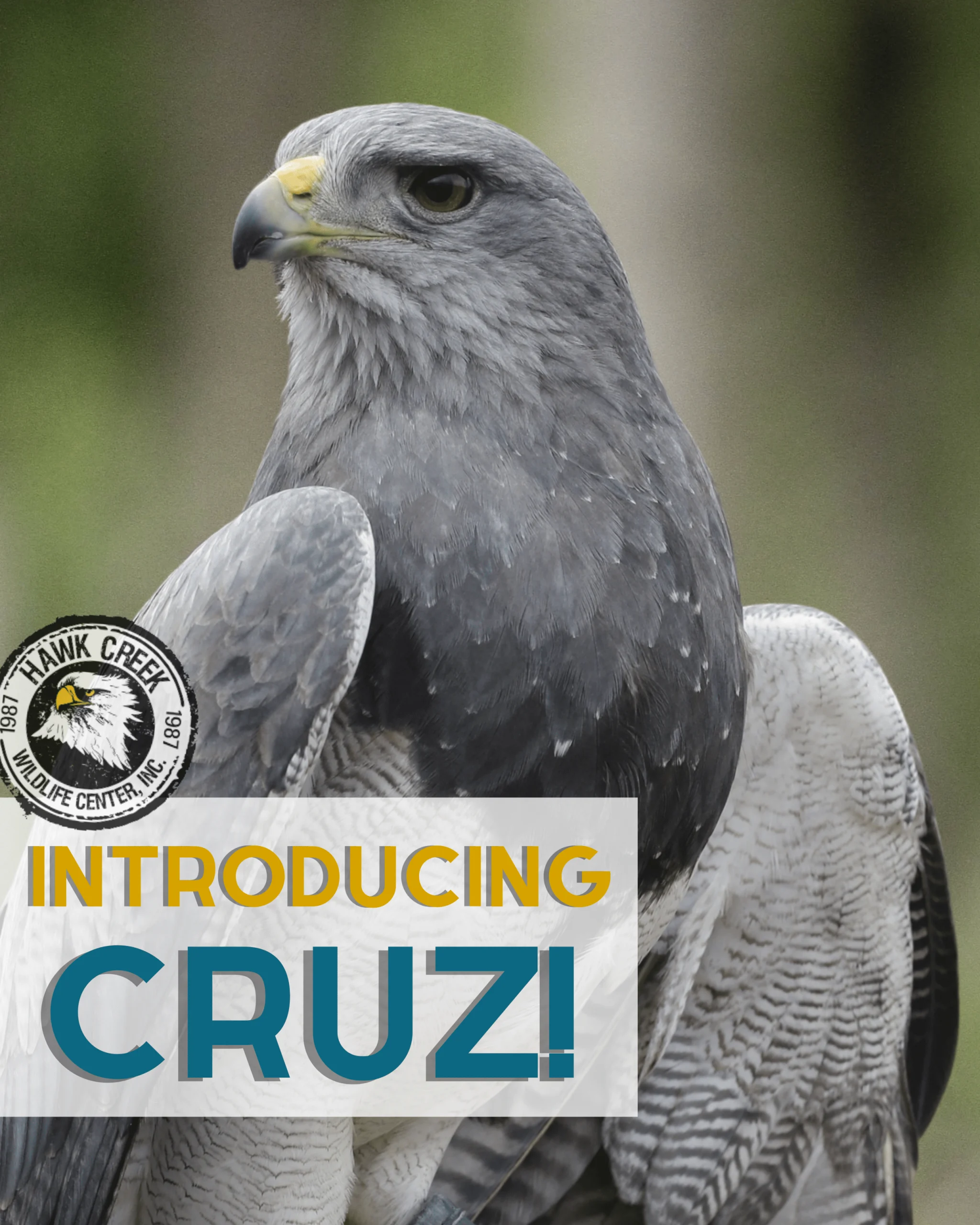
Hawk Creek has expanded its avian ambassador program with the exciting introduction of a magnificent Black-Chested Buzzard-eagle, a species known by a variety of names across its native South American range, including the Chilean Blue Eagle, Patagonian Eagle, and Gray Buzzard Eagle. Within the sanctuary of Hawk Creek, this impressive raptor will be affectionately known as Cruz. This addition marks a significant moment for the organization, offering the local community and visitors an unparalleled opportunity to connect with a species rarely, if ever, observed in the United States. The introduction of Cruz underscores Hawk Creek’s commitment to global conservation and its dedication to educating the public about the vital importance of avian biodiversity.
A Glimpse into the Life of Cruz
Cruz, the Black-Chested Buzzard-eagle, is a striking bird of prey native to the elevated, open landscapes of South America. These powerful raptors are characterized by their impressive wingspans and keen eyesight, essential tools for their survival in the vast grasslands and mountainous regions they inhabit. Their primary hunting strategy involves soaring at considerable altitudes, a behavior that lends them their common name "buzzard-eagle" and allows them to survey extensive territories for potential prey. Their diet primarily consists of small mammals, such as degus, and notably, invasive European hares. The presence of invasive species in their natural habitat presents a complex ecological challenge, and Cruz‘s feeding habits highlight the intricate dynamics of predator-prey relationships within these ecosystems.
The Black-Chested Buzzard-eagle’s unique ecological niche and its role in controlling populations of both native and introduced species make it a subject of considerable scientific interest. While data on their precise population numbers and breeding habits across their entire range can be scarce, studies from various South American ornithological societies indicate a healthy, though sometimes localized, distribution. For instance, research conducted in the Patagonian steppe has documented their presence in areas characterized by arid scrubland and rocky outcrops, where they construct large nests on cliffs or in the branches of hardy trees. Their territorial nature means that individual pairs may defend significant areas, contributing to the overall health and balance of their respective ecosystems. The introduction of Cruz to Hawk Creek provides a platform to disseminate information about these fascinating aspects of the species’ life.
Forging Global Partnerships for Avian Conservation
The acquisition of Cruz was facilitated through a crucial partnership with leading eagle conservationists at Sia, an organization based in Oklahoma. This collaboration exemplifies Hawk Creek’s broader mission to support and engage in global eagle conservation initiatives. Sia, the Comanche Ethno-Ornithological Initiative, brings a unique and deeply rooted perspective to avian conservation, blending indigenous knowledge with contemporary scientific approaches. Their work often focuses on understanding the cultural significance of birds of prey within Native American communities, as well as implementing practical conservation strategies.
This partnership is not new to Hawk Creek. It has previously enabled the sanctuary to introduce other rare and captivating eagle species to the public, species that are seldom seen outside their native continents. Among these notable introductions are Jara, a Short-toed Snake Eagle, and Onyx, a Verreaux’s Eagle. The Short-toed Snake Eagle, native to Europe, Asia, and Africa, is renowned for its specialized diet of reptiles, particularly snakes, which it locates with exceptional auditory and visual acuity. Verreaux’s Eagle, on the other hand, is a formidable predator of the African continent, primarily preying on rock hyraxes and other medium-sized mammals in mountainous and desert environments. The inclusion of these species, alongside Cruz, showcases the incredible diversity within the eagle family and the critical need for international cooperation in their preservation.
Wild Earth Event: A Deep Dive into Eagle Conservation
To further illuminate the importance of these conservation efforts, Hawk Creek is hosting a special "Wild Earth" event on May 13th. This event will feature a prominent figure in global eagle conservation, Waha Thuweeka, also known as William "Two-Raven" Voelker. Mr. Voelker, representing Sia and the Comanche Ethno-Ornithological Initiative, will be the keynote speaker, sharing his extensive knowledge and passion for eagle conservation. His participation underscores the significance of the partnership between Hawk Creek and Sia, highlighting the synergistic approach required to address the multifaceted challenges facing raptor populations worldwide.
The "Wild Earth" event is designed to be an educational and engaging experience for the community. Attendees will have the opportunity to learn directly from an expert about the conservation status of various eagle species, the threats they face, and the ongoing efforts to protect them. Discussions are expected to cover topics such as habitat loss, poaching, climate change, and the impact of human activities on raptor populations. Furthermore, Mr. Voelker’s unique background, bridging indigenous wisdom with scientific research, promises a rich and insightful presentation. The event serves as a testament to Hawk Creek’s commitment to not only housing and caring for these magnificent creatures but also to fostering a deeper understanding and appreciation for their ecological roles and the conservation imperatives.
The Broader Implications of Conservation Through Education
The introduction of Cruz and the subsequent "Wild Earth" event carry significant implications for conservation awareness and action. By providing direct encounters with species like the Black-Chested Buzzard-eagle, Hawk Creek is creating powerful educational moments. These encounters move beyond abstract concepts, allowing individuals to form personal connections with the natural world and fostering a sense of responsibility for its preservation. The rarity of these species in the U.S. context amplifies the impact, emphasizing the global nature of conservation challenges and the interconnectedness of ecosystems.
The partnership with Sia, with its emphasis on ethno-ornithology, also brings a critical dimension to conservation. This approach recognizes that indigenous communities often possess invaluable traditional ecological knowledge, accumulated over generations, which can inform and enhance modern conservation practices. By integrating these perspectives, conservation efforts can become more culturally relevant, effective, and sustainable. The inclusion of William "Two-Raven" Voelker as a speaker is a direct reflection of this understanding, signaling a commitment to a holistic and inclusive approach to conservation.
The implications extend beyond immediate attendance at the event. The stories and knowledge shared will ripple through the community, potentially inspiring future conservationists, advocating for policy changes, and supporting broader ecological initiatives. In an era where biodiversity loss is a pressing global concern, institutions like Hawk Creek, in collaboration with organizations like Sia, play a pivotal role in bridging the gap between scientific understanding and public engagement. The success of such initiatives is not measured solely by the number of visitors or the scientific papers published, but by the lasting impact on public perception and the tangible actions taken to protect the planet’s precious natural heritage. The presence of Cruz at Hawk Creek is more than just an exhibit; it is a living symbol of a shared commitment to the future of avian life and the health of our planet.
