
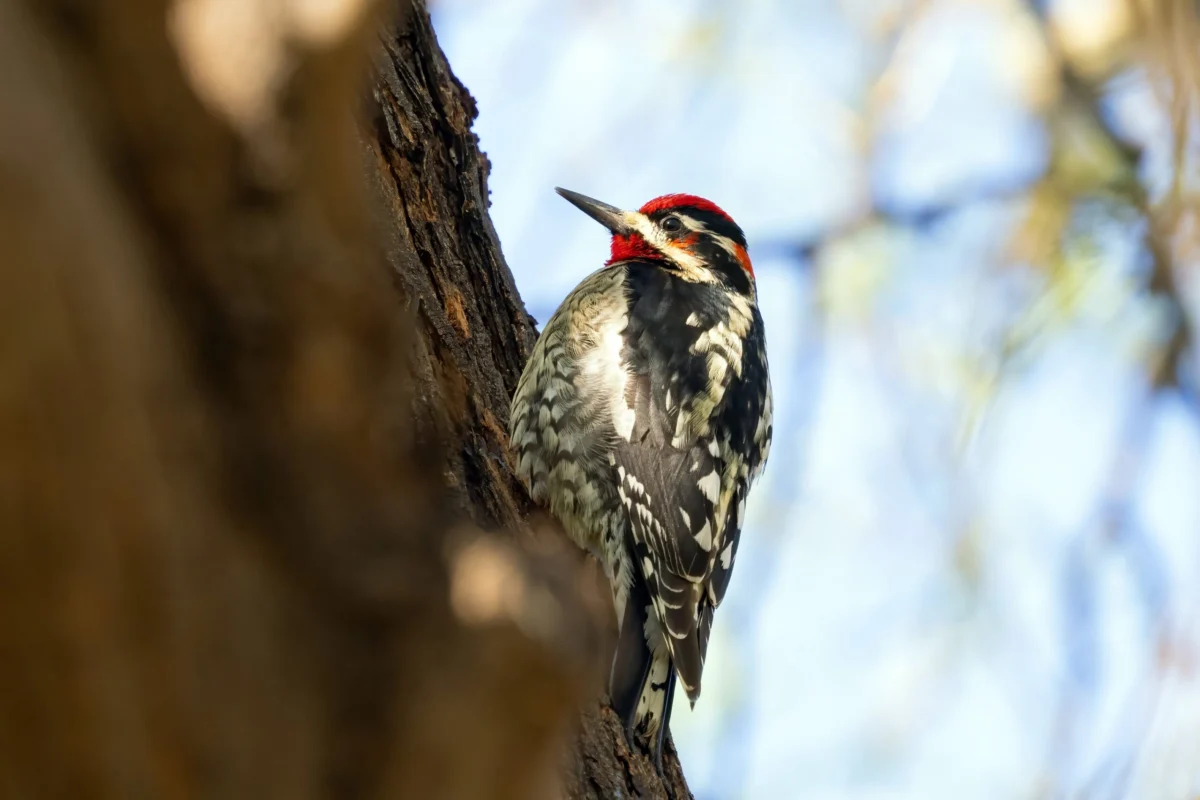
As the Northern Hemisphere gracefully transitions into spring, marked by lengthening days and the fragrant awakening of flora, a vibrant procession of migratory birds commences its annual journey. Among the diverse avian species that grace the landscapes of the Southwest—from the darting hummingbirds to the energetic warblers and agile flycatchers—arrives a particularly striking member of the woodpecker family: the Red-naped Sapsucker. This handsome bird, Sphyrapicus nuchalis, is not merely another avian visitor; it is a master of a specialized foraging technique, an ecological linchpin, and a captivating subject for ornithologists and bird enthusiasts alike, distinguished by its dashing plumage and unique behaviors. Its arrival heralds the full embrace of spring, bringing with it a distinctive drumming sound and the subtle artistry of sap-tapping.
A Tapestry of Plumage: Distinguishing Features and Taxonomy
The Red-naped Sapsucker is characterized by a distinctive red patch on the back of its head, or nape, a feature present in both males and females. This crucial field mark serves as the primary differentiator from its close relative, the Yellow-bellied Sapsucker (Sphyrapicus varius), a species with which the Red-naped Sapsucker was long considered conspecific, existing as a subspecies. The taxonomic reclassification, which occurred in the late 20th century, notably in 1983, was primarily driven by detailed studies of their vocalizations, breeding behaviors, and genetic analyses. Scientists observed distinct differences in their drumming patterns, courtship rituals, and the limited hybridization in their overlapping ranges, leading to their recognition as separate species. This split underscored the nuanced complexities of avian speciation and refined our understanding of the Sphyrapicus genus, which includes four North American species: the Red-naped, Yellow-bellied, Red-breasted (Sphyrapicus ruber), and Williamson’s Sapsucker (Sphyrapicus thyroideus).
Within this genus, sapsuckers present an interesting anomaly among woodpeckers regarding sexual dimorphism. Typically, vibrant red markings on the head are reserved exclusively for male woodpeckers, serving as a display of vigor and territoriality. However, females of three of North America’s four sapsucker species proudly display red markings on their heads. In the case of the Red-naped Sapsucker, discerning between the sexes is relatively straightforward due to an additional distinctive feature: the female possesses a prominent white chin located between her beak and her otherwise crimson throat, a mark absent in the male, whose throat is entirely red. Beyond these specific indicators, both sexes share a remarkably debonair appearance, featuring a jaunty red cap, a striking black-and-white striped facial pattern, and a rakish crimson kerchief-like patch adorning the neck, often complemented by a yellowish wash on the belly and intricate barring on the back. Adults typically measure between 7.5 to 8.7 inches (19 to 22 cm) in length, with a wingspan ranging from 16 to 17 inches (41 to 43 cm) and weighing approximately 1.6 to 2.2 ounces (45 to 62 grams). These precise measurements and detailed plumage descriptions are invaluable for birdwatchers and researchers, aiding in accurate identification and population monitoring.
The Ingenious Forager: The Art and Ecology of Sapsucking
The second part of the bird’s common name, "sapsucker," directly references the specialized feeding behavior for which this group of birds is renowned. This unique foraging strategy involves the methodical creation of sap wells in the bark of trees, a practice that sets them apart from other woodpecker species that primarily excavate for insects. Much like humans tapping maple trees for syrup, sapsuckers meticulously drill rows of small, shallow holes, typically less than a quarter-inch deep, into the bark of living trees. These holes are strategically spaced to avoid girdling the tree, ensuring the preservation of the cambium—the vital "living" layer of the tree trunk responsible for transporting water and nutrients between the roots and leaves. This instinctual spacing prevents significant damage, allowing the tree to remain alive and continue producing sap, even with potentially hundreds of such perforations on a single trunk.
Once sap begins to seep from these freshly drilled holes, it provides the sapsucker with a virtually complete nutritional profile. The sugary sap, rich in carbohydrates, serves as a crucial energy source, especially during demanding periods like migration and breeding. Moreover, the sweet sap acts as an attractant for a variety of insects, including ants, flies, and beetles. These insects, drawn to the sugary liquid, inadvertently become an easily accessible and rich source of protein for the sapsucker. This dual-source feeding mechanism is remarkably efficient. The sapsucker’s brush-tipped tongue is perfectly adapted for lapping up the viscous sap, allowing it to efficiently collect both the liquid and the trapped insects. The tree species targeted by Red-naped Sapsuckers vary regionally and seasonally, but they show a preference for thin-barked trees such as aspen, birch, cottonwood, and various conifers like pine and spruce, which offer abundant sap flow.
Ecological Architects: Sapsuckers as Keystone Species
The foraging activities of Red-naped Sapsuckers extend beyond their immediate sustenance, creating a significant ecological impact that benefits numerous other species, establishing them as an unwitting keystone species in their forest ecosystems. The sap wells they create become a crucial resource for a diverse array of other animals. Several species of hummingbirds, for instance, are frequently observed following sapsuckers, taking advantage of the readily available sap and the small insects attracted to it. Rufous, Broad-tailed, and Calliope Hummingbirds are particularly known to utilize sapsucker wells, especially during their arduous migratory journeys when energy-rich food sources are vital. This interspecies reliance highlights a fascinating symbiotic relationship where the sapsucker inadvertently provides for others.
Beyond hummingbirds, other birds such as warblers, kinglets, and even some insectivorous passerines have been documented feeding from sapsucker wells. Mammals, too, benefit from this resource; squirrels, chipmunks, and even bats have been observed drinking sap from these wells, particularly in late winter and early spring when other food sources are scarce. The availability of sap wells also supports a localized insect community, providing food for insectivorous birds and small predators. This complex web of interactions underscores the sapsucker’s role as an "ecosystem engineer," shaping the availability of resources for a multitude of forest dwellers. While extensive sapsucker activity can occasionally cause minor stress to individual trees, especially young ones, the vast majority of trees sustain minimal long-term damage, and the overall ecological benefits often outweigh localized impacts. Forest managers and arborists generally regard sapsucker activity as a natural component of forest health, with severe damage being relatively rare.
Rhythmic Communication: Drumming and Vocalizations
The scientific nomenclature, Sphyrapicus nuchalis, is derived from the Greek "sphura" and "pikos," meaning "hammer" and "woodpecker," respectively, with "nuchalis" referring specifically to the nape of the neck. The hammering behavior of woodpeckers is widely recognized as one of their most distinctive features, serving multiple purposes from foraging to communication. Each woodpecker species, however, possesses a slightly different method and rhythm of drumming, often distinct enough that seasoned ornithologists and birdwatchers can identify species solely by the sound of their pecking.
The Red-naped Sapsucker’s drumming pattern is particularly unique and memorable. It typically begins with a short, rapid burst of pecks that then slows in cadence, creating a characteristic stuttering rhythm, often described as sounding like a small gas motor sputtering to a stop, or a Morse code message that trails off. This distinctive pattern is a key acoustic identifier. Drumming serves several critical functions for sapsuckers: it is a primary form of territorial advertisement, signaling the presence of an individual or a pair to rivals; it is also used in courtship, with males drumming to attract mates and communicate with their partners. Beyond drumming, Red-naped Sapsuckers also produce a variety of vocalizations, including plaintive, slurred "queer" or "wee-ooh" calls, chatters, and whines, particularly when interacting with mates or young, or when alarmed. These vocalizations, combined with their unique drumming, form a complex auditory landscape crucial for their survival and social interactions within their forest habitats. Researchers often use acoustic monitoring to track populations and study their behavior across their extensive range.
Seasonal Journeys: Migration, Habitat, and Breeding Biology
Red-naped Sapsuckers are quintessential migratory birds, undertaking impressive seasonal journeys that span vast geographical distances. Their year-round presence is typically limited to relatively narrow ranges in the southern parts of Arizona, New Mexico, and Texas, where milder winters allow for continued foraging. However, the majority of the population embarks on significant migrations. As autumn approaches, typically in late August and September, these birds begin their southward trek, moving as far south as the highlands of Jalisco and Michoacán in Mexico. This southward migration allows them to escape the harsher conditions of their northern breeding grounds and access reliable food sources during winter.
With the onset of spring, usually in March and April, Red-naped Sapsuckers undertake their northward migration, traveling all the way up to central British Columbia and Alberta in Canada, as well as into the western United States, including the Rocky Mountains and the Great Basin. This return journey is timed to coincide with the emergence of insects and the budding of trees, providing ample resources for breeding and raising their young. Upon reaching their breeding grounds, which often encompass mixed coniferous-deciduous forests at mid-to-high elevations (typically between 5,000 and 10,000 feet, or 1,500 to 3,000 meters), they seek out suitable nesting sites.
For nesting, Red-naped Sapsuckers show a strong preference for soft-wooded trees, which are easier to excavate for cavity nests. Frequently chosen species include cottonwood, aspen, birch, and various species of larch and fir. They often select trees that are dead, diseased, or partially decayed, as the softened wood makes the arduous task of creating a nest cavity less demanding. Both male and female participate in the excavation, a process that can take several weeks. The typical clutch size ranges from 4 to 7 white eggs, which are incubated for approximately 12 to 13 days. Both parents share incubation duties and subsequently feed the nestlings, which fledge about 25 to 29 days after hatching. The young are highly dependent on parental care for a period after fledging, learning essential foraging skills before they disperse. This period is critical for their survival and often involves intense parental activity, including constant sapsucking and insect foraging to meet the high energetic demands of growing chicks.
Conservation Status and Ecological Significance
Globally, the Red-naped Sapsucker is classified as a species of "Least Concern" by the International Union for Conservation of Nature (IUCN), indicating a stable and widespread population. However, like many migratory species, they face various localized threats and long-term challenges. Habitat degradation and loss, particularly the logging of mature deciduous and mixed forests that provide preferred nesting and foraging trees, pose a concern in certain areas. Climate change also presents potential impacts, altering migration patterns, shifting breeding ranges, and affecting the timing of sap flow and insect emergence, which could disrupt their delicate ecological balance.
Organizations such as the National Audubon Society play a crucial role in monitoring sapsucker populations and advocating for habitat preservation. Through citizen science initiatives like the Christmas Bird Count and the Great Backyard Bird Count, valuable data on population trends and distribution are collected, aiding conservation efforts. Ornithologists emphasize the importance of maintaining diverse forest ecosystems, particularly those with a mix of softwoods and hardwoods, to ensure the continued health of sapsucker populations. Researchers at institutions like Cornell Lab of Ornithology and various university ecology departments conduct ongoing studies on sapsucker behavior, migration, and genetics, providing critical insights into their ecological role and potential vulnerabilities. These studies help inform land management practices that protect both the sapsuckers and the myriad species that depend on their unique foraging activities. The presence of a healthy sapsucker population often serves as an indicator of a thriving and biodiverse forest ecosystem.
Observing the Red-naped Sapsucker: A Call to Nature
As the warmer months surge forward, the annual migration of Red-naped Sapsuckers reaches its peak. This spring, observations from various locales confirm their active presence. A recent report from the Randall Davey Audubon Center in Santa Fe, New Mexico, noted that a male and female pair has already commenced the crucial task of "shopping around" for a suitable location to excavate a nest and raise their family. This observation aligns perfectly with the typical chronology of their breeding cycle, which begins shortly after their arrival on the breeding grounds. Such reports from Audubon centers and local birding communities provide invaluable real-time data, allowing researchers to track the progression of migration and breeding activities across the continent.
A spokesperson for the Randall Davey Audubon Center highlighted the excitement surrounding these early sightings, stating, "The arrival of the Red-naped Sapsuckers is always a highlight of spring. Their unique drumming and striking appearance make them a favorite among our visitors. We encourage everyone to keep an open ear for their distinctive calls and drumming, and a sharp eye for their elegant plumage. Witnessing these diligent birds begin their nesting preparations is a profound reminder of nature’s resilience and the interconnectedness of our ecosystems." This statement underscores the public engagement aspect of bird conservation and the joy that these migratory birds bring to local communities.
For those eager to witness these fascinating creatures, an understanding of their preferred habitats and behaviors is key. During the breeding season, focusing efforts on mixed forests, especially those with aspen, birch, or cottonwood stands, will increase the chances of a sighting. Listening for their characteristic "stuttering motor" drumming pattern is often the first clue to their presence. Birdwatchers are encouraged to move slowly and quietly, allowing the birds to acclimate to their presence, and to observe from a respectful distance to avoid disturbing nesting activities. The Red-naped Sapsucker stands as a vibrant testament to the intricacies of avian migration and the delicate balance of forest ecosystems. Its distinctive appearance and specialized feeding habits make it a compelling subject, serving as a reminder of the rich biodiversity that enriches our natural world. Keep an open ear and a sharp eye—there may just be a dapper-dressed, sap-tapping woodpecker migrating through your neighborhood, ready to reveal the wonders of its specialized existence.
