
For a migratory songbird, the annual trek from the boreal forests of eastern Canada to the tropics of Central and South America is a marathon of survival, spanning thousands of miles across diverse landscapes. As these avian travelers move south, they traverse mountain ranges, agricultural expanses, and sprawling urban corridors. Upon reaching the terminus of the Florida peninsula, they face a daunting final hurdle: the vast expanse of the Gulf of Mexico or the Caribbean Sea. It is at this critical juncture that sites like the Corkscrew Swamp Sanctuary in South Florida become essential, providing a necessary haven for birds to rest, forage, and refuel before attempting their final oceanic crossing.
Recognized as a Ramsar Wetland of International Importance and serving as the regional gateway for the Great Florida Birding and Wildlife Trail, the 13,000-acre Corkscrew Swamp Sanctuary stands as a cornerstone of the Atlantic Flyway. Its ecological significance is underscored by its status as an Audubon Important Bird Area, with more than 268 species recorded within its boundaries. While the sanctuary is a sanctuary for common migrants, it has increasingly become a focal point for ornithologists tracking rare and "vagrant" species—birds that appear outside their traditional, documented migration corridors.
A Rare Encounter: The Canada Warbler
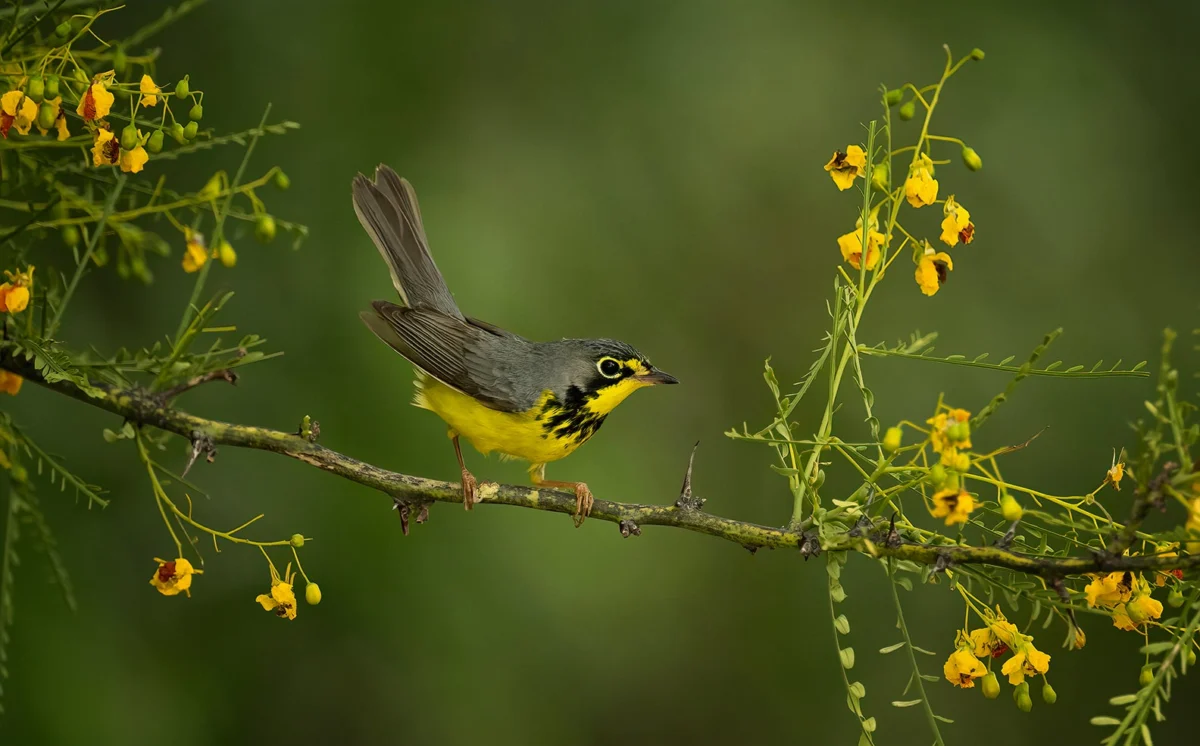
The complexity of bird migration was recently highlighted by a notable observation in September, when Sanctuary Director Keith Laakkonen spotted a Canada Warbler foraging near North Lettuce Lake. This sighting carries significant ornithological weight, as standard range maps for the Canada Warbler typically show the species migrating west of the Appalachian Mountains, traversing the central United States toward Mexico, and largely bypassing the southeastern Atlantic states.
Laakkonen’s observation is only the third recorded instance of a Canada Warbler at the sanctuary on the eBird database, a global citizen-science platform. While historical records indicate that at least seven of these warblers have been documented in Collier County over the past several decades, the rarity remains striking.
Ornithological analysis suggests that these sightings are not necessarily anomalies of behavior, but perhaps reflections of a more complex migratory reality. Research has identified three genetically distinct populations of Canada Warbler, a factor that may influence disparate migratory routes. Furthermore, because Collier County covers a landmass larger than the state of Delaware, it is highly probable that many more individuals pass through the region undetected, potentially utilizing the Florida peninsula as a transit point for a Caribbean crossing rather than a traditional land-based route.
The Phenomenon of Avian Vagrancy
The Canada Warbler is far from the only rare visitor to grace the sanctuary’s diverse habitats. In the preceding year, staff and visitors documented the presence of a Wilson’s Warbler, a Western Tanager, and a Lazuli Bunting—species whose primary ranges are typically far to the west or north.
Dr. Bryant Dossman, director of the Audubon Everglades Research Station, notes that the study of vagrants is critical to understanding the fluidity of avian movement. "We find them in Florida sometimes because we are along their general trajectory," Dr. Dossman explains. These occurrences provide a lens through which scientists can examine the failure or redirection of innate navigational systems.
The Mechanics of Migration and Navigational Error
The precision with which birds navigate the globe is one of nature’s most sophisticated feats, relying on a combination of innate genetic programming and environmental cues. Songbirds possess specialized proteins in their eyes that allow them to perceive geomagnetic inclinations, while nocturnal migrants rely on celestial navigation to maintain their orientation. However, this internal "map" is not infallible.
Navigation is often refined by age and experience, leaving juvenile birds particularly vulnerable to displacement. A young bird on its first migratory journey lacks the accumulated experience of its elders, making it highly susceptible to environmental disruptions. Such disturbances can be as subtle as a minor shift in wind currents or as dramatic as major meteorological events.
A clear example of the latter occurred in 2023 with the arrival of Hurricane Idalia. The storm system displaced hundreds of American Flamingos, blowing them off their traditional routes between Cuba and Mexico and depositing them across Florida and the southeastern United States. Many of these flamingos have since integrated into Florida’s local ecosystems, demonstrating the long-term impacts that single weather events can have on species distribution.
The Implications for Evolution and Biodiversity
When a bird is blown off course or follows an experimental route, the outcome is often grim. Many individuals perish due to the lack of suitable habitat or the exhaustion of their energy reserves. However, as Dr. Dossman points out, there is a secondary, evolutionary significance to these accidental journeys.
"Sometimes a bird can get lucky, find good habitat, and survive winter to return north the following spring," says Dr. Dossman. "Or it could be an early colonizer that returns the following year, potentially founding a population in a new area. Over long enough timelines, this is one way they end up becoming new subspecies."
This process of "accidental colonization" is a fundamental driver of biodiversity. By monitoring where these vagrants end up, researchers gain insight into how species expand their ranges in response to changing climates and environmental conditions.
Modern Tracking and Data Collaboration
To move beyond anecdotal evidence, researchers are increasingly relying on advanced technology to demystify the migration process. The Motus Wildlife Tracking System, an international network coordinated by Birds Canada, has become the gold standard for tracking small-bodied animals. By utilizing automated radio telemetry, the system detects tagged birds in real time as they pass through specific monitoring stations. Since 2022, the Motus station at Corkscrew Swamp Sanctuary has successfully detected 28 birds across 17 different species, providing granular data on movement patterns that were previously impossible to document.
Furthermore, the Audubon Society’s Bird Migration Explorer integrates data from the Motus network with a wide array of other scientific sources. This digital tool provides a comprehensive look at the annual journeys of more than 450 bird species, allowing researchers and the public alike to visualize the connectivity between breeding grounds in the north and wintering sites in the south.
Conservation in an Uncertain Future
For over a century, the National Audubon Society has focused on the preservation of the essential habitats required for the survival of migratory birds. The findings at Corkscrew Swamp Sanctuary highlight the urgency of this mission. As urbanization and climate change continue to alter landscapes, the availability of high-quality "stopover" sites becomes increasingly critical.
The data gathered at the sanctuary—ranging from the rare Canada Warbler to the documented movements of Motus-tagged individuals—serves as a reminder that these habitats are not merely local parks; they are vital nodes in a global network of survival. By securing these spaces, organizations ensure that both the common and the rare, the experienced and the novice, have the refuge they need to complete their heroic journeys.
The presence of human visitors at the sanctuary further emphasizes the intersection of conservation and public engagement. As the public becomes more aware of the challenges facing migratory species, the collective effort to protect these environments grows, ensuring that the skies remain filled with the rhythm of migration for generations to come. Through continued research, technological integration, and the protection of biodiversity hotspots, the scientific community remains committed to deciphering the maps that guide the world’s most resilient travelers.
