
The global landscape of wildlife conservation has long struggled with the complex behaviors of apex predators, particularly when attempting to rebuild depleted populations through captive-breeding and relocation initiatives. For decades, conservationists operating across tropical and subtropical regions have faced a persistent hurdle: the remarkable, almost unerring homing instinct exhibited by crocodilians. When mature wild crocodiles are relocated to safer habitats or away from human settlements, they frequently expend vast amounts of energy attempting to navigate back to their original capture sites, often resulting in failed conservation outcomes, heightened mortality risks, or renewed human-wildlife conflict.
However, a groundbreaking study published in the journal Wildlife Research offers a promising paradigm shift for conservation management. Conducted within the fragile ecosystems of the Sundarbans mangrove forest in Bangladesh, the research reveals that saltwater crocodiles born or raised in captivity do not exhibit this compulsive drive to return to their breeding facilities once released into the wild. Instead, these captive-reared adults readily integrate into local ecosystems, establishing home ranges comparable to their wild counterparts. This vital discovery could fundamentally reshape how environmental agencies approach the recovery of dwindling crocodile populations across South and Southeast Asia, providing a viable alternative to traditional hatchling-release strategies that have historically suffered from abysmally low survival rates.
Understanding the Mechanics of Crocodilian Homing Behavior
To fully grasp the significance of the recent findings, wildlife biologists emphasize the need to examine the evolutionary mechanics of homing behavior across the animal kingdom. For countless species, spatial memory and the ability to navigate back to a home base are critical evolutionary adaptations dictating survival and reproductive success. While many smaller animals undertake routine daily journeys to return to nests or burrows following foraging excursions, others undertake monumental migrations spanning thousands of kilometers across weeks, months, or even years.
Among apex predators, crocodilians represent a uniquely fascinating case study. These formidable reptiles occupy the apex of freshwater and brackish aquatic food webs throughout the tropics and subtropics, maintaining ecosystem health through top-down trophic regulation. According to Dr. Ru Somaweera, a behavioral ecologist and Adjunct Associate Professor at Murdoch University who contributed to the study, crocodilians possess an extraordinarily potent internal compass.
"Crocodilians are remarkably good at finding their way home, often returning to their original capture sites and limiting the success of relocation programs," Dr. Somaweera explained. Prior to this study, however, a critical knowledge gap persisted within wildlife management literature: how this sophisticated spatial memory and homing drive manifest in individuals that have spent formative years, or even their entire lives, sequestered in artificial captive environments prior to reintroduction.
Historical Context and the Plight of the Sundarbans Saltwater Crocodile
The urgency of this research is underscored by the precarious conservation status of saltwater crocodiles (Crocodylus porosus) within Bangladesh. The setting for the study, the Sundarbans mangrove forest, represents one of the nation’s final remaining ecological refuges for the species. Straddling the delta of the Padma, Brahmaputra, and Meghna river systems across Bangladesh and India, the Sundarbans is the largest single tract of mangrove forest in the world, characterized by a complex network of tidal waterways, mudflats, and small islands.
Historically, saltwater crocodiles were abundant throughout the estuarine systems of Bangladesh. However, the twentieth century brought catastrophic ecological decline. Driven by heavy commercial hunting for the global leather trade, crocodile populations were decimated throughout the region leading up to the 1970s. Although the government of Bangladesh instituted legal protections for saltwater crocodiles as early as 1973, prohibiting unregulated hunting and exploitation, the species has stubbornly failed to show any measurable demographic recovery in the decades since.
Today, conservation assessments paint a grim picture. The vast majority of the country’s surviving saltwater crocodiles are restricted to the remote reaches of the Sundarbans. Even within this protected biosphere, the population remains perilously small. The most recent comprehensive wildlife surveys estimate that only 140 mature individuals remain in the wild across the entire Bangladeshi sector of the forest. This low population density leaves the species highly vulnerable to stochastic environmental events, inbreeding depression, and ongoing anthropogenic pressures.
The Limitations of Traditional Reintroduction Methodologies
For decades, conservation biologists seeking to reverse the decline of crocodilian populations have relied heavily on a conventional playbook: collecting wild eggs or using captive-hatched juveniles (hatchlings) for reintroduction into historical habitats. While this method avoids the complexities of moving adult animals, it is fraught with biological and logistical inefficiencies.
Hatchling saltwater crocodiles face staggering natural mortality rates in the wild. Due to their diminutive size, they serve as easy prey for a wide array of secondary predators, including wading birds, large fish, monitor lizards, and mature conspecifics. Furthermore, because they start their lives at the bottom of the size spectrum, it takes many years—often a decade or more—for these individuals to reach reproductive maturity and contribute to population growth.
"The traditional approach has been to use hatchlings in reintroduction programs, but their survival rates are extremely low and they take a long time to reach reproductive maturity," noted Associate Professor Somaweera. "Understanding whether larger, captive-bred crocodiles can be used instead represents an important knowledge gap."
Transitioning to larger, subadult or adult crocodiles in reintroduction programs would theoretically bypass the high-mortality juvenile phase, instantly adding breeding-age biomass to depleted wild populations. Yet, conservation planners long feared that releasing older captive-bred animals would trigger immediate homing instincts, causing the expensive and logistically challenging reintroductions to fail as the animals attempted to trek back to their familiar enclosure walls or breeding pools.
Methodology: Tracking Captive-Reared Versus Wild Translocated Crocodiles
To resolve this critical operational uncertainty, an international and interdisciplinary research team deployed advanced tracking technology within the Sundarbans. The initiative was led by IUCN Bangladesh and the Bangladesh Forest Department, with financial backing provided by the Deutsche Gesellschaft für Internationale Zusammenarbeit (GIZ).
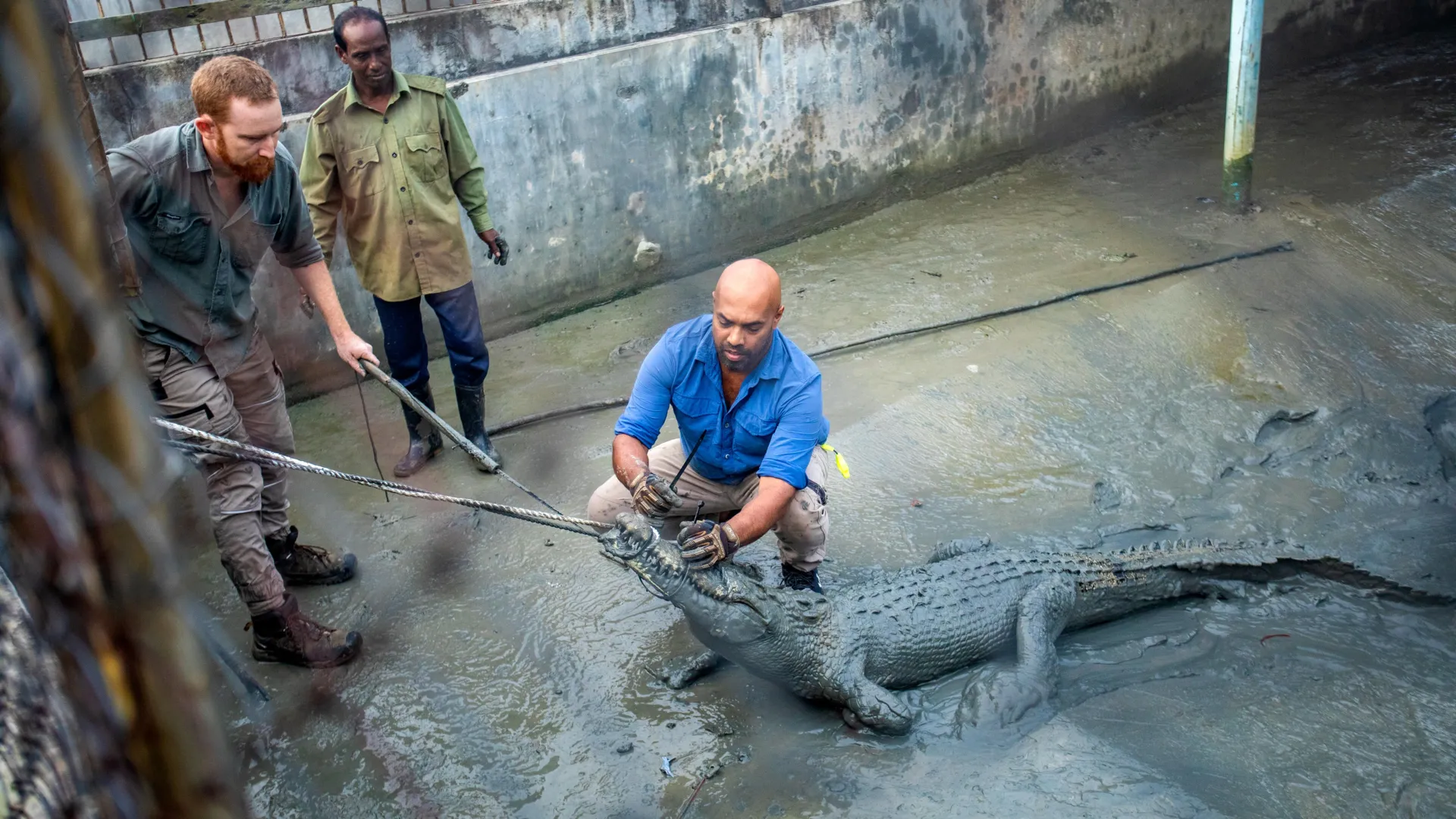
The scientific team selected five mature saltwater crocodiles to serve as subjects in the high-stakes tracking experiment. The cohort was deliberately designed to compare different life histories and past experiences. It included three captive-reared females that had spent between 8 and 22 years of their lives continuously confined within artificial breeding facilities. For comparison, the researchers also tracked two wild crocodiles: one local resident individual that was captured and promptly released back at its exact site of origin, and a second wild crocodile—subsequently named Jongra by the research team—that was captured and translocated a significant distance away from its home territory.
Specialized satellite tracking devices were securely fitted to each of the five specimens. These transmitters allowed researchers to monitor the precise spatial movements, daily travel distances, and directional trajectories of the animals over several months following their respective releases into the complex waterways of the Sundarbans.
Contrasting Fates: Captive Adaptability Versus Wild Homing Drives
The empirical data yielded by the satellite transmitters provided clear, actionable insights that surprised the research team and shattered long-held assumptions regarding the behavioral limitations of captive-raised predators.
According to Dr. Somaweera, the most encouraging and transformative outcome of the study centered on the three captive-reared female crocodiles. Despite having spent up to two decades in human-managed environments devoid of natural hunting pressures, complex tidal dynamics, and vast territorial boundaries, none of the three individuals exhibited any behavioral inclination to return to their natal or rearing facilities.
Instead of undertaking erratic, long-distance dispersal or trying to navigate back to captivity, the captive-reared crocodiles demonstrated a remarkable capacity for ecological integration. Within a remarkably short timeframe, they successfully carved out small, well-defined home ranges. Their movement patterns closely mirrored those of the local wild crocodile included in the control group, suggesting that the physiological and behavioral machinery required for wild survival remains largely intact—or easily unlocked—even after prolonged periods of captivity.
"This tells us they are possibly able to adapt to their new environment seamlessly," Associate Professor Somaweera noted, highlighting the behavioral plasticity of the species.
Conversely, the telemetry data told a starkly different story for Jongra, the wild-caught crocodile that had been translocated approximately 132 kilometers away from his established home territory prior to release. Jongra’s movements immediately betrayed the classic hallmarks of a powerful, hardwired homing instinct.
"Unfortunately, the results weren’t as good for the wild crocodile Jongra, who was translocated about 132km from his home before being released," Associate Professor Somaweera explained. "Although Jongra didn’t make it back to his original capture site during the study, his movements were very clearly going in that direction. He traveled far more each day than any other crocodile we tracked, covered an exceptionally large area, and even recorded single-day movements of more than 30 kilometers: all typical signs of homing behavior."
Jongra’s frantic expenditure of energy underscores why wildlife relocations involving wild adult apex predators are fraught with peril. Driven by spatial memory and territorial attachment, translocated wild animals often ignore local resource availability, exhausting their energy reserves, entering high-conflict zones with humans or rival predators, or sustaining injuries during their relentless cross-country or cross-estuary marches.
Practical Implications for Global Crocodile Conservation
The profound behavioral dichotomy observed between the captive-reared females and the translocated wild male provides conservation managers with a powerful, evidence-based toolkit for future wildlife interventions.
First and foremost, the study provides empirical validation for modifying reintroduction protocols. By demonstrating that subadult and adult saltwater crocodiles raised in captivity do not possess an innate or conditioned drive to return to breeding facilities, the research opens the door for large-scale augmentation programs. Conservationists can now justifiably utilize older, robust captive-bred individuals—animals that possess higher baseline survival rates and immediate reproductive capacity—to jump-start declining wild populations without fear that the animals will simply try to check themselves back into captivity.
Second, the findings emphasize the urgent need for refined planning when dealing with wild-origin animals. For situations where problem crocodiles must be removed from populated areas or infrastructure zones, standard translocation methods must be re-evaluated. Simply dumping a wild adult crocodile into a distant watershed is unlikely to succeed if the animal’s navigational instincts propel it on a dangerous, energy-depleting quest to return home. Conservation planners must incorporate careful release site selection, potential soft-release enclosures, or alternative management strategies to mitigate these strong homing tendencies.
Broader Ecological and Institutional Impact
The publication of this study in Wildlife Research marks a significant milestone in applied behavioral ecology and conservation biology. As human populations expand and coastal habitats undergo intense fragmentation and degradation, wildlife management agencies are increasingly forced to manage threatened species through intensive interventions, including captive breeding, head-starting, and strategic translocations.
In Bangladesh, where the Sundarbans mangrove ecosystem remains an irreplaceable bastion of biodiversity, the implications are particularly profound. The Bangladesh Forest Department and IUCN Bangladesh, supported by international partners like GIZ, now possess critical scientific backing to refine the country’s national crocodile conservation strategy. Strengthening the wild population from a mere 140 mature individuals requires every available conservation tool; transforming captive-reared facilities from holding pens into active population-source reservoirs could finally turn the tide for the species.
Ultimately, the research bridges a crucial gap between theoretical animal behavior and practical field conservation. By listening to the telemetry signals broadcast from the waterways of the Sundarbans, conservationists have learned a valuable lesson: while the wild mind of a native predator is fiercely anchored to its home, captive-raised individuals may hold the key to restoring the future of their species in the wild.
