
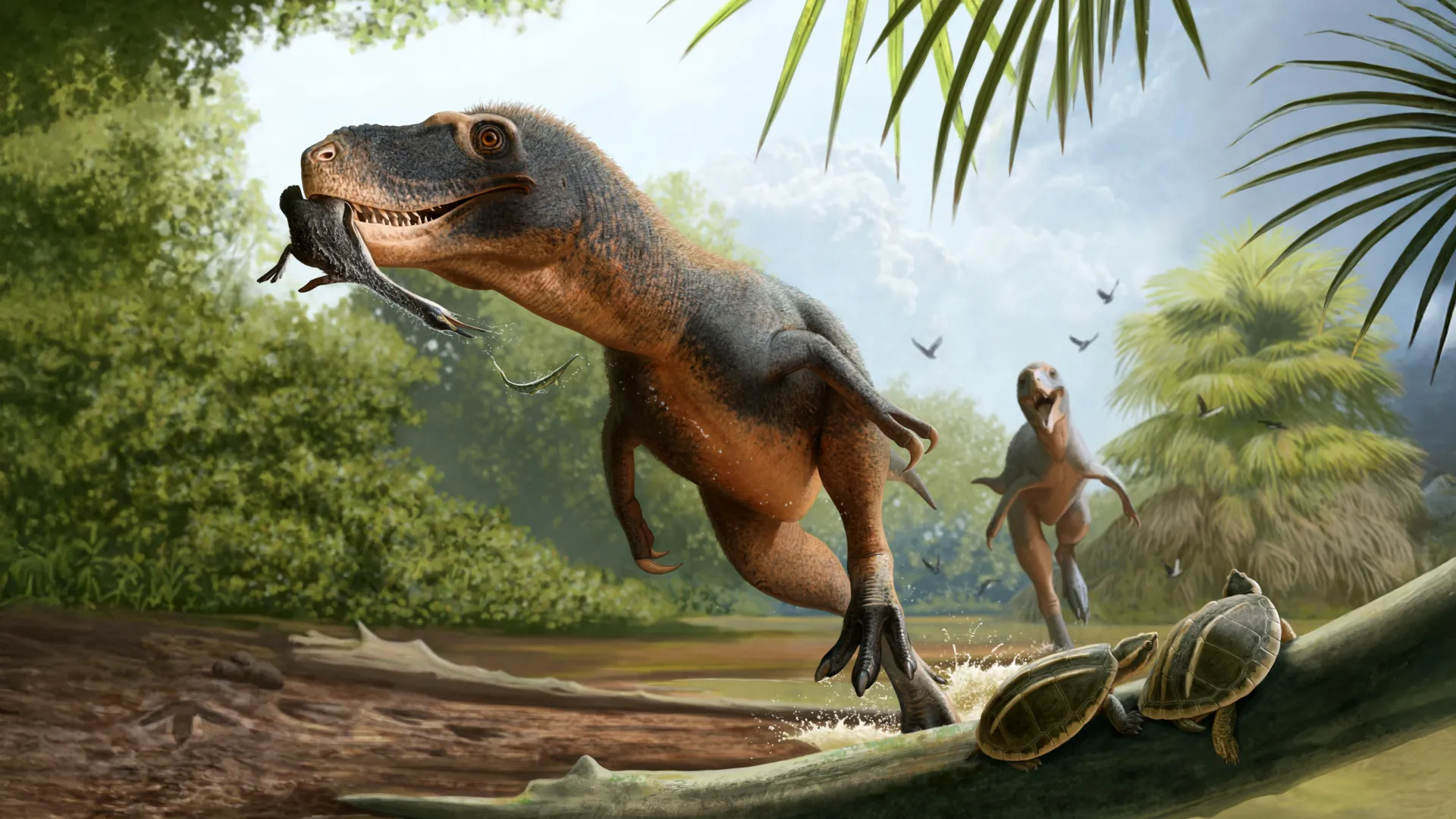
Approximately 66 million years ago, a massive apex predator—potentially a Tyrannosaurus rex or a closely related Nanotyrannus—stalked its prey in what is now the lush, swampy landscape of modern-day Montana. Following a successful hunt, the giant theropod consumed an ancient diving bird, sealing the fate of both animal and prey in a biological record that would endure for tens of millions of years. Today, paleontologists have extracted remarkable evidence of this prehistoric meal from a fossilized specimen of dinosaur feces, commonly known as a coprolite. The discovery has yielded what researchers describe as the finest, most detailed 3D feather preservation ever recovered from the Mesozoic Era, offering vital insights into why certain avian lineages managed to survive the cataclysmic mass extinction that wiped out the rest of the dinosaur family tree.
The findings, published in the peer-reviewed scientific journal Current Biology, represent a significant collaborative effort among researchers from the Field Museum in Chicago, the University of Washington’s Burke Museum, the Carter County Museum, and several other academic and scientific institutions. By deploying advanced micro-CT scanning technology to peer inside a nondescript, golf ball-sized lump of fossilized dung, the research team unlocked a treasure trove of microfossils, shedding light on ancient ecosystems, predator-prey dynamics, and the physiological traits that dictated life and death at the close of the Cretaceous Period.
A Chance Discovery in the Hell Creek Formation
The incredible journey of this fossil began in 2016 during routine fieldwork in the fossil-rich Hell Creek Formation of northeastern Montana. David DeMar, Jr., a research scientist and the Hell Creek Project collections manager at the Burke Museum, was actively prospecting along a rocky outcrop, collecting ancient fish fossils. While navigating the terrain, a small, dark reddish-brown nodule caught his eye. Roughly half the size of a standard golf ball, the rock appeared unassuming at first glance.
However, upon picking it up and examining its surface through a hand lens, DeMar made an astonishing observation: a tiny, impeccably preserved fossil feather was embedded directly in the rock. Given that feathers had never previously been documented within the Hell Creek Formation despite more than a century and a half of intensive geological and paleontological prospecting, the find was treated with cautious optimism.
Realizing the potential significance of the object, the research team transferred the nodule to a laboratory for non-destructive analysis. To examine the interior without damaging the delicate organic structures trapped inside, scientists utilized high-resolution micro-CT scanning facilities at the University of Southern California’s medical campus. This imaging technique relies on thousands of individual X-rays to construct a comprehensive, three-dimensional digital replica of an object’s internal architecture.
The results surpassed all expectations. According to Nate Carroll, a co-author of the study and a paleontologist at the Carter County Museum, the digital reconstruction revealed a complex matrix of organic remains hidden beneath the mineralized exterior. Every hour of data processing exposed new layers of biological detail, including additional feathers, microscopic fish scales from ancient gar, and delicate avian leg bones. For paleontologists accustomed to relying heavily on amber deposits—which are geographically restricted and often limited in scope—the realization that fossilized dinosaur waste could preserve soft tissues in such exquisite 3D detail marked a major methodological breakthrough.
Reconstructing the Last Meal of an Aquatic Diver
Through detailed morphological analysis of the internal remains, the research team successfully pieced together the identity of the prey. The bones and associated plumage belonged to a hesperornithiform, an extinct group of specialized, flightless aquatic birds that occupied an ecological niche roughly analogous to modern loons. These prehistoric divers relied on powerful, specialized feet to propel themselves through marine and freshwater environments in pursuit of fish.
The close physical association of the feathers and the leg bones within the coprolite strongly indicated that they originated from the same individual animal, ingested whole or torn apart during predation. Hesperornithiforms were evolutionary cousins of Neornithes, the specific avian lineage that ultimately survived the end-Cretaceous mass extinction and gave rise to all modern birds. However, hesperornithiforms belonged to a distinct evolutionary branch that perished entirely alongside non-avian dinosaurs, pterosaurs, and marine reptiles.
This anatomical context provides a unique focal point for addressing a longstanding paleontological enigma: why one specific group of birds endured the global catastrophe while virtually all other feathered lineages vanished.
The Evolutionary Timeline of Mesozoic Birds
To understand the magnitude of the extinction event 66 million years ago, researchers look to the deep history of the avian family tree. Birds are scientifically classified as theropod dinosaurs, sharing a common ancestor with towering predators like T. rex. The earliest known bird, Archaeopteryx, first appeared in the fossil record approximately 150 million years ago during the Late Jurassic Period.
For nearly 100 million years following the appearance of Archaeopteryx, a diverse array of avian species coexisted alongside terrestrial dinosaurs, pterosaurs, and marine creatures. During the Cretaceous Period, the dominant group of birds was the enantiornithines, which occupied a vast range of terrestrial and arboreal ecosystems. Simultaneously, other specialized lineages, such as the aquatic hesperornithiforms and the ancestral representatives of modern birds (Neornithes), established their own ecological strongholds.
This complex evolutionary landscape was brought to an abrupt halt approximately 66 million years ago, when a massive asteroid—estimated to be roughly six miles wide—impacted the Yucatán Peninsula in modern-day Mexico. The collision released energy equivalent to billions of atomic bombs, triggering global firestorms, devastating earthquakes, massive tsunamis, and an extended period of atmospheric disruption known as an impact winter.
During this prolonged winter, massive quantities of soot, dust, and sulfur aerosols blocked incoming solar radiation, causing global temperatures to plummet and halting photosynthesis across land and oceans. The resulting collapse of primary productivity caused a trophic cascade that eradicated roughly 75 percent of all plant and animal species on Earth, including all non-avian dinosaurs and the vast majority of prehistoric birds.
Evaluating Hypotheses on Avian Survival
For decades, scientists have debated the specific survival mechanisms that allowed the Neornithes lineage to weather the end-Cretaceous cataclysm. One prominent hypothesis has centered on habitat specialization. Because many early Neornithes inhabited aquatic or semi-aquatic environments, researchers previously suggested that freshwater and marine ecosystems might have provided a buffer against the immediate devastation on land, shielding these birds from extreme thermal shifts and food scarcity.
However, the discovery of the hesperornithiform remains inside the Montana coprolite complicates this neat narrative. Like many surviving Neornithes, hesperornithiforms were distinctly aquatic creatures adapted for a life of diving and swimming. Yet, despite occupying these water-rich environments, their entire lineage was completely extinguished. This empirical contradiction demonstrates that habitat alone cannot fully explain the selective survival of modern birds.
Lead author Jingmai O’Connor, associate curator of fossil reptiles at the Field Museum, points to physiological differences—specifically related to plumage and molting strategies—as a more probable driver of differential survival.
"We think the types of feathers that these birds had, and/or the way they molted those feathers, may have been one of the underlying causes of the selectivity of the end-Cretaceous mass extinction—essentially, why some birds died out and why others survived," O’Connor explained.
Primitive Plumage Versus Modern Insulation
Detailed analysis of the newly recovered hesperornithiform feathers revealed a structural composition that bridges the gap between primitive dinosaur-like fuzz and fully modern avian plumage. While some of the feathers exhibited modern, waterproof characteristics suited for an aquatic lifestyle, others retained smaller, fuzzy, primitive body feathers structurally similar to those found in enantiornithines and non-avian theropods.
Body feathers are essential for thermal regulation, trapping heat close to the skin to maintain metabolic body temperature. In the aftermath of the asteroid impact, when global temperatures dropped sharply during the impact winter, efficient thermal insulation would have been an absolute prerequisite for survival.
If hesperornithiforms and enantiornithines possessed primitive or less efficient insulating plumage compared to the advanced feathers of Neornithes, they would have been far more vulnerable to the sudden, severe cold. Consequently, even though hesperornithiforms shared aquatic habitats with surviving lineages, their physiological limitations regarding heat retention likely sealed their evolutionary fate.
Greg Wilson Mantilla, a professor at the University of Washington, curator of vertebrate paleontology at the Burke Museum, and a co-author of the study, emphasized the rarity and significance of the find.
"We rarely find fossils of birds and even more rarely their feathers, giving us such important insight into the evolution of this key aspect of their biology," Wilson Mantilla noted. "On top of that, these bird feathers found within a large fossilized dinosaur dung give us an incredible window into predator-prey interactions 66 million years ago."
Implications for Future Paleontological Research
Beyond addressing evolutionary questions surrounding the mass extinction, the discovery underscores the untapped potential of coprolites as unexpected archives of prehistoric soft tissue. Historically, paleontologists looking for delicate structures like feathers have focused on fine-grained sedimentary deposits, exceptional Konservat-Lagerstätten, or amber inclusions.
The successful extraction of pristine 3D feathers from fossilized dinosaur feces challenges traditional collection biases and introduces a novel methodological framework for paleontological research. Because coprolites frequently contain mineralized or partially digested remains that are protected from immediate scavenging and subaerial weathering by the digestive tract and subsequent mineralization, they may preserve microscopic structures that are typically destroyed in standard fossilization pathways.
The research team hopes that this discovery will encourage museums, academic institutions, and field researchers worldwide to re-examine existing coprolite collections using modern non-destructive imaging techniques such as micro-CT scanning. Countless specimens currently stored in archives could potentially harbor unstudied microfossils, offering fresh perspectives on ancient diets, predator-prey dynamics, and the micro-anatomical traits of extinct organisms.
By turning to an unconventional source—fossilized dinosaur waste—scientists have successfully bridged a critical gap in the evolutionary history of feathers, illuminating the complex biological factors that determined which lineages perished in Earth’s darkest hour and which lived on to populate the modern world.
