
As North America faces an era of unprecedented climate volatility, the Western United States is grappling with a hydrological crisis that threatens the very foundation of its agricultural, urban, and ecological systems. With wildfires scorching the landscape and long-term drought conditions depleting critical freshwater reservoirs, the Colorado River and the San Francisco Bay Delta have emerged as the focal points of a desperate, high-stakes battle over water rights. The conflict pits the survival of critical ecosystems against the immediate needs of millions of residents and a multibillion-dollar agribusiness sector, forcing federal and state governments into a complex, often adversarial, legislative landscape.
A Chronology of the Crisis
The current water emergency is not an overnight occurrence but the culmination of decades of over-allocation and changing climatic patterns. The Colorado River, which supports 40 million people and irrigates 5.5 million acres of farmland across seven states, has been the subject of contentious, stalled negotiations for months.
In response to the gridlock, the federal government has intervened, proposing stricter, centralized regulations that have failed to satisfy the stakeholders involved. A key point of contention in this federal proposal is the inclusion of a biennial renegotiation clause, a feature critics argue will introduce chronic instability and legal convolution into an already fractured system.
Historically, the Colorado River was a powerhouse of biodiversity, reaching the Sea of Cortez in a thriving delta ecosystem. However, that terminus has been dry for over 30 years. Similarly, California’s water infrastructure—the most heavily altered in the United States—is facing a breaking point. Lake Powell and Lake Mead, the two largest reservoirs on the Colorado, have plummeted to less than 30% of their total capacity. Projections indicate that if current draw rates persist, Lake Powell’s water levels will fall below the critical intake threshold by March 2027, rendering the reservoir effectively useless for hydropower generation and downstream distribution.
The Anatomy of California’s Hydrological Divide
California’s water management is governed by a Byzantine web of state and federal statutes designed for a climate that no longer exists. The state’s Mediterranean climate, characterized by warm, dry summers and cool, wet winters, requires the movement of water over vast distances. The majority of precipitation falls in the north, yet the primary centers of population and agriculture are located in the south.
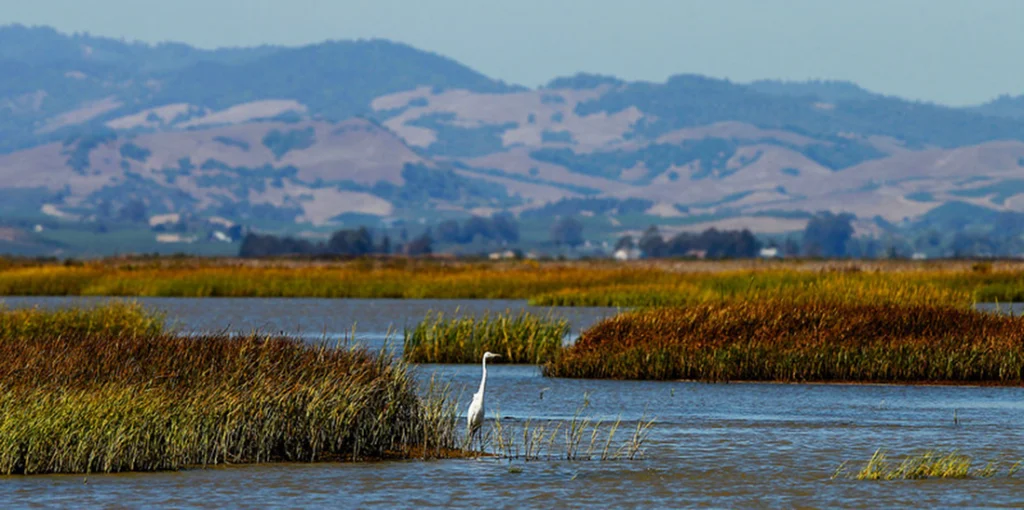
At the heart of this system lies the Sacramento-San Joaquin Delta, the only inland delta in the United States. Unlike traditional deltas that widen toward the sea, the Sacramento Delta narrows, funneling freshwater through a complex network of channels into the San Francisco Bay. This region acts as the primary plumbing system for the state, exporting water to over 25 million people and 3 million acres of irrigated land through two primary entities: the State Water Project (SWP) and the Central Valley Project (CVP).
Data from the California Department of Water Resources indicates that over 80 percent of the state’s developed water is allocated to agribusiness. This heavy reliance on irrigation, combined with urban demand and the necessity of maintaining flood control, has resulted in the loss of approximately 80% of historical tidal marshes in the San Francisco Bay.
The Ecological Cost: Silence in the Legislative Process
While human stakeholders—cities, developers, and agricultural giants—dominate the headlines, the ecological side of the equation remains chronically under-represented. California Fish and Game Code 5937 mandates that water be allowed to pass through dams to maintain fish in "good condition," yet environmental advocates and fisheries biologists describe this statute as vague and consistently under-enforced.
The diversion of water does more than just lower levels; it fundamentally alters the physical chemistry of the estuary. By reducing freshwater flow, the salinity, pH, nutrient levels, and temperature of the Bay change, creating artificial drought conditions even in years of moderate rainfall. These shifts are catastrophic for juvenile fish, which rely on the high-flow pulses of natural spring snowmelt to trigger migration and provide breeding grounds.
The Role of Eelgrass as a Bio-Indicator
The health of the San Francisco Bay Estuary is best measured by the vitality of its eelgrass meadows. These underwater plants serve as a foundational "nursery" for more than 120 species of fish and 30 species of waterfowl. The Richardson Bay Audubon Center has identified eelgrass as a critical habitat for Pacific Herring, which deposit their eggs on the blades in late winter. This event draws thousands of migratory sea ducks, which rely on the protein-rich eggs to refuel during their arduous journeys.
Beyond serving as a food source, eelgrass performs essential ecosystem services. The plants sequester carbon, anchor sediment to prevent shoreline erosion, and act as natural buffers against storm surges. Furthermore, they are oxygenators, vital for water clarity. However, these plants are remarkably delicate. They require high light availability and are highly sensitive to the increased turbidity caused by sediment runoff and the saltwater intrusion that follows reduced freshwater inflows. When freshwater is diverted upstream, the resulting increase in salinity can trigger Eelgrass Wasting Disease, further destabilizing the entire marine food web.
Policy Implications and the "Voluntary Agreement" Model
The current legislative approach, known as the "voluntary agreement" plan for the Bay Delta, has drawn significant fire from environmental groups and indigenous tribes. Unlike traditional regulatory frameworks that impose data-driven limits, these agreements rely on the "willing sacrifice" of major water users to leave more water in the rivers.
Critics argue that this model is inherently flawed, as it provides too much leeway to wealthy interest groups while lacking the rigorous oversight necessary to ensure ecosystem survival. The argument from these groups is not merely an aesthetic or moral one; it is an economic one. The collapse of the Delta’s ecological health has direct, cascading impacts on the commercial fishing industry and the resilience of the state’s natural flood protection infrastructure.
Looking Toward an Adaptive Future
The challenge of the next decade will be reconciling the needs of 40 million people with the necessity of preserving a functioning, living estuary. Experts suggest that long-term management will require more than just marginal reductions in water usage; it will likely necessitate a structural shift in how the Southwest manages its industrial and agricultural output.
As the climate continues to change, the "managed" water systems of the 20th century are proving increasingly inadequate. The resilience of the Bay Delta depends on a more holistic approach to water management—one that recognizes that the prosperity of human communities is inextricably linked to the survival of the rivers and estuaries that sustain them. Protecting these natural resources is not a luxury, but a fundamental requirement for the long-term stability of the Western United States. Without a commitment to scientific-based flow management, the state risks losing the very ecological infrastructure that mitigates the impacts of its most severe climate stressors.
