
Last summer, during a visit to my sister Annie in California, the anticipation of seeing her new home was eclipsed only by the excitement of finally meeting a neighbor she had often spoken about. This particular neighbor, despite being a frequent presence in Annie’s anecdotes, initially remained elusive, perhaps deterred by the boisterous energy of my children. A few days into the visit, however, I found myself in a narrow side yard, coming face-to-beak with Sal. Above a vibrant tapestry of succulents and wildflowers, Sal’s gaze met mine with an intensity and frank appraisal that, if originating from a human, would have bordered on rudeness. Then, with a flash of glossy black feathers, the American Crow took flight.
Annie and her partner, Jack, first encountered Sal in early 2024, shortly after settling into their new residence. While Annie was engaged in the mundane task of removing old landscaping fabric, a crow landed on a nearby fence, observing her with palpable curiosity. Intrigued, Annie gestured towards the freshly exposed soil where the tarp had been lifted. To her surprise, the bird swooped down and promptly snatched a worm. “It seemed like Sal understood,” Annie recounted, a sense of wonder still evident in her voice.
The Genesis of an Interspecies Bond
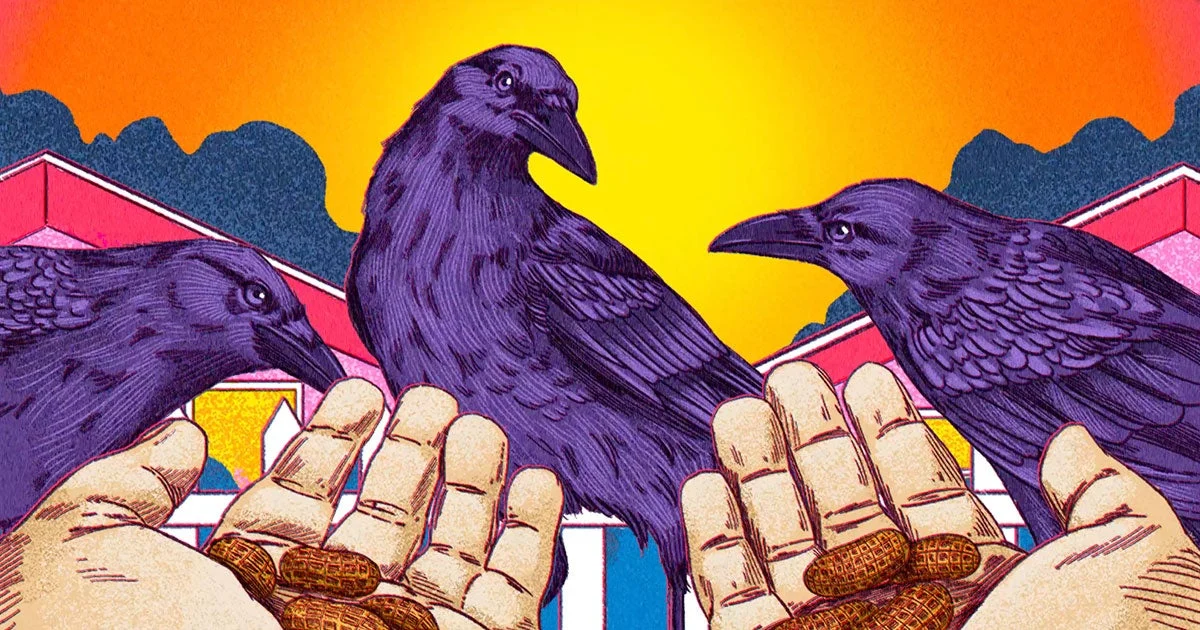
American Crows (scientific name: Corvus brachyrhynchos) are, to the untrained human eye, largely indistinguishable from one another. Yet, Annie and Jack soon learned to recognize Sal, a remarkably bold individual characterized by a distinctive hop, a consequence of a discernible limp. Their burgeoning connection led them to offer Sal unsalted peanuts, a treat that swiftly attracted a second, more timid crow, whose uniquely deformed foot served as its identifying mark. They affectionately named this companion Pal. Within a mere few weeks, the couple found themselves purchasing peanuts in bulk, inadvertently establishing a routine. Through consistent food offerings, they appeared to have trained the two corvids to make regular visits.
However, a fascinating question emerged: was it truly the humans doing the training, or were the roles subtly reversed? Annie herself pondered whether, from the crows’ perspective, they might be the orchestrators of this reciprocal relationship.
Indeed, the humans were undeniably rewarded. Annie often found herself anticipating the morning ritual of opening her curtains, greeted by the sight of the crows swooping onto her fence, a seemingly personal salutation. Their presence outside, a gentle swoosh of wings or a watchful perch on a patio chair as she worked on her laptop, became a comforting routine. The trust Sal and Pal had placed in her was deeply gratifying, a feeling further amplified when Annie discovered the crows possessed active social lives beyond her yard. Another neighbor, for instance, knew Sal by the name Russell. “Clearly they have so much else going on,” Annie remarked, reflecting on the crows’ autonomy. “It felt like they had these busy lives that we were fitting into.”
Scientific Perspectives on Corvid-Human Interactions
The question of who truly influences whom in corvid-human connections is not unique to Annie’s experience. Carl Bergstrom, an evolutionary biologist at the University of Washington, has cultivated profound bonds with numerous crows both at his home and on campus. He readily admits that such relationships “absolutely alters my behavior.” Bergstrom humorously detailed how, if he forgets to bring peanuts for the university crows, he resorts to elaborate evasive maneuvers, "sneaking across campus in a tunnel or through buildings, because I feel so bad when I run into them.”
Like Bergstrom and Annie, countless individuals worldwide forge sustained personal connections with their local crow populations. These interactions are often perceived as a privilege and a source of profound joy, with many even referring to the animals as friends. What remains a subject of ongoing scientific and philosophical inquiry, however, is the extent to which crows reciprocate these complex sentiments.
At its most fundamental level, crows likely perceive humans who provide food as a reliable resource, a critical component for survival. Urban environments, including our backyards, offer relatively safe havens for congregating and foraging, a stark contrast to open fields where predators like Red-tailed Hawks pose a greater threat. The provision of readily available treats merely sweetens this advantageous arrangement.
The Enigma of "Gifts" and Motivations
A frequently observed behavior involves crows seemingly leaving "gifts" – such as keys, coins, stones, or, in Bergstrom’s experience, even a ring his daughter had lost – for their human benefactors. While recipients often interpret these offerings as gestures of gratitude, behavioral ecologists offer a more prosaic explanation. Anne B. Clark, a retired Binghamton University researcher who specialized in urban crow behavior, noted that in all documented instances of this phenomenon, the birds involved were juveniles. Young crows are known for their exploratory nature, often carrying and manipulating interesting objects. Thus, a crow might simply be dropping an object already in its beak to make room for food. “My own opinion is that crows are not terribly interested in us,” Clark stated, emphasizing a more pragmatic view of these interactions.
However, the line between inadvertent action and strategic behavior in intelligent animals can be blurry. Crows, ravens, and rooks, all members of the genus Corvus, are globally recognized for their exceptional intelligence. Their cognitive abilities include tool fashioning, complex problem-solving, and sophisticated social learning. If a crow observes that leaving an object is consistently followed by a reward, it is entirely plausible that it might continue or even intentionally adopt this behavior. “It’s not a heavy lift for a smart animal,” affirmed John Marzluff, a professor emeritus and prominent corvid biologist at the University of Washington.
Despite scientific caution, many individuals who experience regular attention from crows maintain a belief in the birds’ more complex motivations. “It seemed like they would just come by to hang out,” my sister mused, articulating a sentiment akin to human companionship.
Defining Interspecies Friendship: A Philosophical Lens
To delve deeper into the nature of interspecies friendship, I consulted Thom van Dooren, a field philosopher at the University of Sydney and author of The Wake of Crows, a 2019 book exploring the intricate, shared lives of humans and corvids. Van Dooren proposes that crows engage with humans in ways that fulfill several key criteria for friendship.
The first criterion is individual recognition. “In order to strike up a friendship, you have to be the kinds of organisms who can firstly recognize one another as individuals,” van Dooren explained. In this regard, corvids possess a distinct advantage. While humans often struggle to differentiate individual crows, crows are remarkably adept at identifying individual humans. This capacity is ecologically crucial; crows have long lifespans, with Clark noting individuals living as long as 19 years, making the ability to recall allies and adversaries a significant evolutionary benefit.
Empirical studies underscore this remarkable memory. Urban crows have been documented holding grudges against individuals who have previously mistreated them, expressing their displeasure through harsh cawing and mobbing behavior, sometimes years after the initial encounter. Annie’s crow companions recognized her despite changes in haircut, or when she wore hats or sunglasses. Bergstrom’s crows recognized him even in a new jacket with the hood up. He recounted instances of encountering crows in different parts of town who seemed to know him, landing nearby with an expectant gaze. Upon his return to campus after a year-long absence, crows immediately greeted him, as if to say, “Where the hell have you been?”
Yet, merely recognizing a familiar face does not constitute friendship. Shared experiences are equally vital. Within their own species, crows form prolonged family relationships, with juveniles often remaining with their parents for several years to assist in raising younger siblings. They extend this social awareness to humans. Van Dooren’s next criterion, intersubjective engagement – the meeting of two conscious minds sharing a reality – is suggested by the way crows not only recognize humans but also keenly observe our gaze, meeting our eyes and following our line of sight.
Furthermore, a friendship cannot be purely utilitarian, van Dooren argues. Crows that establish relationships with humans must be seeking more than just peanuts and protection. “I think there’s all sorts of interesting motivations for these behaviors that are about curiosity, exploration—just leading an interesting life,” he posited. (It is worth noting that keeping entertained can, in itself, be considered a form of utility.)
A few years ago, one of Marzluff’s graduate students conducted an experiment inspired by Aesop’s fable, “The Crow and the Pitcher.” Four out of sixteen crows successfully learned to drop stones into a tube of water to raise a cheese puff. Subsequent brain scans revealed distinct neural activity patterns in these successful birds compared to their less competent peers when viewing the apparatus. Marzluff interpreted this as the crows “basically reliving that experience,” akin to a skier visualizing a run. In essence, the crows were constructing a narrative for themselves. This, van Dooren suggests, points to another prerequisite for friendship: the ability “to make sense of your life as a narrative” before one can truly know its recurring characters.
A Millennia-Long Coevolutionary Saga
While the precise thoughts of crows remain beyond human comprehension, as storytelling creatures ourselves, we are naturally inclined to perceive crows as significant players in our personal narratives – each friendship unfolding on a small stage, perhaps a park bench or a backyard patio. However, the epic saga of humanity’s relationship with corvids spans millennia, a grand narrative woven into the fabric of our shared history.
In their seminal work, In the Company of Crows and Ravens, Marzluff and coauthor Tony Angell advance the concept of “cultural coevolution” between these birds and humans. In prehistoric eras, ravens and crows began to frequent human hunting and fishing grounds, scavenging from our spoils. As corvids transitioned from mere scavengers to companions and competitors, human cultures developed practices to manage their presence, ranging from hunting and chasing to the creation of scarecrows. Our habits profoundly shaped theirs, and vice versa.
These ever-present birds also profoundly influenced mythologies across the globe. The raven, often depicted as a shape-shifter or trickster, holds immense significance for Indigenous peoples in North America. A Haida legend, for instance, tells of Raven discovering the first humans hidden within a clamshell. Conversely, ancient Greeks associated crows with the god Apollo and immortalized them in the constellation Corvus.
Corvids continue to appear in more contemporary lore, from Edgar Allan Poe’s haunting poem to Alfred Hitchcock’s chilling film. However, with fewer people engaged in farming, hunting, or direct subsistence activities that concern scavengers, the birds likely exert less influence on our culture than in previous eras. Yet, Marzluff emphasizes, we continue to shape theirs.
Urban Adaptations and the Crow’s Keen Eye
As human populations have increasingly concentrated in urban areas, crows have followed suit. Like coyotes and other adaptable wildlife, they have discovered that city dwellers are generally less prone to trapping or shooting them. Ever resourceful, crows have developed new behaviors, such as nesting on utility poles, and, mirroring many urban species, they appear to be growing less wary of human presence. These behavioral shifts may be cultural, with knowledge passed down through generations of birds. Alternatively, such changes could become genetically encoded if individuals with an innate inclination towards, for example, foraging for discarded fries or nesting on high-rises, possess a higher survival and reproductive rate.
Through millennia of trailing humans into new habitats, crows have also learned of our species’ inherent fickleness. Humans can be providers of sustenance, yet also sources of harassment or mortality. Our settlements can be alternately perilous or protective. To “avoid danger and take advantage of riches,” Marzluff explained, “they can’t not be interested in people.” Consequently, they have evolved to meticulously observe human behavior. This keen, persistent attention may be the very foundation of a truly singular friendship.
While other wild animals do form relationships with humans, many lack the exceptional cognitive abilities of crows or ravens, which possess a brain-to-body ratio comparable to that of a small monkey. Other highly intelligent species, such as elephants or whales, do not share the same extensive coevolutionary history with Homo sapiens. And while individual ravens or magpies may occasionally befriend a person, Marzluff notes that the vast majority of corvid-human relationships involve crows, largely due to their ubiquity across the Northern Hemisphere. Crows are, quite simply, everywhere we are, perpetually keeping a watchful eye.
The Wild Heart: On Their Own Terms
Even when humans experience what feels like a genuine friendship with a crow, the relationship inherently unfolds on the wild animal’s terms. They visit when they choose, and they may vanish from our lives with little warning. Consider Tatterwing, Bergstrom’s favorite crow, whose missing feathers gave her wings a Swiss cheese-like appearance. (Tatterwing also frequently made a distinctive rattle-knock call, more common among females.) One day, she simply disappeared. Bergstrom speculates she molted and grew new feathers, rendering her unrecognizable without her distinctive tatters. While he later saw a bird around his home that behaved like Tatterwing, he could not be certain of its identity.
Pal and Sal, too, eventually departed. One day last September, Annie observed Pal behaving unusually, lying down in an odd, seemingly hidden spot. After this incident, neither crow returned to her yard, and a new pair soon appeared. Annie suspects her former friends were ousted from their territory; a month later, Sal was reportedly sighted at a neighbor’s home a block away. “I miss them,” Annie confessed. She and Jack have continued to leave peanuts for the new crows, but thus far, consistent visits have not materialized.
Crows, undeniably, lead lives entirely independent of human interaction. This reality became profoundly clear to me during a meeting with Craig Gibson, an amateur naturalist and photographer dedicated to observing the birds in Lawrence, Massachusetts. Approximately 25 miles north of Boston, this industrial city hosts one of New England’s largest winter crow roosts. While crows typically maintain territorial boundaries during the breeding season, in colder months, they converge, foraging in vast flocks. At night, up to 15,000 birds may crowd together in Lawrence, shoulder to shoulder, as they sleep.
I arrived around 4 p.m. on a cold, thickly overcast December day, just before sunset. The crows, however, knew the time. Gibson and I peered through barbed wire toward a brick building complex where American Crows and some Fish Crows gathered on rooftops, wires, and asphalt – occupying every available perch. Shortly after sunset, they would transition from these staging areas to the branches of river birches and silver maples lining the Merrimack River.
Having not yet succeeded in cultivating a crow friendship in my own Boston-area yard, I found contentment in Lawrence as a mere onlooker. I swiveled my head as avian rivers streamed towards us, flying purposefully, dense overhead, and descending with playful dives and barrel rolls I had never before witnessed. The cawing was a constant, raucous symphony.
Gibson, for his part, maintains no personal relationships with any specific birds within this immense flock. He has dedicated nearly 500 nights to observing them as a collective – wild, anonymous, and untamed. “They’re putting on a good show for you!” he shouted over the din. Yet, in truth, these birds were not performing for us; they were performing for one another. While humanity will undoubtedly continue to weave stories about corvids, in that profound moment, their story was entirely their own.
