
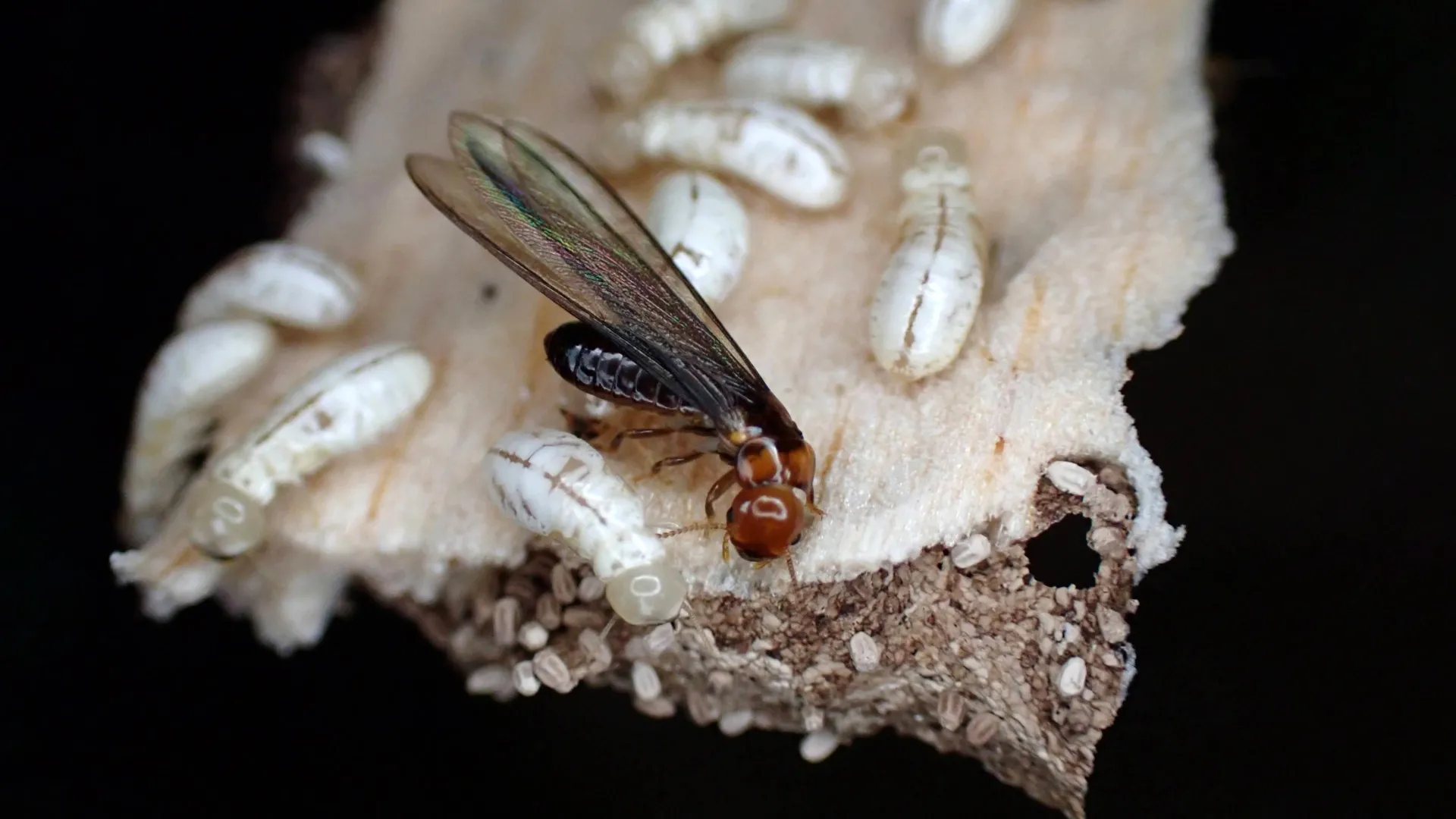
For decades, property owners and pest control professionals have waged a difficult war against one of nature’s most effective hiders: the western drywood termite. Unlike their subterranean counterparts, which maintain active, visible connections to damp soil beneath structures, drywood termites require virtually no contact with the ground. Instead, they burrow deep into the architectural framing, structural support beams, hardwood flooring, and antique furniture of homes and commercial buildings. Inside these dark, protected wooden galleries, colonies expand silently over many years, carving out complex networks of tunnels while leaving the outer shell of the wood completely intact.
This hidden existence has historically made western drywood termites exceptionally difficult to locate and eradicate. Traditional eradication methods, most notably whole-structure fumigation, require residents to temporarily vacate their properties, seal entire buildings in heavy tarpaulins, and introduce toxic gases to clear out infestations. While effective at achieving blanket eradication, fumigation is notoriously disruptive, expensive, and crucially, offers zero residual protection against future infestations introduced by flying reproductives or new lumber.
However, a multi-year research initiative emerging from the Department of Entomology at the University of California, Riverside (UCR), is laying the groundwork for a sweeping paradigm shift in how structural pests are managed. By turning the fundamental biology, social habits, and even the waste products of western drywood termites against them, UCR scientists are developing precision-targeted, low-impact treatment strategies that could eventually offer homeowners viable alternatives to whole-house fumigation.
The Biological Vulnerability: Exploiting the Molting Process
The breakthrough began when UCR researchers identified an unavoidable biological weak point in the termite lifecycle: they must molt to grow. Unlike mammals and other vertebrates that possess internal skeletons capable of growing organically alongside body mass, insects are encased in a rigid external shell known as an exoskeleton. This protective armor provides structural integrity and critical attachment points for muscle movement, with one of its most essential organic components being chitin—a tough, fibrous natural polysaccharide that is also found in fungal cell walls, fish scales, and the beaks of cephalopods.
Because this hard outer shell cannot stretch indefinitely, a growing western drywood termite must shed its old exoskeleton roughly seven times throughout its lifespan, stepping out of the restrictive armor and replacing it with a larger one.
Recognizing this mandatory developmental checkpoint, the UCR research team investigated a specialized chemical class known as chitin synthesis inhibitors. In a landmark study published in 2025 in the Journal of Economic Entomology, doctoral student and corresponding author Nicholas Poulos, alongside senior author and entomology professor Dong-Hwan Choe, evaluated the efficacy of bistrifluron, an insect growth regulator designed to interrupt the physiological manufacturing of chitin.
Unlike conventional, fast-acting neurotoxins that kill insects almost instantly upon contact, bistrifluron operates on a delayed timeline. When termites consume or encounter treated wood containing bistrifluron, the chemical does not immediately halt their daily activities. Instead, it quietly blocks their physiological ability to synthesize a new exoskeleton for their upcoming molt.
When the inevitable time arrives for the insects to shed their shells, the catastrophic failure becomes apparent. "Once the termites reach a certain stage, they have to molt. They cannot avoid that," Professor Choe explained. "With a lethal dose of this chemical, they’ll try to shed their old exoskeleton but won’t have a new one ready to protect them." Deprived of protective armor, the exposed termites rapidly succumb.
Laboratory Findings and Comparative Performance
In controlled laboratory experiments detailed in the 2025 study, the research team compared three distinct chitin synthesis inhibitors: bistrifluron, chlorfluazuron, and noviflumuron. Under standardized testing conditions, bistrifluron demonstrated exceptionally rapid mortality rates compared to its chemical counterparts.
When termites were continuously exposed to wood treated with a 0.1 percent concentration of bistrifluron with no alternative food source, the compound achieved approximately 99 percent mortality within a 60-day window. More impressively, when the insects were given a free choice between treated wood and untreated wood, the same bistrifluron concentration still yielded a remarkable 95.7 percent mortality rate.
Furthermore, researchers highlighted that bistrifluron offers a significantly safer ecological profile than traditional structural insecticides. Because the chemical targets chitin synthesis—a biological mechanism exclusive to invertebrates and fungi—it poses virtually no physiological threat to humans, pets, or other mammals that rely on internal bone structures.
Social Sharing and the Domino Effect within the Colony
Perhaps the most compelling discovery in the UCR study centers on how the poison moves through a closed colony. Western drywood termites are intensely social insects that maintain elaborate cooperative behaviors, including the continuous exchange of food, fluids, and gut symbionts.
To test whether a localized exposure could scale up to affect an entire hidden population, the researchers exposed a small fraction of a termite group to bistrifluron, tracked their movements using colored dyes, and subsequently reintroduced them to healthy, untreated nestmates.
The results demonstrated a devastatingly efficient chain reaction. Within 24 to 48 hours, ingested material from the initially exposed termites had successfully transferred to previously untouched members of the colony via social feeding behaviors. Most notably, in experimental groups where only 5 percent of the population was initially exposed to bistrifluron, the entire colony reached 100 percent mortality by day 90. Groups where 50 percent of the population started with exposure showed virtually identical ultimate mortality outcomes.
This high rate of transmission is heavily facilitated by specialized behaviors that UCR researchers have documented extensively. In complementary imaging and video research published in 2026, the Riverside team captured detailed footage of western drywood termites engaging in proctodeal trophallaxis—a critical social behavior wherein one termite receives nourishing fluids and essential hindgut microbes directly from the anus of another. While this behavior normally ensures the colony’s survival by passing down the necessary protozoa required to digest cellulose, it inadvertently acts as a Trojan horse for chitin synthesis inhibitors, carrying the lethal compound deep into parts of the colony that never made direct physical contact with treated wood.
Expanding the Arsenal: The Role of Natural Attractants
Bistrifluron represents only one pillar of UCR’s broader campaign to modernize drywood termite management. Recognizing that localized treatments are only as effective as their ability to reach hidden insects, the same laboratory has explored methods to actively draw pests toward localized poison deposits.
In previous research published in 2024, the team investigated pinene, a naturally occurring fragrant organic chemical compound released by many conifer species. To a western drywood termite tunneling through structural framing, the scent of pinene acts as an environmental beacon, signaling an attractive feeding site.
By combining pinene with localized aqueous insecticide applications, researchers dramatically altered mortality outcomes. While standard insecticide treatments alone yielded approximately 70 percent mortality in targeted setups, introducing pinene alongside the treatment pushed mortality rates past 95 percent by actively luring the insects out of their deep recesses and into contact with the toxic compound.
This innovation advanced further toward commercialization when the University of California filed a patent application in April 2025, which was subsequently published in October 2025. The patent details methods for incorporating alpha-pinene or beta-pinene into localized insecticide injections for western drywood termites. The proposed technology suggests that by enticing termites toward specific treated zones, pest control technicians could potentially space injection holes significantly farther apart, thereby reducing labor costs, structural damage from drilling, and the total volume of chemical agents required to achieve colony collapse.
Solving the Diagnostic Puzzle of Termite Droppings
While chemical delivery mechanisms and attractants are crucial, pest control operators face a foundational diagnostic challenge before any treatment can begin: determining whether an infestation is actively inhabited or merely a historical ghost town.
Drywood termites are notorious for pushing tiny, hard, hexagonal fecal pellets out of kick-out holes in infested wood. For property owners, discovering piles of these frass pellets is frequently the first warning sign of trouble. However, because old frass can remain trapped inside wall voids and framing for months or even years after a colony has naturally died out or been eradicated, visual inspection of droppings alone is notoriously unreliable.
To solve this diagnostic ambiguity, Poulos and his colleagues turned to microbiology. In research subsequent to the bistrifluron study, the team analyzed the bacterial communities residing within fresh western drywood termite pellets and compared them against samples aged for three months, six months, and one year.
The findings revealed a distinct biological clock embedded within the frass. Using quantitative DNA analysis, researchers discovered that total bacterial DNA levels declined precipitously as the pellets aged. In pellets produced by termites feeding on natural hardwood and Douglas fir—a standard lumber material used extensively in residential construction—estimated bacterial quantities plummeted by up to 190-fold between fresh samples and those aged for a full year.
Furthermore, the composition of the microbiome shifted predictably over time. The team identified five specific bacterial families that were consistently present in fresh Douglas fir-derived frass but vanished entirely after predetermined aging thresholds. The identification of these microbial signatures paves the way for the development of rapid diagnostic tools, allowing pest management professionals to test frass samples on-site and definitively determine whether an active infestation justifies chemical intervention.
Global Distribution and the Future of Structural Pest Control
The urgency driving these technological advancements is underscored by the expanding geographic footprint of the western drywood termite (Incisitermes minor). Native natively to the southwestern United States and northwestern Mexico, the species has long been recognized as a primary structural pest throughout California.
However, modern global commerce and the constant transport of commercial lumber, pre-built furniture, and wooden packaging materials have enabled the species to transcend its natural boundaries. Established populations have now been documented across diverse international regions, including Hawaii, Florida, New York, parts of Canada, China, Japan, Korea, and Australia.
As global trade networks continue to move timber across climatic borders, and as shifting environmental conditions create new habitats capable of supporting introduced populations, the risk of structural infestations grows increasingly universal.
"As we move lumber around the world, the termites are constantly transported to new locations. If they find the climate there acceptable, the problem will spread," Professor Choe noted. "In areas where these termites are common, it’s just a matter of time before homes are infested, so this study is a good initial step toward alternative strategies for controlling them."
Before bistrifluron and similar chitin synthesis inhibitors can transition from controlled laboratory environments to commercial pest control toolkits, researchers must clear remaining practical hurdles. In their experiments, scientists dissolved bistrifluron in acetone to facilitate wood treatment, allowing the solvent to evaporate before introducing the insects. While acetone is an ideal laboratory medium, its high flammability and strong chemical odor make it entirely unsuitable for residential application. Consequently, the research team is actively engineering safe, stable formulations that can be readily utilized by licensed technicians in real-world residential and commercial settings.
Despite these remaining developmental steps, the cumulative body of research coming out of UCR points toward an entirely new era in structural pest management. By moving away from blunt-instrument whole-structure fumigation and toward sophisticated, knowledge-based interventions that exploit termite biology, social behavior, chemical attraction, and microbial markers, science is steadily closing the loop on one of nature’s most elusive destroyers.
