
For generations, the scientific consensus regarding fossilization was absolute and unforgiving: the process was viewed as a total geochemical purge. According to orthodox paleontology and biochemistry, when an organism died and its remains were buried under layers of sediment, the passage of tens of millions of years would inevitably obliterate all original organic molecules. Bone, teeth, and soft tissues were thought to undergo complete mineralization, wherein delicate biological polymers like proteins, carbohydrates, and DNA were entirely replaced by inorganic minerals circulating in groundwater. Under this long-standing paradigm, the notion that endogenous proteins could survive across geological epochs—surviving the cataclysms that wiped out non-avian dinosaurs some 66 million years ago—was dismissed as a chemical impossibility.
However, a groundbreaking study led by a multidisciplinary team at the University of Liverpool has shattered this foundational dogma. Providing the most robust evidence to date, researchers have successfully demonstrated that Mesozoic fossils, specifically those belonging to iconic dinosaur species, retain verifiable traces of their original organic building blocks. By deploying state-of-the-art analytical techniques on an exceptionally preserved specimen from the Cretaceous period, the research team has not only confirmed the existence of ancient proteins within dinosaur bones but has also reignited a fierce, decades-old scientific debate regarding the true limits of molecular preservation in deep time.
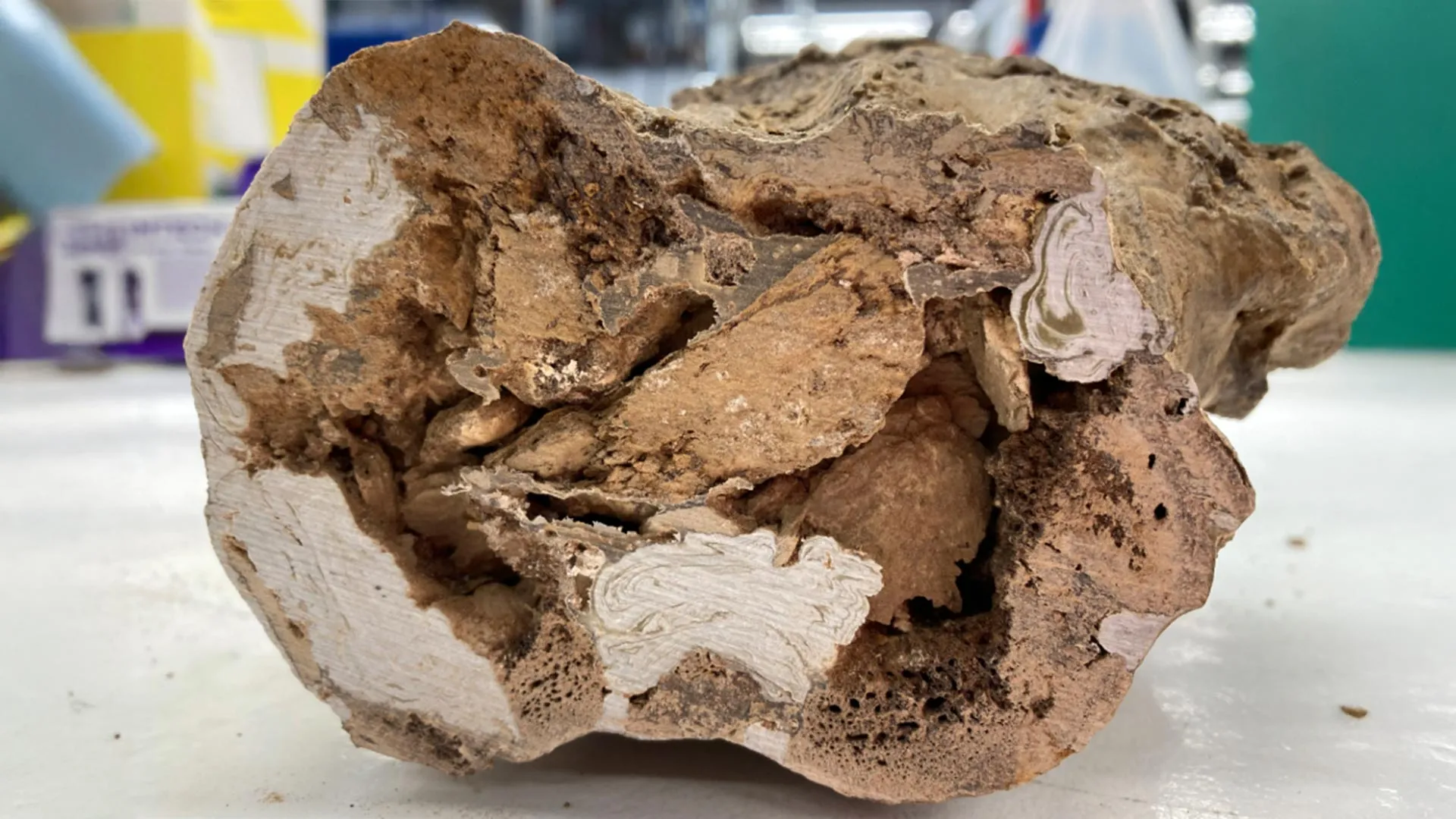
The landmark study, published in the peer-reviewed journal Analytical Chemistry, centers on the meticulous examination of a 22-kilogram fossilized sacrum—a complex structure of fused vertebrae linked to the pelvis—belonging to an Edmontosaurus, a massive duck-billed dinosaur (hadrosaur). Excavated from the fossil-rich Upper Cretaceous rock strata of the Hell Creek Formation in South Dakota, this specific specimen now resides within the permanent collections of the University of Liverpool. The Hell Creek Formation is globally renowned among paleontologists for preserving a diverse array of terrestrial and freshwater flora and fauna from the closing chapters of the Mesozoic Era, serving as a vital window into the final days of the dinosaur dominion.
What made this particular Edmontosaurus sacrum an ideal candidate for cutting-edge molecular investigation was its extraordinary state of preservation. While most fossil bones are heavily leached of organic content or heavily recrystallized, this specimen retained microstructural features that caught the attention of researchers, prompting them to apply advanced protein sequencing and high-resolution mass spectrometry.
The Chronology of a Scientific Controversy
To fully appreciate the gravity of the University of Liverpool’s findings, one must understand the tumultuous chronological arc of molecular paleontology over the last thirty years. The modern quest to extract biomolecules from dinosaur fossils began in earnest during the mid-1990s, when pioneering researchers first reported finding putative protein fragments and blood vessel-like structures in dinosaur bones, most notably in specimens of Tyrannosaurus rex.
These initial claims sent shockwaves through the scientific community, but they were almost immediately met with profound skepticism. The prevailing biochemical models of protein degradation—specifically the rate at which peptide bonds break down via hydrolysis at ambient surface temperatures—dictated that proteins like collagen should have a half-life of several hundred thousand years at most, meaning they should be utterly undetectable after a few million years, let alone sixty-five or seventy millions.
Consequently, a decades-long academic standoff ensued. Skeptics argued that any organic material detected in ancient fossils could not possibly be endogenous. Instead, critics hypothesized that these organic signatures were the result of modern contamination. Potential culprits included infiltrating microbes (such as biofilms and bacterial colonies), organic compounds leaching from surrounding soils, residues left behind by field excavators and museum preparators, or cross-contamination in high-sensitivity laboratory environments. This contamination hypothesis became the default shield for orthodox paleontology, casting a cloud of doubt over every subsequent claim of ancient biomolecule recovery.
The new research from Liverpool directly confronts and dismantles this contamination objection. By utilizing an array of highly sensitive, cross-verified analytical platforms, the research team established that the detected organic signatures are chemically bound to the ancient mineral matrix of the fossil, rather than sitting on the surface as modern interlopers.
Data, Methodology, and Analytical Precision
The strength of the Liverpool-led study lies in its multi-institutional collaborative approach and the deployment of rigorous, complementary analytical techniques. The research brought together specialists from the University of Liverpool’s Department of Electrical Engineering & Electronics, the prestigious Materials Innovation Factory, the Centre for Proteome Research, and external collaborators from the University of California, Los Angeles (UCLA).
Mass spectrometry, the primary analytical engine of the study, is a powerful technique that identifies molecules by measuring their mass-to-charge ratio and examining their fragmentation patterns. In this investigation, the team searched specifically for molecular signatures associated with collagen, which is the most abundant structural protein found in vertebrate bones, accounting for the vast majority of the organic matrix that gives bone its tensile strength and flexibility.
At UCLA, researchers utilized advanced tandem mass spectrometry to detect and quantify—for the very first time in this context—the amino acid hydroxyproline. Hydroxyproline is a non-proteinogenic amino acid that plays a critical role in stabilizing the triple-helix structure of collagen. Because hydroxyproline is exceptionally rare outside of collagen and a few other specialized structural proteins, its unambiguous detection in the interior matrix of the fossilized bone serves as a definitive chemical fingerprint. It confirms not only that proteinaceous material is present, but that it is specifically degraded collagen native to the bone tissue.
Concurrently, researchers at the University of Liverpool’s Mass Spectrometry Research Group performed detailed protein sequencing, while specialists at the Centre for Proteome Research identified specific fragments of collagen alpha-1, the primary genetic variant of collagen found within vertebrate bone. Further structural confirmations were carried out by materials scientists at the University’s Materials Innovation Factory, ensuring that every data point was scrutinized through multiple independent methodological lenses.
Official Responses and Expert Insights
Professor Steve Taylor, chair of the Mass Spectrometry Research Group at the University of Liverpool’s Department of Electrical Engineering & Electronics, emphasized the profound ramifications of the study during a press statement following the publication of the findings.
"This research shows beyond doubt that organic biomolecules, such as proteins like collagen, appear to be present in some fossils," Professor Taylor stated, summarizing the core takeaway of the multi-year investigation.
Addressing the long-standing skepticism that has plagued the field, Professor Taylor elaborated on the broader implications for analytical paleontology. "Our results have far-reaching implications. Firstly, it refutes the hypothesis that any organics found in fossils must result from contamination. By proving that endogenous peptides can survive under specific geological conditions, we are shifting the baseline of what is biochemically possible in fossilization."
Furthermore, Professor Taylor highlighted how these findings could transform routine laboratory practices across natural history museums worldwide. "Secondly, it suggests that cross-polarized light microscopy images of fossil bones, collected for a century, should be revisited. These images may reveal intact patches of bone collagen, potentially offering a ready-made trove of fossil candidates for further protein analysis. This could unlock new insights into dinosaurs—for example, revealing connections between dinosaur species that remain unknown."
The Broader Impact: A New Era for Paleoproteomics
The implications of this study extend far beyond the validation of a single dinosaur bone. For decades, traditional paleontology has relied almost entirely on macroscopic and microscopic osteological anatomy—the shape, size, and structural morphology of bones and teeth—to reconstruct the evolutionary trees and phylogenetic relationships of extinct organisms. However, morphological convergence and evolutionary plasticity can sometimes obscure true ancestral lineages, leaving significant gaps in the paleontological record.
By opening the door to reliable paleoproteomics (the study of ancient proteins), scientists can begin to utilize molecular data to study extinct lifeforms in a manner traditionally reserved for DNA analysis in more recent sub-fossil remains. Because proteins are encoded by genes, variations in amino acid sequences can serve as molecular clocks and phylogenetic markers. If researchers can routinely extract and sequence collagen and other stable structural proteins from Mesozoic fossils, it may soon be possible to construct robust molecular phylogenies for dinosaurs, shedding light on their exact evolutionary relationships with modern birds, reptiles, and each other.
Moreover, the discovery breathes new life into historical museum archives. Millions of fossil specimens housed in academic institutions around the globe have been cataloged using cross-polarized light microscopy—a technique that utilizes optical filters to reveal birefringent crystalline structures within bone. If characteristic optical signatures in these century-old archives can be correlated with the preservation of localized collagen patches, researchers will possess an immediate roadmap of high-value fossil candidates, bypassing the need for speculative, destructive sampling on random specimens.
The Unresolved Mystery of Deep-Time Preservation
Despite the triumph of the analytical data, the study also leaves the scientific community face-to-face with one of the most compelling biochemical mysteries of the natural world: the mechanism of ultra-long-term preservation.
Standard biochemical calculations indicate that peptide bonds are thermodynamically unstable over geological timescales when exposed to water, heat, and background radiation. Yet, samples like the Edmontosaurus sacrum from the Hell Creek Formation have clearly defied these thermodynamic expectations. How did these protein fragments manage to persist, structurally intact and chemically detectable, for approximately 75 million years?
Scientists hypothesize that several preservation mechanisms may act in concert to protect ancient organics. These may include the extensive cross-linking of collagen fibers within a dense mineral hydroxyapatite matrix, which can physically shield the protein molecules from water and microbial enzymatic attack. Additionally, localized geochemical microenvironments—such as rapid encasement in impermeable clay-rich sediments or the presence of natural cross-linking agents like reactive oxygen species, tannins, or iron-mediated free radicals—might effectively "tann" or polymerize the proteins, locking them into an inert state that arrests normal decay processes.
Solving this enigma will require intensive, interdisciplinary collaboration between geochemists, materials scientists, and paleontologists. Researchers must recreate and model the micro-geochemical conditions of ancient burial environments to understand the precise kinetic barriers that allow biomolecules to cheat decay across deep time.
Conclusion and Future Outlook
The University of Liverpool’s successful identification of original collagen in an Upper Cretaceous Edmontosaurus fossil marks a watershed moment in the earth and life sciences. By decisively countering the contamination hypothesis through rigorous multi-technique mass spectrometry and protein sequencing, the research team has moved paleoproteomics past its contentious infancy and firmly into a new era of empirical validation.
As scientists begin to re-examine historical microscopy archives and refine extraction protocols for ancient biomolecules, the boundaries of paleontology are expanding outward. The once-insurmountable barrier of deep time is slowly being redrawn, offering humanity an unprecedented, molecular-level glimpse into the biological fabric of a world that vanished sixty-six million years ago.
