
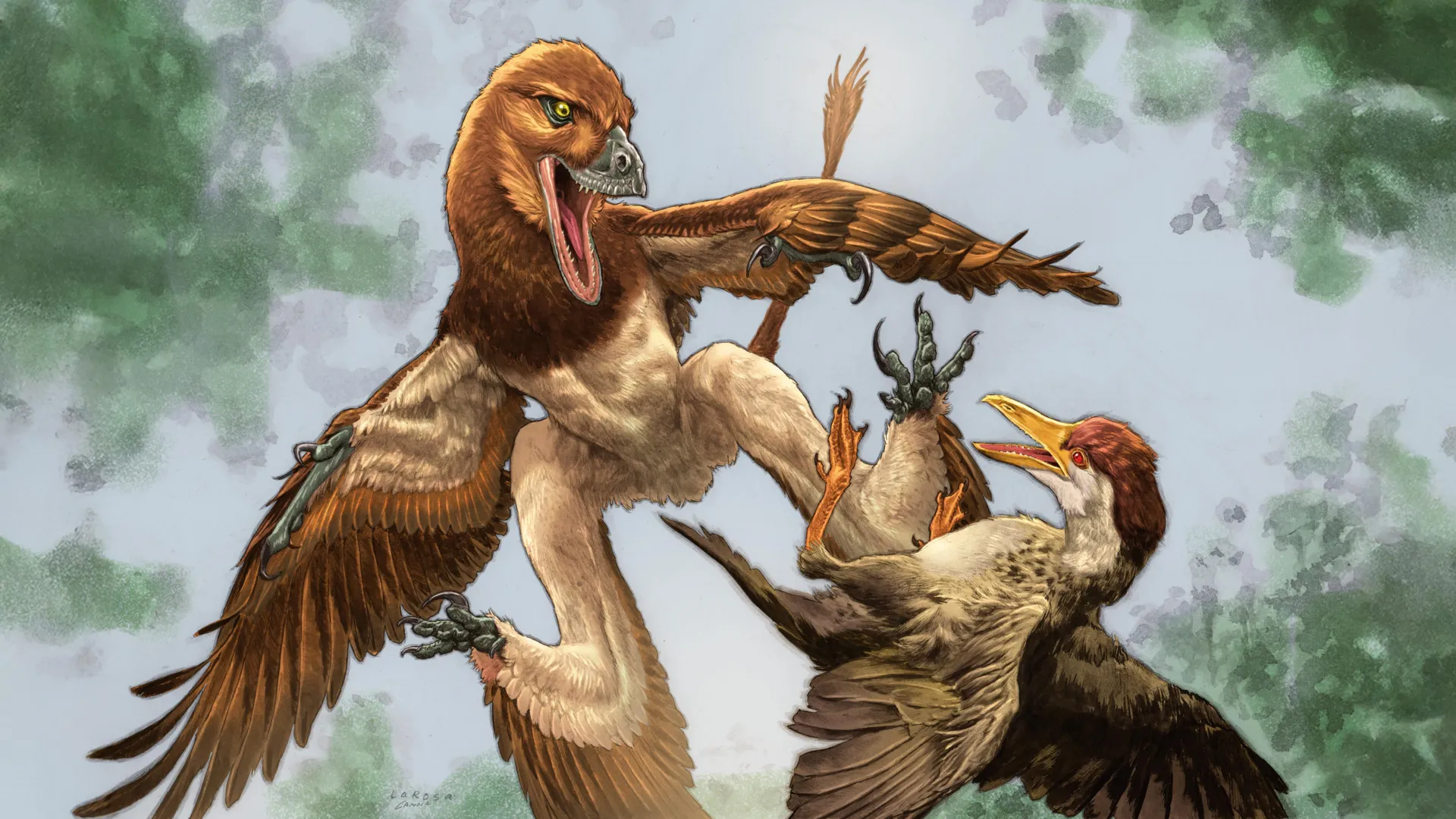
Paleontologists working in the remote badlands of northwestern China have uncovered a vital piece of an evolutionary puzzle that has perplexed researchers for decades. A remarkable fossil deposit in the Gansu province, renowned for yielding hundreds of exceptionally preserved prehistoric bird specimens, has finally revealed the identity of an elusive apex predator that once roamed the ancient landscape. For years, the excavation site offered up baffling clues—specifically, dense clusters of shattered, compressed bird bones arranged in pellet-like masses eerily reminiscent of the regurgitated waste produced by modern owls. While these pellet fossils strongly implied the presence of a larger, specialized hunter, direct physical evidence of the culprit remained frustratingly absent.
That silence has now been broken. In a comprehensive study published in the Annals of Carnegie Museum, an international team of scientists has formally described a newly discovered dinosaur species that matches the profile of the elusive predator. Named Jian changmaensis, this newly unveiled creature was a feathered, carnivorous relative of the iconic Velociraptor. Boasting distinctive anatomical features in its arm and shoulder girdle, Jian is currently considered the prime suspect behind the mysterious accumulation of pulverized bird remains scattered across the Changma fossil bed. This discovery not only closes a significant gap in our understanding of Cretaceous ecosystems but also provides unprecedented context regarding the survival pressures faced by the evolutionary precursors of modern avian species.
Anatomy and Morphology of a Specialized Hunter
To understand the ecological role of Jian changmaensis, researchers must rely on the fragments recovered from the Gansu site, which primarily consist of a remarkably well-preserved upper arm bone measuring approximately four inches in length. Although incomplete, this single element allows paleontologists to extrapolate the creature’s overall dimensions and physical capabilities with a high degree of confidence. Scaling from the humerus, scientists estimate that Jian possessed a wingspan stretching roughly four feet, making it comparable in size to a modern barn owl.
Crucially, Jian belongs to a specialized subgroup of dromaeosaurs known as microraptors. While most members of this lineage were diminutive—with some species shrinking down to the size of a common crow—Jian changmaensis ranks among the largest microraptor specimens ever scientifically documented. Like its smaller relatives, Jian was almost certainly a four-winged gliding animal. Long, aerodynamic feathers extended from both its forelimbs and hind limbs, creating a dual-airfoil surface.
Biomechanically, these animals were not capable of true, powered flight akin to that of modern sparrows or pigeons. Instead, Jian likely utilized its four-winged configuration for arboreal gliding, swooping between ancient conifers much like a modern flying squirrel. This specialized mode of locomotion would have made it a silent, lethal ambusher in the dense, subtropical forests of the Cretaceous period. The genus name honors "Jian," a mythical winged creature from traditional Chinese folklore, while the specific epithet changmaensis serves as a geographical homage to the Changma Basin where its fossilized remains were unearthed.
The Chronology of Discovery and the Changma Ecosystem
The story of the Changma fossil bed is one of extraordinary scientific yield tempered by profound ecological puzzles. Over the past several decades, paleontological expeditions to the Gansu province have recovered more than one hundred fossilized bird specimens, cementing the region’s status as one of the world’s most significant windows into early avian evolution. These ancient birds lived during the Cretaceous period, sharing the landscape with a diverse array of flora and fauna millions of years before a cataclysmic asteroid impact wiped out the non-avian dinosaurs 66 million years ago.
For years, however, the faunal census at Changma presented a glaring statistical anomaly. While avian fossils were abundant, researchers found a near-total absence of non-avian dinosaurs at the site. This imbalance puzzled paleoecologists, as balanced ecosystems typically require a pyramid of biomass featuring numerous predators supporting a smaller base of prey, or vice versa. The discovery of the pellet-like bird bone masses only heightened the mystery, confirming that an active carnivore was systematically hunting the local avifauna, yet refusing to leave behind skeletal remains that could definitively identify it.
The breakthrough occurred when analysts processed the latest batch of fossils recovered from the basin, isolating the unique dromaeosaur elements that would become the type specimen of Jian changmaensis. This singular non-avian dinosaur bone shatters the long-standing ecological vacuum of the site. It confirms that predatory theropods were indeed active participants in the Changma food web, directly interacting with the diverse bird populations that defined the region.
Official Responses and Expert Analysis
The significance of the Jian changmaensis discovery extends far beyond the borders of Gansu province, offering broad implications for the study of vertebrate paleontology and evolutionary biology.
"Scientists have found these weird, broken-up clusters of bird bones at this site, and we didn’t know what made them. This new microraptor dinosaur, Jian changmaensis, is our best guess," explains Dr. Jingmai O’Connor, associate curator of fossil reptiles at the Field Museum in Chicago and senior author of the descriptive study. Emphasizing the uniqueness of the find, O’Connor notes, "It’s the only dinosaur found at this site that wasn’t a bird, it was a carnivore, and it was much bigger than everything else that we’ve found there."
This sentiment is echoed by Dr. Matt Lamanna, the Mary R. Dawson Curator of Vertebrate Paleontology at the Carnegie Museum of Natural History, who served as the corresponding author for the research. "Jian changmaensis reveals that non-avian dinosaurs lived in what is now the Changma Basin, an area famous for its fossil birds," Lamanna states. Highlighting the rarity of the specimen within the local stratigraphy, he adds, "Our team has recovered more than a hundred bird fossils at Changma, but only this single non-avian dinosaur specimen. Jian provides critical new insight into the biological history of the Changma region and the ecological context of the ancestors of today’s birds."
The collaborative nature of the research underscores the globalized effort required to piece together Earth’s deep history. The formal study was co-authored by an international roster of experts, including Ling-Qi Zhou of the Gansu Geological Museum, Matthew Lamanna of the Carnegie Museum of Natural History, Ashley Poust representing the University of Nebraska State Museum and the University of California Museum of Paleontology, Da-Qing Li of Gansu Agricultural University, and Hai-Lu You of the Institute of Vertebrate Paleontology and Paleoanthropology at the Chinese Academy of Sciences, alongside Jingmai O’Connor.
Broader Impacts: Decoding the Success of Modern Birds
To contextualize the importance of Jian changmaensis, researchers emphasize the necessity of examining the crucible in which modern avian traits were forged. Today, birds represent the most successful and diverse clade of land-dwelling vertebrate animals on Earth, having successfully navigated the mass extinction event that brought an abrupt end to their towering theropod cousins. However, understanding how and why this lineage achieved such evolutionary dominance requires a thorough investigation of the selective pressures they faced during the Mesozoic Era.
Predation by agile, feathered hunters like Jian changmaensis undoubtedly played a pivotal role in shaping the evolutionary trajectory of early birds. The constant threat of being ambushed by four-winged gliders in the forest canopy would have exerted intense selective pressure on avian precursors, driving adaptations in flight agility, sensory perception, social flocking behaviors, and nest-building strategies. By reconstructing the predator-prey dynamics of the Changma Basin, scientists gain a sharper lens through which to view the mechanisms of natural selection that prepared a select group of feathered dinosaurs to inherit the earth.
"You cannot understand life on the planet today without looking at its origins," O’Connor concludes, summarizing the overarching philosophy driving modern paleontological research. "Birds are arguably the most successful group of land-dwelling vertebrate animals on Earth today. Learning about early birds and their close non-bird dinosaur relatives gives us a better understanding of what made the group of birds that survived so special."
As ongoing excavations in northwestern China and across the globe continue to yield new fossils, researchers remain optimistic that additional specimens of Jian changmaensis will eventually be unearthed. Discoveries of more complete skeletal material will allow scientists to test hypotheses regarding its gliding mechanics, hunting strategies, and precise ecological footprint, ultimately bringing a long-hidden chapter of Cretaceous history fully into the light.
