
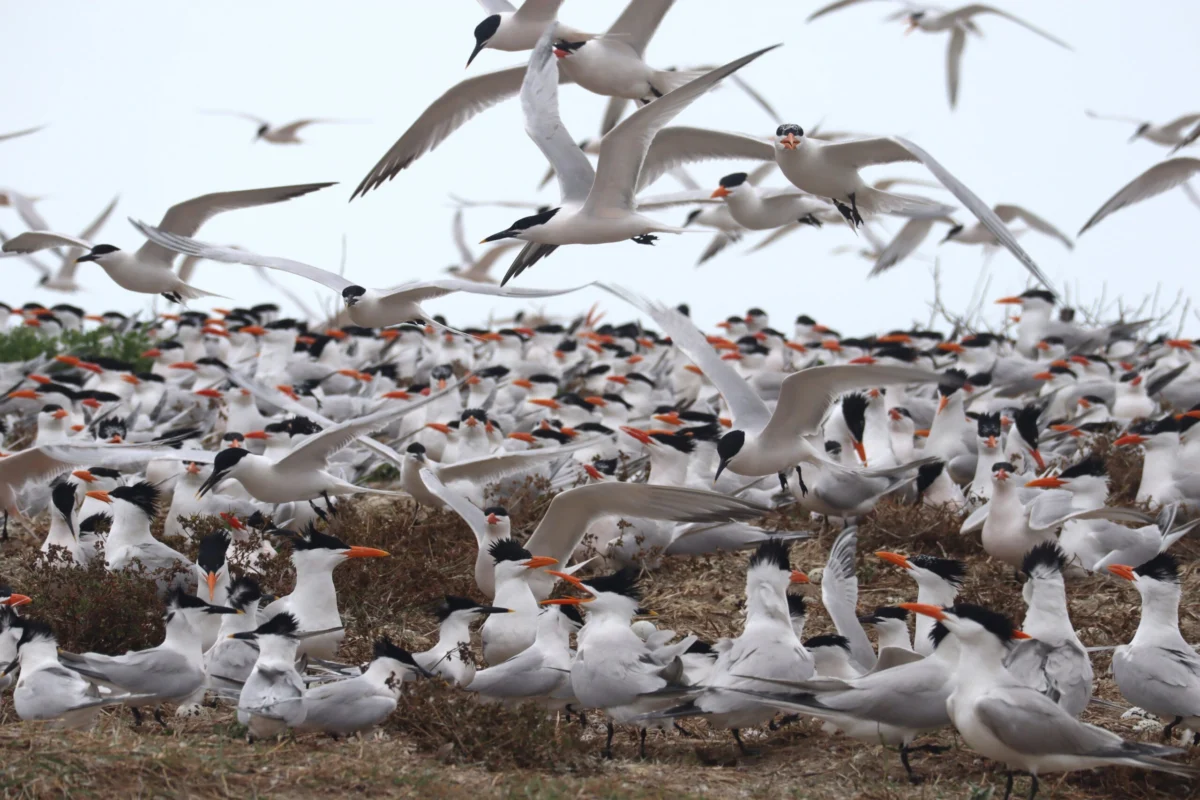
For the first time ever, we documented the route of a Sandwich Tern migrating from the Atlantic Coast of North America to the Pacific Coast of South America and back again. This landmark achievement in avian research, conducted through a partnership between Audubon and Dr. Kate Goodenough of Larid Research and Conservation, has unveiled the intricate, long-distance movements of one of the Atlantic coast’s most recognizable seabirds. By utilizing advanced satellite tracking technology, researchers have transformed theoretical knowledge into precise geographical data, providing a roadmap for future international conservation efforts.
The Mystery of the Atlantic Breeding Grounds
Royal and Sandwich Terns have maintained nesting colonies along the North Carolina coastline for decades, yet their lives beyond these summer shores have long been shrouded in mystery. While banding programs—the traditional method of attaching unique metal identification rings to bird legs—had previously confirmed that these terns migrated toward South America, the specific corridors, stopover sites, and final wintering destinations remained largely unknown.
For conservationists, this knowledge gap represented a significant hurdle. Without understanding where these birds spend the winter or how they navigate the thousands of miles between nesting and feeding grounds, it is impossible to design effective habitat protection strategies. The collaborative project aimed to bridge this gap, focusing on the Cape Fear River and Ferry Slip Island, where thousands of data points were transmitted to local base stations throughout the recent breeding season.
A Journey to the Humboldt Current
The standout discovery of the study centers on a single Sandwich Tern. Its documented migration path began with a slow, deliberate movement south along the Atlantic coastline, passing through the waters off Honduras and Panama. Unlike the majority of the population that remains within the Atlantic basin, this specific bird navigated across the Isthmus of Panama, transitioning from the Atlantic to the Pacific.
Upon reaching the Pacific, the tern descended into Ecuador before settling at the Paracas National Reserve in Peru. This site is a sprawling 335,000-hectare marine sanctuary, comparable in scale to the state of Rhode Island. The selection of this specific location by the tern was not a matter of random chance; it was a calculated biological necessity. Paracas is influenced by the Humboldt Current, a cold, nutrient-rich oceanic highway that flows northward along the Peruvian coast. When this current collides with the shallow shelves of the reserve, it forces cold, nutrient-dense water to the surface, creating a "biological soup" that supports an immense density of fish.
For the Sandwich Tern, this provided the ideal foraging ground to sustain its body mass throughout the winter months. After spending four months in this productive environment, the bird successfully navigated the return journey to North Carolina in the spring, completing a transcontinental circuit that underscores the species’ remarkable physiological resilience.
Chronology of Data Collection
The research project unfolded over three primary phases, focusing on the deployment of trackers and the subsequent analysis of behavioral data:
- Year One: Baseline Establishment. Initial tracking efforts focused on identifying the immediate dispersal patterns of Royal Terns upon leaving the North Carolina colonies.
- Year Two: Technological Refinement. Researchers scaled up the deployment of transmitters on Sandwich Terns, focusing on high-accuracy satellite tags that could survive the harsh conditions of maritime travel.
- Year Three: The Transcontinental Breakthrough. The deployment on five Sandwich Terns yielded the high-resolution data that allowed for the mapping of the Pacific-crossing route, while simultaneously collecting third-year data on the Royal Terns.
The data gathered from 21 tracked Royal Terns during this period has been equally illuminating. While some birds chose to winter in closer proximity to the United States—specifically in Florida—others undertook significant journeys to the Dominican Republic, Cuba, Mexico, Panama, and Colombia.
Implications of Site Fidelity
A critical finding of the three-year study is the high degree of site fidelity observed among the Royal Terns. Dr. Kate Goodenough noted that four of the tracked Royal Terns returned to the exact same wintering locations for two consecutive seasons. This behavior suggests that these birds rely on "memory-based" migration, where specific coastal stopovers and wintering areas are not just incidental, but essential components of their survival strategy.
"This is an exciting finding and tells us just how important it is to conserve sites across the hemisphere for their continued use," Goodenough stated. If a specific patch of coastline in Panama or Colombia is degraded, the birds may lack the flexibility to find a suitable alternative, potentially leading to population declines.
Official Responses and Scientific Context
The research team emphasizes that the data serves as a wake-up call regarding the limitations of localized conservation. Because these birds spend roughly six months in North Carolina and the other six months in diverse jurisdictions across the Western Hemisphere, the survival of the species depends on international policy.
"This research has underscored the importance of stopover and foraging areas for migrating waterbirds," Dr. Goodenough remarked. "We only have them in North Carolina for about six months and [they] spend the other part of their life in parts of the world that require international attention and collaboration."
This sentiment is echoed by broader conservation organizations, including Audubon, which has shifted its strategy toward a hemispheric model. By partnering with initiatives like Conserva Aves, conservationists are working to secure legal protections for critical habitats across South and Central America. The goal is to create a "chain of protection" that mirrors the birds’ migration route, ensuring that every leg of the journey—from the breeding colony in North Carolina to the foraging grounds of the Humboldt Current—is safeguarded against development, pollution, and climate-driven ecosystem collapse.
Analysis: Why This Data Matters
The significance of this study extends beyond the individual birds tracked. The data provides a quantitative basis for identifying "Critical Habitat Areas." Under environmental law, identifying these areas allows for targeted conservation measures, such as restricted fishing zones or limitations on coastal development, which are necessary to maintain the fish stocks these terns depend on.
Furthermore, the documentation of the Sandwich Tern’s migration across the Isthmus of Panama into the Pacific challenges existing assumptions about the rigid migratory boundaries of the species. It suggests that these birds may be more adaptive to changing climate conditions than previously thought, provided that their primary food sources—such as those generated by the Humboldt Current—remain stable.
Future Directions
As the project moves into its next phase, the focus will shift toward expanding the sample size of tracked individuals. While 21 Royal Terns and five Sandwich Terns have provided a foundational dataset, larger population studies are required to understand the variability in migration timing and route selection.
Additionally, the team plans to correlate their migration data with satellite-derived ocean temperature and productivity maps. This will allow researchers to predict how future climate change, which is expected to alter the path and intensity of ocean currents like the Humboldt, might impact the birds’ ability to find food.
The successful tracking of these birds serves as a potent reminder of the interconnectedness of global ecosystems. A bird nesting on a riverbank in North Carolina is effectively a global citizen, reliant on the health of ecosystems thousands of miles away. Through the continued integration of technology and international cooperation, the conservation community is moving closer to ensuring that these avian travelers can continue their epic journeys for generations to come. The maps and findings generated by this study are now being integrated into global migratory bird databases, providing a resource that will inform both policy decisions and future biological research for years to follow.
