
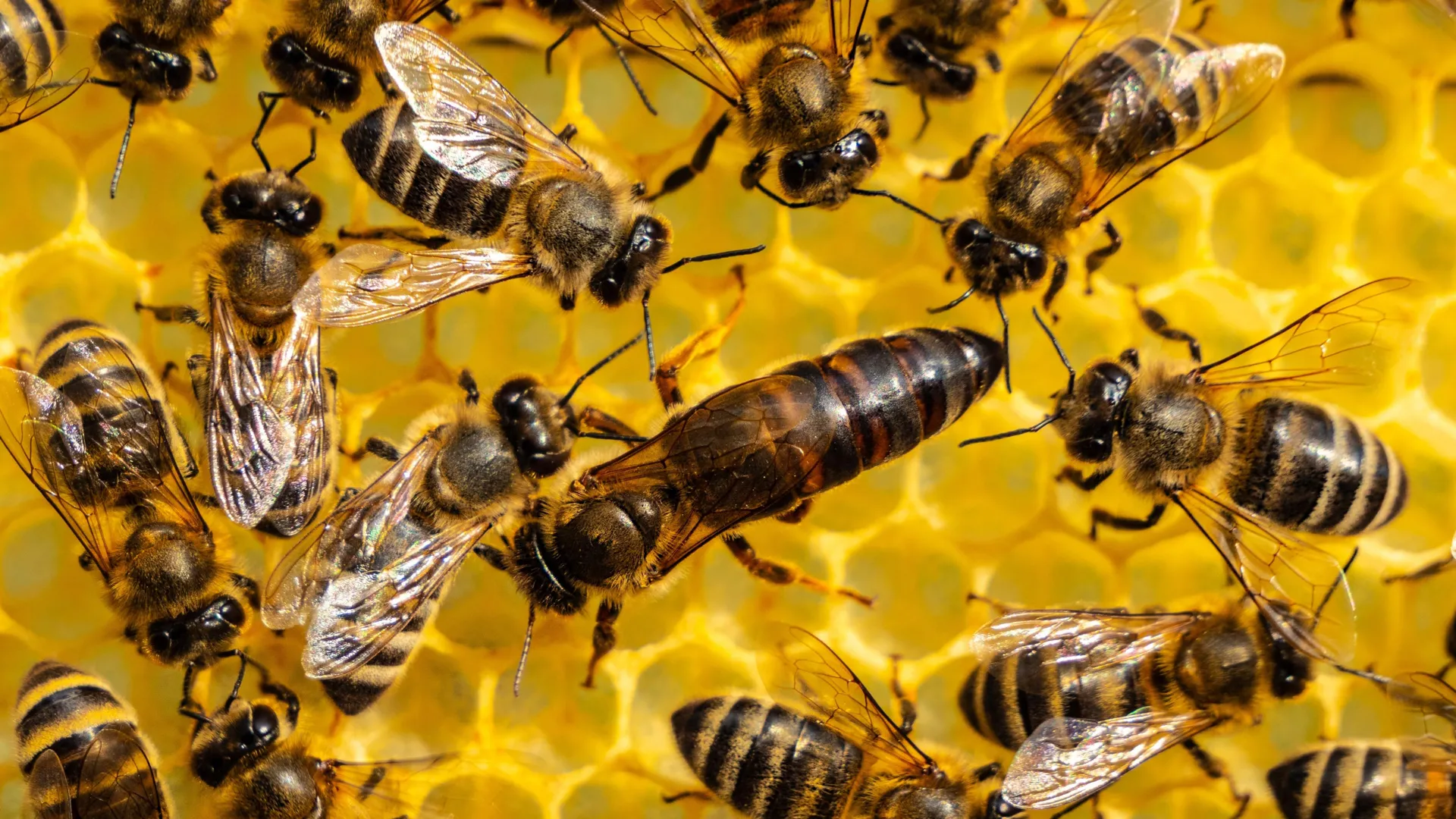
The intricate social architecture of a honeybee colony has long been celebrated as a marvel of nature, featuring a meticulously organized division of labor where worker bees act as the ultimate guardians of the hive. For generations, scientists understood that these sterile female workers served as the primary line of defense against environmental toxins, carefully filtering out harmful agricultural chemicals from the food supply before they could ever reach the heart of the colony. However, groundbreaking new research has shattered this conventional wisdom, revealing that honeybee queens possess an unexpected and desperate survival mechanism of their own when that protective barrier inevitably fails.
According to a study published in the scientific journal Current Biology, honeybee queens exposed to chronic pesticide ingestion engage in a process known as "maternal offloading." When environmental contaminants accumulate within the queen’s body beyond safe thresholds, she shunts the toxic burden directly into her developing eggs. This biochemical offloading allows the reigning matriarch to preserve her own physiological health at a devastating potential cost to the next generation. Led by researchers at the University of California, Davis, in collaboration with the Lawrence Livermore National Laboratory (LLNL) and the U.S. Department of Agriculture’s Agricultural Research Service (USDA-ARS), the findings offer unprecedented insight into the hidden toll of agricultural chemicals on the most vital member of the hive.
The implications of this discovery stretch far beyond academic toxicology, raising urgent concerns for commercial beekeepers, agricultural producers, and global food security. With roughly one-third of the human diet reliant on insect pollination—predominantly by honeybees—understanding the subtle, cumulative mechanisms behind colony stress has never been more critical. As researchers peel back the layers of how hives process modern chemical exposures, they are uncovering a slow-creeping biological threat that could redefine how integrated pest management is practiced worldwide.
The Limits of Worker Bee Filtration
To fully comprehend the significance of maternal offloading, one must examine the traditional protective roles within a standard honeycolony. Under normal conditions, worker bees forage across agricultural landscapes, collecting nectar and pollen that inevitably carry residues of synthetic pesticides. Upon returning to the hive, these foragers and nurse bees process the incoming food, theoretically utilizing specialized physiological filters and enzymatic breakdowns to detoxify the provisions before feeding them to the queen and developing larvae.
For decades, entomologists assumed this worker-managed buffer zone was largely impenetrable, shielding the high-value queen from direct chemical exposure. However, the UC Davis research team discovered that this filtration capacity has a definitive breaking point. As Angela Encerrado-Manriquez, the study’s lead author and a recent Ph.D. graduate from UC Davis, noted, the relentless accumulation of pesticides over time eventually overwhelms the workforce’s ability to protect the hive’s leader.
When the filtering system falters, the contaminants begin to build up within the queen herself. It is at this critical juncture that the queen’s internal chemistry shifts from passive victim to active accumulator, diverting dangerous toxins away from her vital organs and depositing them straight into the ovaries and subsequent eggs. While this process successfully lowers the chemical load on the queen’s body, it introduces a dangerous vector of contamination into the brood comb, threatening the viability of the very offspring required to sustain the colony.
Inside the Experimental "Nanocolonies"
Investigating the microscopic movement of pesticides within a living, breathing beehive required an extraordinary feat of experimental design and technological precision. Because tracking infinitesimal traces of chemicals through thousands of bustling insects in a full-sized commercial hive is practically impossible, the research team engineered specialized "nanocolonies."
These controlled, miniature ecological systems were housed within conical plastic containers featuring netted bottoms to allow proper ventilation. Each nanocolony was populated by a single queen bee and a cohort of sixty worker bees, accurately mimicking the social dynamics and workload distribution of a natural colony on a micro-scale.
The chronology of the experiment was meticulously structured. The nanocolonies were provided with a steady diet of pollen, water, and artificial nectar deliberately contaminated with methyl parathion, a widely recognized organophosphate insecticide. To trace the exact pathway of the chemical through the insects, the pesticide was tagged with a low-level radioactive marker. This innovative labeling allowed scientists to pinpoint the precise destination of the toxin at every stage of the lifecycle.
The initial findings on day one of the experiment seemed to reaffirm the defensive power of the workforce: worker bees successfully filtered out approximately 95% of the ingested pesticide, safely sequestering it away from the queen and depositing the remainder into the surrounding honeycomb wax. However, as the days progressed, a worrying trend emerged. By day tenth of continuous exposure, the worker bees’ filtration efficiency dropped significantly to 86%. The system was fatiguing, the protective barrier was leaking, and the chemical burden was steadily shifting inward toward the queen.
Cutting-Edge Technology and Trace-Level Detection
Tracking minute quantities of radioactive markers across complex biological samples required the advanced technological capabilities of the Lawrence Livermore National Laboratory. The research team utilized Accelerator Mass Spectrometry (AMS)—specifically biological AMS, or BioAMS—a high-precision analytical tool more commonly associated with biomedical research and carbon dating.
Bruce Buchholz, an LLNL scientist and co-author of the study, emphasized the sensitivity of the equipment used in the project. According to Buchholz, BioAMS allows researchers to trace extraordinarily low levels of a pesticide down to the molecular scale, ensuring that the concentrations administered during the experiment were not instantly lethal. Instead, the chemical doses mirrored environmentally relevant levels—the exact concentrations of pesticide residues that foraging bees routinely encounter in modern agricultural landscapes.
This technological precision enabled the team to map out the distribution of toxins across various anatomical structures within the hive, including the queen’s body, her ovaries, the resulting eggs, and the structural wax. The data provided undeniable empirical proof that the chemicals were not merely breaking down harmlessly inside the queen, but were actively being concentrated and packaged into her reproductive output.
The Tipping Point: Implications for Colony Collapse
The discovery of maternal offloading introduces a chilling hypothesis regarding the phenomenon known as Colony Collapse Disorder (CCD), a mysterious syndrome that has decimated bee populations across North America and Europe over the past two decades. While CCD is generally attributed to a multifactorial matrix of stressors—including habitat loss, varroa mites, pathogens, and poor nutrition—chronic chemical accumulation has always been a primary suspect.
Sascha Nicklisch, senior author of the paper and associate professor in the UC Davis Department of Environmental Toxicology, warned that maternal offloading may represent a hidden ticking clock for honeybee populations. As queens continuously dump chemical loads into their eggs, a point is eventually reached where the developing embryos become so heavily saturated with toxins that they fail to hatch, develop abnormally, or exhibit severe cognitive and behavioral deficits upon emergence.
"When pesticides accumulate to the extent that the queen bee has eggs that are so loaded they may no longer develop properly, there could be a tipping point," Nicklisch explained during a briefing on the findings. "There may be a slow creeping effect of chemical accumulation that will contribute to delayed colony collapse."
Because a healthy queen is capable of producing between 1,500 and 2,000 eggs every single day, the sheer volume of contaminated brood introduced to a hive during a period of heavy agricultural spraying could quietly hollow out a colony from the inside out. Even if adult worker bees appear healthy and the queen herself survives the initial toxic exposure, the failure of the next generation creates an unmanageable generational deficit from which the colony cannot recover.
Industry Reactions and Broader Agricultural Impact
The release of these findings has sent ripples through the agricultural and beekeeping communities, prompting calls for a reevaluation of how pesticide safety is tested and regulated. Current regulatory frameworks predominantly evaluate the acute toxicity of chemicals on adult worker bees, measuring whether a given pesticide kills the insect within 24 to 48 hours of direct contact or ingestion.
However, this new research demonstrates that acute toxicity assays fail to capture the insidious, long-term sub-lethal effects that accumulate silently across generations. Commercial beekeepers, who frequently transport their hives across the country to pollinate massive monoculture crops like almonds and apples, have long reported mysterious declines in queen longevity and hive productivity that standard veterinary diagnoses fail to explain.
Agronomists and integrated pest management (IPM) planners are now being urged to factor chronic maternal offloading into their seasonal calculations. By understanding that pesticide residues can linger and build up within the physiological architecture of the hive long after active foraging periods have ended, growers may need to adjust the timing and selection of chemical applications to protect colonies during critical expansion phases.
Future Horizons in Apicultural Toxicology
Despite the groundbreaking nature of the UC Davis and LLNL study, the scientific community emphasizes that this research is merely the opening chapter in a much larger investigation. Several critical questions remain unanswered, serving as the primary targets for upcoming research initiatives.
Foremost among these unknowns is the duration for which a queen can sustain maternal offloading before her own reproductive system collapses entirely. Researchers also hope to determine whether different classes of pesticides—such as neonicotinoids, organophosphates, and synthetic pyrethroids—trigger distinct offloading responses or varying degrees of reproductive damage. Furthermore, scientists are investigating whether genetic variations among different honeybee subspecies influence a queen’s resilience to chemical burdens.
The collaborative research effort—supported by funding from the USDA’s National Institute of Food and Agriculture, the Non-Assistance Cooperative Agreement program, the PAm-Costco USA Scholarship program, and the University of California National Laboratory Fees Research Program—underscores the interdisciplinary urgency required to address environmental challenges in modern agriculture. Alongside Nicklisch, Encerrado-Manriquez, and Buchholz, researchers Julia Fine and Eliza Litsey of the USDA-ARS, as well as David Baliu-Rodriguez and Sean Leonard of LLNL, contributed vital expertise to the project.
As the scientific community digs deeper into the hidden biochemical struggles of the hive, the message to the agricultural world is clear. The resilience of the honeybee is immense, but it is not infinite. Protecting the future of global food production will require looking past the bustling activity of the worker bees on the surface and acknowledging the silent, toxic burden carried by the queen within.
