
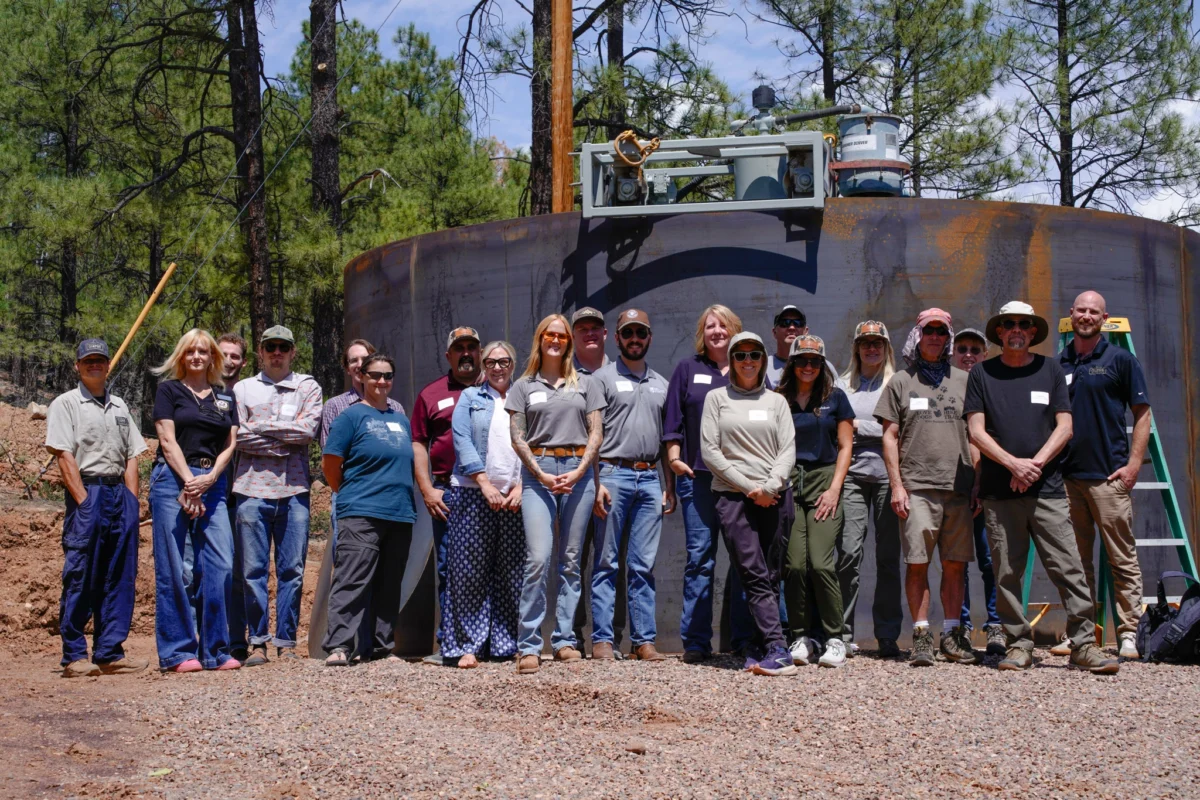
The arid landscape of the American Southwest has long been defined by its relationship with water. As climate variability and prolonged drought conditions continue to place unprecedented stress on the Colorado River Basin, the necessity for a dual-pronged strategy—integrating modern engineering with ecological restoration—has transitioned from a theoretical ideal to an urgent operational requirement. In late August, Audubon Southwest convened a field tour in the White Mountains of eastern Arizona to demonstrate the practical application of this strategy. The tour showcased the critical intersection of "hard" infrastructure, such as piping and storage, and "natural" infrastructure, such as restored meadows and healthy watersheds, illustrating how targeted funding serves as a lifeline for both small municipalities and the state’s broader water security.
Defining the Infrastructure Divide
Water security in Arizona is rarely a monolithic challenge. Experts distinguish between two primary categories of investment: built infrastructure and natural infrastructure. Built, or "hard," infrastructure encompasses the mechanical and structural systems—booster pumps, water meters, storage tanks, and canal systems—that ensure the reliable delivery of water to end-users. Conversely, natural infrastructure refers to the biological and topographical systems that dictate how water moves through a landscape. Forests, alpine meadows, and riparian corridors serve as the original, organic filtration and storage systems for the region. By slowing the velocity of snowmelt and capturing rainfall, these natural features recharge groundwater aquifers and regulate the flow into the massive reservoir systems that sustain urban centers like Phoenix.
Rural Water Challenges: A Case Study in Crisis
The vulnerability of rural water systems was underscored during the tour by a dramatic event in the Heber Domestic Water Improvement District. For years, the district had been preparing for an infrastructure upgrade, securing nearly $4 million in funding from the Water Infrastructure Finance Authority’s (WIFA) Water Supply Development Revolving Fund. The primary goal was to interconnect two disparate systems and install a new storage tank to provide redundancy—a safeguard against system failure.
The urgency of this project was punctuated by a stark reality: just three days prior to the arrival of tour participants, the district’s 50-year-old original tank suffered a catastrophic structural failure, releasing 300,000 gallons of water in under two minutes. Only through the rapid intervention of the district’s operator, who managed to bypass the damaged system using a makeshift hose connection to a secondary tank, was service maintained. This incident serves as a primary example of the "redundancy gap" in rural Arizona, where aging infrastructure is often operated well beyond its intended lifespan. Without the timely allocation of state funds, such failures would result in prolonged service outages, potentially leaving communities without fire protection or potable water.
Further demonstrating the impact of collaborative funding, the tour stopped at Pinedale Estates. Here, a community long plagued by poor water quality—due to naturally occurring mineral deposits—and failing storage infrastructure reached a turning point. By pooling resources and securing loans and grants from both WIFA and the Arizona Department of Environmental Quality, Pinedale Estates transitioned from a piecemeal maintenance strategy to a comprehensive system overhaul. The installation of new groundwater wells and modern storage capacity represents more than just a convenience; it marks the introduction of the first fire hydrants in the community, fundamentally altering the safety and development profile of the area.
Watershed Health and the "Sponge" Effect
While rural utilities focus on the final mile of water delivery, the health of the state’s headwaters provides the foundation for the entire system. The tour’s final destination, the Thompson-Burro Meadow near Mount Baldy, offered a glimpse into how ecological restoration directly benefits urban water supply.
The meadow, located at the headwaters of the Salt River, was severely degraded by the 2011 Wallow Fire. The fire removed vegetation that previously anchored the soil and moderated streamflow, leading to erosion and a decrease in the meadow’s ability to act as a natural water sponge. To rectify this, Trout Unlimited, in coordination with the U.S. Forest Service, initiated a restoration project involving the placement of over 200 woody "log jam" structures. These engineered log jams mimic natural beaver dams, forcing the water to spread out, slow down, and sink into the groundwater table.
The hydrological implications are significant. By reconnecting the river with its floodplain, the project facilitates the growth of native riparian vegetation, such as willows, which further stabilizes banks and filters runoff. This water eventually flows into the Black River and subsequently the Salt River, which is a primary water source for the Phoenix metropolitan area. Effectively, the work being done in the high-altitude forests of the White Mountains functions as a critical upstream component of the Salt River Project, demonstrating that the health of rural forests is intrinsically linked to the reliability of urban tap water.
Financial Landscapes and Public Sentiment
The investment models required to sustain these projects are as varied as the infrastructure itself. Funding for such initiatives is increasingly drawn from a tapestry of sources, including local tax revenues, state revolving funds, federal grants, and philanthropic investments. Recent polling data underscores the political and social gravity of this issue; a significant majority of Arizona voters now view water security in the Colorado River Basin as a top-tier policy priority.
This consensus suggests a shift in public understanding. There is a growing recognition that neither hard infrastructure nor natural restoration can solve the state’s water challenges in isolation. Hard infrastructure provides the immediate, reliable delivery of water, while natural infrastructure provides the long-term sustainability and quality that the mechanical systems rely upon. Without a healthy watershed to capture and filter snowmelt, the efficiency of downstream reservoirs and pipelines is diminished. Conversely, without the built infrastructure to manage and distribute water, even the most pristine watershed cannot meet the needs of a modern population.
Analysis of Future Implications
The implications of the White Mountains tour are clear: Arizona is moving toward an integrated water management paradigm. For policymakers, the lesson is that "preventative maintenance" is an essential category of expenditure. The near-collapse in Heber illustrates the catastrophic potential of deferred maintenance, while the Pinedale Estates project shows how small, targeted investments can provide long-term, compounding benefits.
Furthermore, the scale of restoration projects, such as the one in Thompson-Burro Meadow, highlights a potential pathway for large-scale carbon and water sequestration initiatives. As the state looks to navigate the volatility of the Colorado River, expanding the scope of watershed restoration will likely become a pillar of water management plans. The collaborative nature of these projects—often involving private conservation groups, federal land managers, and state agencies—provides a blueprint for future initiatives that require cross-sectoral cooperation.
The success of these interventions hinges on the continued flow of capital. The Water Infrastructure Finance Authority has emerged as a central pillar in this effort, but the sheer number of rural districts with aging systems suggests that the demand for funding will continue to outpace available resources for the foreseeable future. As the state moves forward, the integration of ecological health into standard engineering protocols will likely define the next generation of Arizona’s water policy. The tour served as a reminder that behind every tap in a metropolitan high-rise lies a complex, fragile, and ultimately interdependent system that stretches back to the highest peaks of the Arizona wilderness. Maintaining this system is not merely an engineering challenge, but an economic and ecological imperative for the future of the state.
