
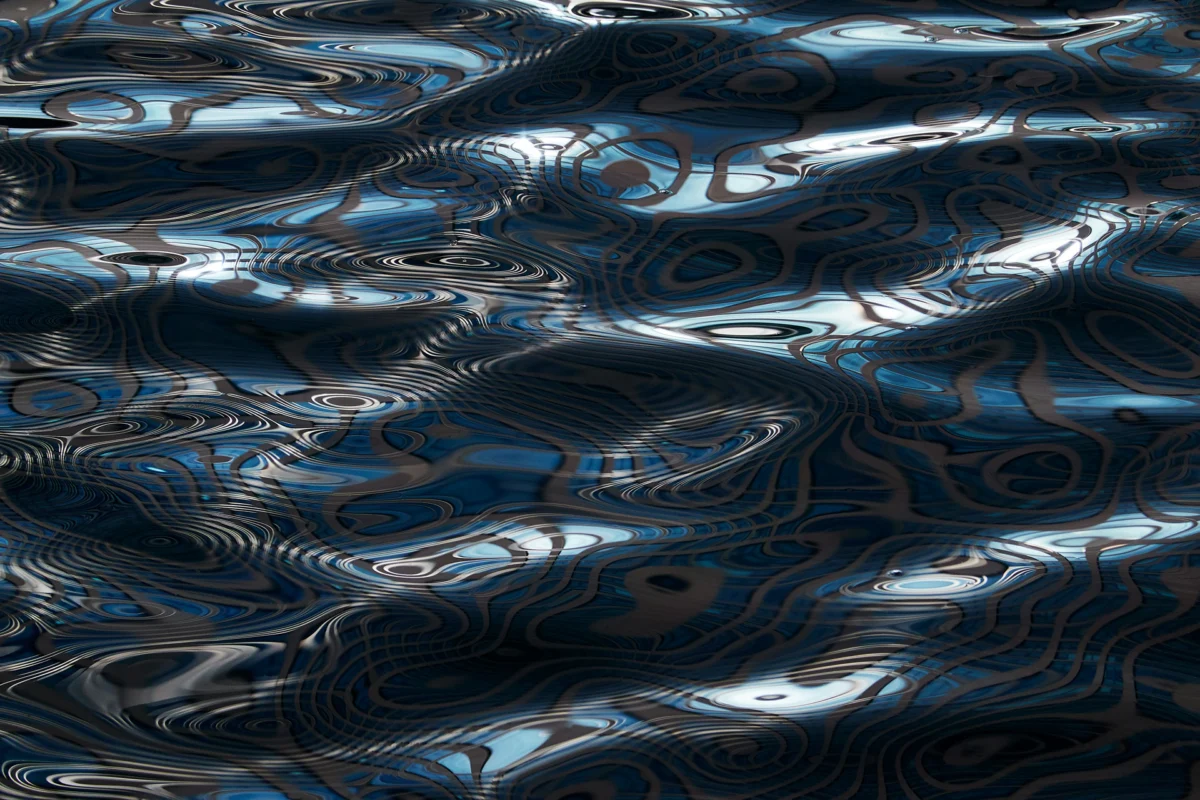
For those encountering the Fleeting Reflections series for the first time, the immediate assumption is almost invariably one of digital fabrication. Viewers routinely look at the vibrant ribbons of color, fractured geometries, and iridescent patterns and credit them to software suites like Adobe Photoshop. Yet, the reality of the imagery lies entirely within the physical realm. The photographs are captured in-camera, utilizing light bouncing off architectural glass and steel, refracted and sculpted by the movement of water. Whether recorded as a single pristine frame or through carefully executed in-camera multiple exposures, the results rely on no digital manipulation, depending instead on physics, timing, and relentless dedication.
The engine driving this body of work is not high-end camera bodies, specialized lenses, or sophisticated digital filters. Rather, the true foundation rests upon a conceptual triad: accessibility, repeatability, and patience. Over a span of more than ten years spent photographing the urban docks of Canary Wharf in London, this methodology has evolved into a masterclass for contemporary nature and abstract photographers seeking profound creative output without the necessity of remote expeditions.

Redefining Nature Photography: The Myth of the Remote Wilderness
Traditional nature and landscape photography often propagates the notion that compelling imagery requires travel to distant, untouched, or dramatic geographies. Photographers frequently feel compelled to chase alpine summits, remote coastlines, or protected wilderness areas to produce work of perceived value. However, the trajectory of the Fleeting Reflections project challenges this premise entirely, demonstrating that profound abstraction and artistic resonance can be extracted from a heavily urbanized, confined environment.
The entirety of the project has been captured within roughly one square mile of dock water enclosed by corporate office towers in East London’s financial district. Rather than viewing Canary Wharf as a sterile concrete and steel jungle, the environment functions as a dynamic, urban light laboratory. The towering glass facades act as primary light sources, projecting color, contrast, and linear frameworks onto the water’s surface. Atmospheric forces, primarily wind and tide, sculpt these reflections into flowing ribbons, jagged waveforms, and geometric fractures.
This geographic proximity eliminates the logistical barriers typically associated with landscape photography. There is no requirement for international flights, special access permits, extended leave, or predawn alpine ascents. The creator can engage with the subject spontaneously—dedicating forty minutes on a whim, working under suboptimal meteorological conditions, or utilizing a rainy afternoon when the water transforms into the visual texture of hammered metal.

Accessibility is the foundational prerequisite of deep creative familiarity. Without the ability to revisit a subject frequently and effortlessly, a photographer remains tethered to surface-level documentation, capturing the obvious rather than investigating the profound.
Repeatability and Environmental Fluidity
The second pillar of this creative framework is repeatability, defined as the selection of a subject that perpetually transforms, defies expectations, and yields novel artistic opportunities with every encounter. Urban waterways bounded by commercial architecture offer this variability in abundance. No single moment at Canary Wharf mirrors another.
A calm morning yields smooth, elongated pulls of pure color, whereas a gusty afternoon shatters the identical architectural structures into serrated lines reminiscent of scientific waveforms or modernist graphic scores. The passage of a commercial vessel or commuter ferry shears reflections into chaotic, hand-drawn gestures, while microscopic films of diesel or industrial residue generate fleeting iridescent interference patterns that vanish within minutes.

This inherent environmental volatility allows for a paradox: photographing the exact physical space thousands of times while continuously producing entirely novel imagery. Extended sessions—sometimes spanning several hours focused on a single square meter of water—reveal a shifting psychological landscape. The pursuit ceases to be architectural documentation and becomes the study of fluid behavior.
Technical mechanisms such as high-speed burst rates are deployed to freeze micro-moments before surface tension collapses, while in-camera multiple exposures layer disparate gestures to enhance existing abstractions. Nevertheless, these technical choices remain secondary to the raw material provided by the environment. The palette shifts continuously with meteorological patterns, geometry bends with air currents, and mood fluctuates with tidal schedules. Without environmental repeatability, a photographer merely captures transient postcards; with it, they construct a definitive, cohesive body of work.
The Unglamorous Core: Patience and Editorial Discipline
While accessibility and repeatability provide the physical framework, patience serves as the psychological anchor of the methodology. Patience operates across multiple dimensions, beginning well before the shutter is ever depressed. Weather conditions must align with personal availability; harsh sunlight on stagnant water produces entirely different results than flat, drizzling overcast light. Reconnaissance walks frequently yield zero usable compositions, underscoring that not all environmental combinations serve the artistic vision.

When conditions align, patience transforms into an exercise in physical endurance. Standing stationary for up to four hours while capturing upwards of 3,000 frames of a seemingly static scene requires immense concentration. The objective is to identify the singular, ephemeral fraction of a second where color, rhythm, structure, and visual tension synchronize. Such moments cannot be rushed; they demand sustained presence.
This rigorous discipline extends directly into the post-production workflow. Upon returning to the studio, the process of reviewing thousands of nearly identical files on high-resolution displays requires brutal editorial honesty. The retention rate is exceptionally low, with the vast majority of frames discarded.
Editing philosophy mirrors this restraint. Processing is executed primarily through global adjustments within Capture One—managing levels, clarity, sharpness, and contrast—while strictly avoiding shape manipulation or synthetic generation in editing suites. The objective is not to manufacture forms, but to reveal the intrinsic structures already present in the medium. This adherence to documentary and technical integrity provides an ethical anchor: the assurance that the events captured genuinely occurred in the physical world.

Chronology of a Decadal Project
The evolution of the Fleeting Reflections project followed a deliberate, unhurried trajectory over many years, underscoring the necessity of long-term artistic maturation:
- 2010–2016: A prolonged period of incubation, quiet fieldwork, and iterative refinement. During these years, the artist deliberately withheld the work from public exhibition, focusing entirely on understanding the nuances of the Canary Wharf docks, defining essential visual elements, and eliminating noise.
- 2017: Publication of the foundational monograph, Fleeting Reflections, by Triplekite Publishing, marking the public debut of the long-term study. This release was accompanied by a prominent solo exhibition at the Greenwich Gallery in London.
- 2019: Expansion of the exhibition footprint with a subsequent showcase at the Anise Gallery in London, further cementing the project’s critical reception within the contemporary photography community.
- 2023: Release of the follow-up volume, Fleeting Reflections II, capturing the evolution of the methodology and expanding upon the visual vocabulary established in the original series.
These milestones demonstrate that sustained creative projects require years of invisible labor. The published books and gallery exhibitions represent merely the visible apex of a pyramid constructed from thousands of hours of field observation, technical refinement, and rigorous editorial rejection.
Implications for Contemporary Photographers
The success of the Fleeting Reflections series offers a clear paradigm shift for photographers grappling with creative stagnation or the logistical burdens of destination photography. The core takeaway is unequivocal: compelling, highly individualized portfolios do not necessitate exotic locales or dramatic topography. Instead, creators are encouraged to identify accessible subjects within their immediate geographic vicinity—be it an urban canal, a municipal harbor wall, an industrial marshland, or even rainwater puddling in a concrete parking structure.

By committing to a local subject and returning through every seasonal shift and meteorological mood, a photographer develops an intimate predictive fluency with their environment. Pairing this familiarity with active patience—defined not as passive waiting, but as an energetic, sustained investment in understanding a subject—yields work characterized by genuine depth. Ultimately, while casual observers may initially respond to the striking colors and abstract shapes within these frames, what they are truly witnessing is the profound weight of sustained human attention.
