
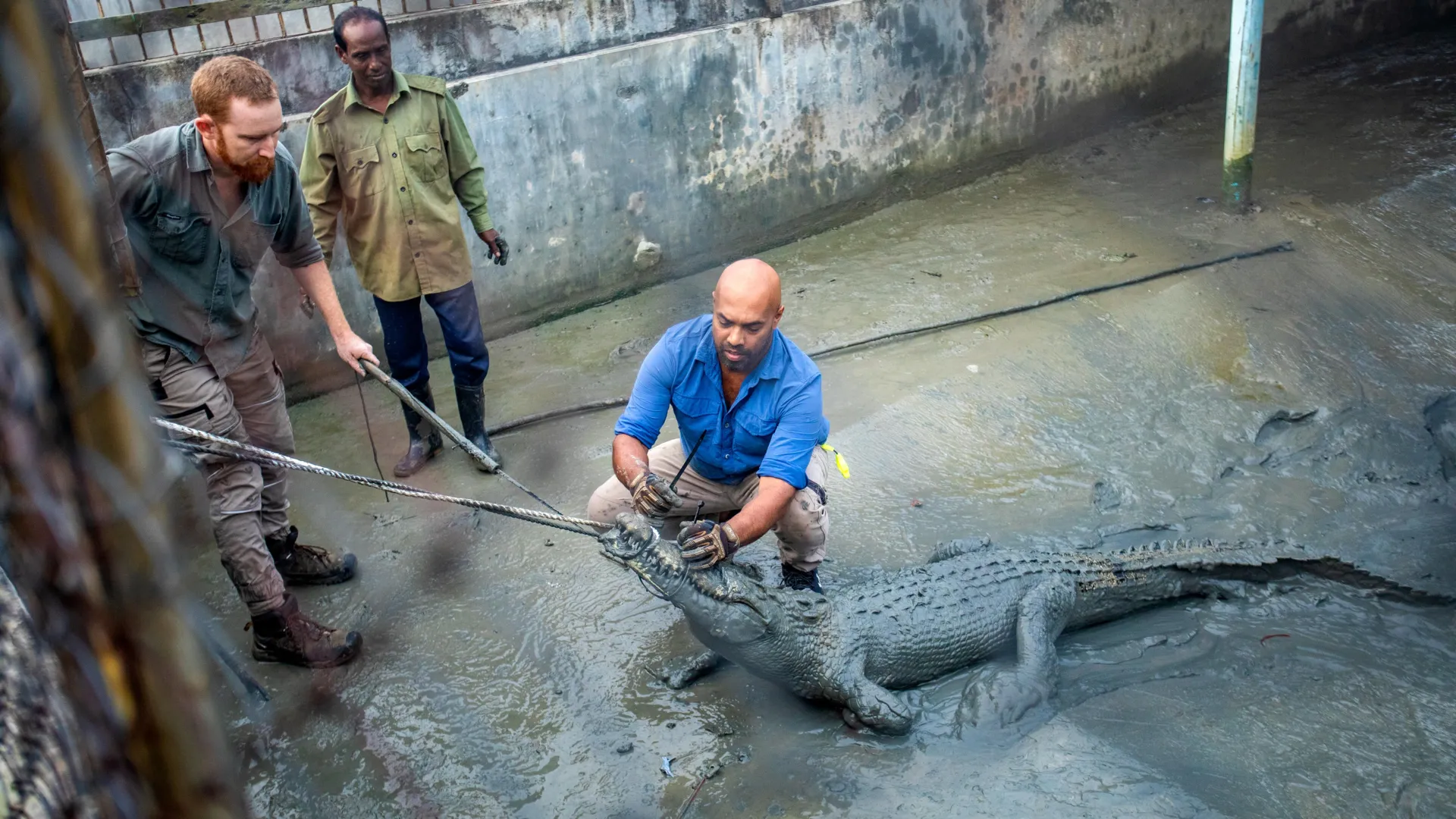
The global effort to restore declining populations of saltwater crocodiles has received a significant boost following the publication of a landmark scientific study. Research conducted in the fragile mangrove ecosystems of Bangladesh indicates that saltwater crocodiles bred or raised in captivity do not exhibit the strong homing instincts that typically complicate animal relocation programs. Instead of attempting to return to their breeding facilities upon release, these mature captive-raised predators successfully integrate into their new environments, offering conservationists a viable new strategy to rebuild dwindling apex predator populations.
The study, titled What is home? Post-release movements of captive-reared and translocated mature saltwater crocodiles in Bangladesh, was recently published in the peer-reviewed journal Wildlife Research. Led by researchers from the International Union for Conservation of Nature (IUCN) Bangladesh and the Bangladesh Forest Department, with funding from the Deutsche Gesellschaft für Internationale Zusammenarbeit (GIZ), the research sheds light on the complex behavioral patterns of crocodilians and addresses a critical knowledge gap that has hindered wildlife management for decades.
Understanding the Homing Instinct in Crocodilians
Navigation and the drive to return to a familiar home range represent fundamental behavioral traits across the animal kingdom, influencing the survival and reproductive success of countless species. While some animals undertake routine daily journeys to return to nests or burrows after foraging, others navigate vast oceanic or terrestrial expanses over periods of weeks, months, or even years.
According to behavioral ecologist and Adjunct Associate Professor Ru Somaweera from Murdoch University, crocodilians occupy a unique position within this ecological framework. As the largest apex predators in tropical, subtropical, freshwater, and brackish environments globally, these reptiles possess an exceptionally powerful homing instinct.
"Crocodiles are remarkably good at finding their way home, often returning to their original capture sites and limiting the success of relocation programs," Professor Somaweera explained. "What we still don’t fully understand, though, is how this behavior plays out in individuals that have been bred or kept in captivity for long periods before being released back into the wild."
Historically, wildlife managers attempting to restock depleted habitats relied heavily on the release of hatchlings. However, this traditional approach presents severe logistical and biological challenges. Hatchling survival rates in the wild are notoriously low due to predation and environmental stressors, and these young animals require many years to reach reproductive maturity. Consequently, conservationists have long debated whether larger, subadult, or adult captive-bred crocodiles could serve as more effective candidates for reintroduction programs. Until now, the behavioral response of these mature captive-reared animals post-release remained largely unstudied.
Historical Context and the Plight of Bangladesh’s Crocodiles
The setting for this pivotal study—the Sundarbans mangrove forest in Bangladesh—underscores the urgent need for innovative conservation strategies. Straddling the delta of the Ganges, Brahmaputra, and Meghna rivers, the Sundarbans represent one of the last major natural strongholds for saltwater crocodiles (Crocodylus porosus) in the region.
During the nineteenth and twentieth centuries, heavy commercial hunting for crocodile skins decimated populations across South and Southeast Asia. In Bangladesh, unregulated harvesting brought saltwater crocodiles to the brink of local extinction by the 1970s. Although the government officially granted the species legal protection under the Bangladesh Wildlife (Preservation) Order of 1973, local populations have failed to show any measurable recovery in the decades since.
Today, the vast majority of Bangladesh’s surviving saltwater crocodiles are restricted to the remote tidal waterways of the Sundarbans. Despite the protected status of the forest and its designation as a UNESCO World Heritage site, the local crocodile population remains precariously small. Recent comprehensive wildlife surveys estimate that the entire region harbors a mere 140 mature individuals. This critically low population density places the species at continuous risk of inbreeding depression, stochastic environmental events, and ongoing human-wildlife conflict.
Methodology and Tracking the Subjects
To determine whether captive-reared adults could be safely introduced to bolster these struggling wild populations, researchers designed a rigorous telemetry study within the Sundarbans. The scientific team selected five mature saltwater crocodiles to be fitted with advanced satellite tracking devices, allowing real-time monitoring of their movements, territory establishment, and behavioral adaptation following release.
The study cohort was deliberately diverse, comprising three distinct categories of crocodiles to compare behavioral outcomes:
- Captive-reared females: Three mature individuals that had spent between 8 and 22 years in continuous captivity within breeding facilities.
- A local wild control crocodile: An indigenous animal captured within the study area and immediately released back into the exact same site.
- A translocated wild crocodile: An adult male wild crocodile, named Jongra, which was captured and then moved a significant distance away from its home territory before being released into unfamiliar waters.
Following the attachment of satellite transmitters, the researchers tracked the daily movements, range expansion, and directional trajectories of all five animals over a period of several months.
Divergent Behaviors: Captive Adaptability Versus Wild Homing
The empirical data yielded striking contrasts between the captive-reared individuals and the translocated wild crocodile, providing crucial insights for future conservation management.
Most encouragingly, the three captive-reared females demonstrated a complete absence of the homing instinct that typically plagues relocation efforts. None of the three animals attempted to navigate back to the breeding facilities where they had spent the vast majority of their lives. Instead, telemetry data revealed that they rapidly established small, well-defined home ranges. Their movement patterns closely mirrored those of the local wild control crocodile, suggesting a seamless and rapid physiological and behavioral adaptation to their natural environment.
"These findings suggest that releasing subadult and adult captive-reared crocodiles can be a viable strategy to strengthen wild populations," Professor Somaweera stated. By bypassing the high-mortality hatchling stage and introducing older, more resilient animals directly into protected habitats, conservationists can potentially accelerate population recovery timelines.
Conversely, the data collected from the translocated wild crocodile, Jongra, highlighted the formidable nature of the natural homing drive in wild-adapted adults. Jongra had been moved approximately 132 kilometers away from his original capture site prior to release.
"Unfortunately, the results weren’t as good for the wild crocodile Jongra, who was translocated about 132km from his home before being released," Professor Somaweera noted. "Although Jongra didn’t make it back to his original capture site during the study, his movements were very clearly going in that direction. He traveled far more each day than any other crocodile we tracked, covered an exceptionally large area, and even recorded single-day movements of more than 30 kilometers: all typical signs of homing behavior."
Such erratic, long-distance movements in unfamiliar territory pose significant risks not only to the animal—which may expend critical energy reserves or traverse high-conflict human settlements—but also to local communities living along riverbanks.
Implications for Global Wildlife Conservation
The publication of this study provides actionable data that extends far beyond the borders of Bangladesh. As wetland habitats face mounting pressures from agricultural expansion, industrial pollution, and climate change, species conservation programs worldwide are increasingly forced to rely on captive breeding and reintroduction frameworks.
For decades, wildlife managers operating in Africa, the Americas, and the Asia-Pacific region have wrestled with the "homing problem." When problem crocodiles or nuisance animals are captured in populated zones and relocated to distant reserves, they frequently embark on arduous journeys to return home, often causing conflicts with humans along the way. Alternatively, when conservationists attempt to restock depleted ecosystems using captive-bred stock, fears of premature abandonment of the release site have limited programmatic ambition.
This research indicates that the behavioral trajectory of a released crocodile is heavily influenced by its developmental history. Because captive-reared individuals lack an established wild home range or historical spatial memory of a specific natal site, they evaluate their release environment through an unbiased lens. Upon finding suitable habitat rich in food resources and shelter, they readily settle into localized territories.
Official Responses and Management Recommendations
Conservation authorities and environmental ministries have welcomed the study’s conclusions as a transformative step forward for freshwater and estuarine biodiversity management. Representatives from the Bangladesh Forest Department emphasized that the empirical evidence provided by satellite telemetry will allow policymakers to refine national species action plans.
Rather than abandoning the relocation of wild nuisance crocodiles, experts stress that such interventions require sophisticated spatial planning and behavioral mitigation. For translocated wild adults, conservationists recommend utilizing natural physical barriers, such as extensive river networks or peninsular geography, to deter homing attempts, alongside rigorous post-release monitoring protocols. Meanwhile, breeding facilities can now be integrated more directly into active population supplementation initiatives by raising selected cohorts specifically for adult-stage release into secure, low-density reserves like the Sundarbans.
As research teams continue to analyze long-term ecological data from the Sundarbans study, the broader scientific community remains optimistic. By demonstrating that captive-reared saltwater crocodiles can successfully transition to independent life in the wild, this study bridges the gap between captive animal husbandry and field conservation, offering a renewed pathway toward saving one of the planet’s most enduring apex predators from the brink of localized extinction.
