
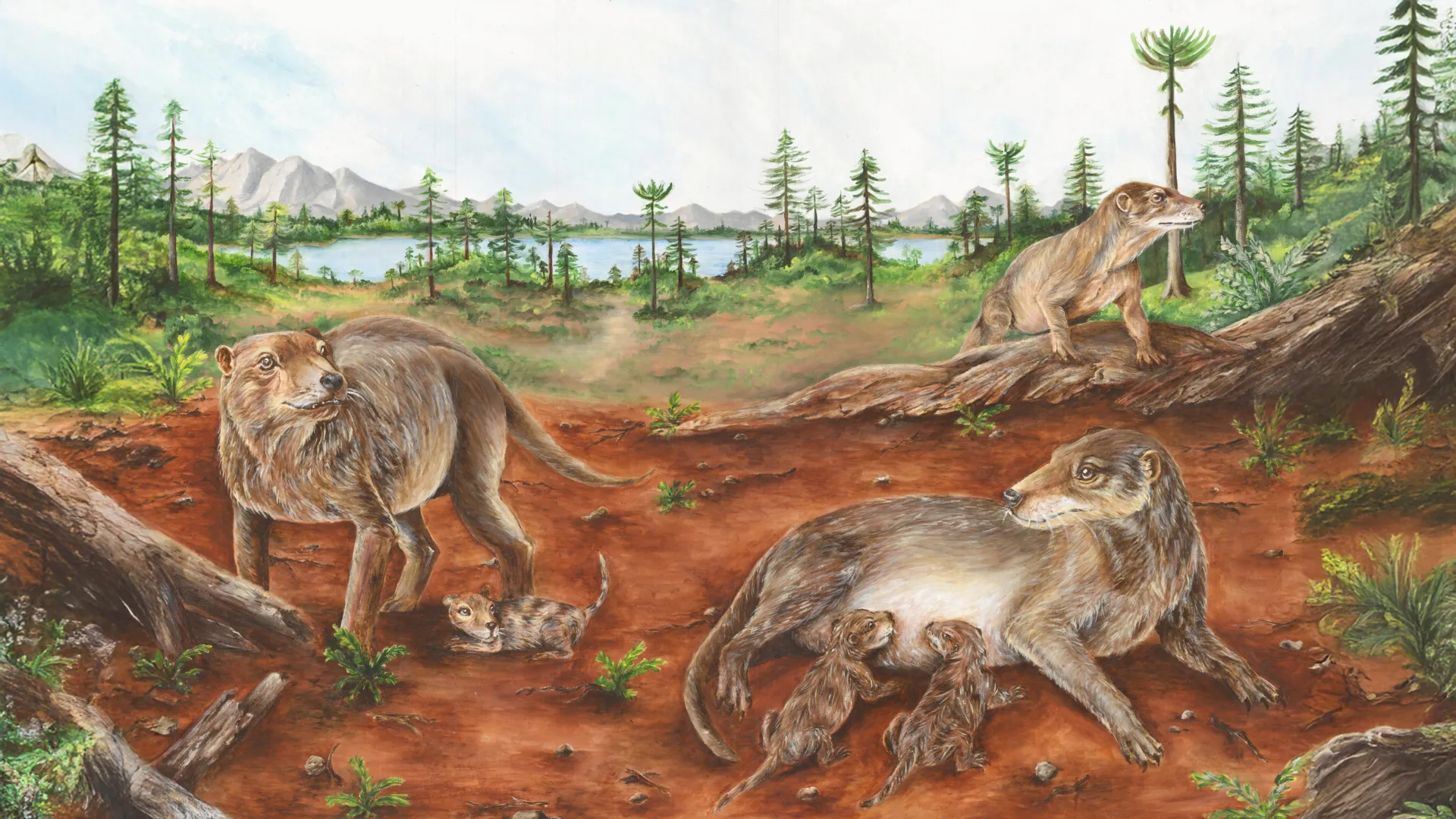
Paleontologists have uncovered compelling new evidence suggesting that the evolutionary timeline for live birth in the mammalian lineage stretches significantly further back than previously understood. According to a landmark study recently published in the scientific journal Frontiers in Mammal Science, at least one ancient mammal ancestor may have bypassed the traditional egg-laying habits of its contemporaries in favor of giving birth to live young. This discovery pushes the historical origins of viviparity—the physiological trait of bearing live offspring rather than laying eggs—back by an estimated 90 to 95 million years, reshaping how scientists view the reproductive strategies of prehistoric fauna.
The research focuses on Chiniquodon theotonicus, a species of cynodont that roamed the earth approximately 236 million years ago during the Triassic period. Cynodonts represent a crucial evolutionary grade of therapsids that ultimately gave rise to modern mammals, including humans. While prior scientific consensus held that early cynodonts reproduced via amniotic eggs akin to modern reptiles and birds, the discovery of a microscopic growth marker within a fossilized C. theotonicus bone suggests a drastically different biological reality.
Main Facts of the Discovery
The breakthrough began serendipitously during a postgraduate research course in Argentina. Paleontologists examining the microscopic internal structure of a fully grown C. theotonicus fossil—excavated from the fossil-rich strata of northwestern Argentina—identified an unusual growth mark. Upon extensive comparison with the bone structures and histology of extant vertebrate species, the research team recognized the feature as a definitive neonatal line.
In modern animals, neonatal lines form as distinct rings within bones or teeth, triggered by the sudden, sharp acceleration of physiological growth that immediately follows birth. The presence of this biomarker in a cynodont fossil provided the crucial missing link required to decode the animal’s reproductive strategy. To validate their hypothesis, the research team developed a novel analytical framework to estimate the body mass of the individual both at birth and at the time of its death.
By measuring the dimensions of the fossilized bones, the team calculated that the C. theotonicus specimen weighed approximately 1.7 kilograms at birth and scaled up to roughly 12 kilograms as a mature adult. This yields a neonate-to-adult body mass ratio of approximately 14 percent—a proportion radically inconsistent with egg-laying amniotes and firmly aligned with the reproductive biology of modern placental mammals.
Chronology and Background Context of the Triassic Environment
To fully appreciate the significance of this discovery, paleontologists must contextualize the harsh environmental pressures of the Triassic period. Following the Permian-Triassic extinction event—the most devastating mass extinction in Earth’s history, which wiped out an estimated 90 percent of marine species and 70 percent of terrestrial vertebrate species—surviving ecosystems underwent a massive restructuring process.
During the Triassic, terrestrial environments were characterized by intense competition for scarce resources, severe predatory pressures, and a prevailing global trend toward aridity and intense seasonal fluctuations. In such volatile conditions, the biological constraints of egg-laying presented severe evolutionary disadvantages. Eggs left in nests are highly vulnerable to environmental desiccation, temperature fluctuations, and opportunistic predators.
Conversely, viviparity offers a mobile, temperature-regulated, and heavily protected environment for developing embryos. Senior study author Adriana Mancuso, a researcher at the National Scientific and Technical Research Council (CONICET) in Argentina specializing in terrestrial ecosystem evolution, noted that these ecological stressors likely served as the primary evolutionary drivers for the development of live birth. The ability to retain embryos internally provided C. theotonicus and potentially other contemporaneous cynodonts with a vital adaptive edge in an unpredictable world.
Comparative Data and Methodological Rigor
Establishing viviparity in the fossil record is notoriously difficult, as soft tissues rarely fossilize, and embryonic remains are exceptionally scarce. To overcome this limitation, lead author Dr. Leandro Gaetano and his colleagues devised an innovative comparative methodology.
The researchers compiled a massive comparative dataset comprising thousands of living mammals, non-avian reptiles, and birds to evaluate neonate-adult body mass ratios across taxonomic groups. Their comparative analysis yielded stark contrasts:
- Reptilian Reproduction: Modern reptiles—including snakes, turtles, and crocodilians with adult body masses ranging from 8 to 14.5 kilograms—produce remarkably small hatchlings. Neonates typically weigh between 9 and 53 grams, resulting in exceptionally low neonate-adult mass ratios of 0.1 percent to 0.6 percent.
- Avian Reproduction: Birds demonstrate similarly modest hatchling proportions. Species such as cranes, pelicans, and vultures with adult weights between 8 and 21.5 kilograms produce offspring weighing 110 to 357 grams, translating to body mass ratios of 1.3 percent to 4.5 percent.
- Mammalian Reproduction: In stark contrast, modern placental mammals of comparable adult sizes (8 to 15 kilograms) exhibit significantly heavier newborns, ranging from 35.5 grams to 1.87 kilograms. Their neonate-adult body mass ratios can soar as high as 18.77 percent.
When the estimated metrics for C. theotonicus were plotted against this comparative spectrum, the fossilized cynodont grouped decisively with extant placental mammals. The bay duiker antelope, for instance, produces offspring that closely match the estimated birth weight of the ancient C. theotonicus specimen. Non-placental mammals—such as egg-laying monotremes and pouch-bearing marsupials, which produce altricial, underdeveloped young—were intentionally excluded from this specific baseline comparison due to their unique reproductive mechanics.
Official Responses and Scientific Reactions
The publication of these findings has reverberated throughout the international paleontological community, sparking renewed debate over the timing of key mammalian physiological traits.
"We show for the first time that live birth was present in at least one mammalian ancestor, Chiniquodon theotonicus, which lived approximately 236 million years ago," stated Dr. Leandro Gaetano during a press briefing following the journal release. "This implies that viviparity among early cynodonts originated in the mammalian lineage at least 95 to 90 million years earlier than previously thought."
Co-author María Miceli Baro, a graduate student at the University of Buenos Aires who contributed to the histological analysis, emphasized the rarity of the find. "In cynodonts, embryonic tissues were never observed before, let alone a neonatal line," Baro noted. "Through its analysis, we found that a trait that is generally linked to evolutionary success was present in animals long before true mammals originated."
Independent paleontologists not directly involved in the study have praised the methodological ingenuity employed by the CONICET research team. By leveraging bone histology and scaling geometry rather than relying solely on the accidental preservation of soft-tissue embryos, the study establishes a powerful new analytical toolkit for investigating the deep-time reproductive biology of extinct vertebrates.
Broader Impact and Evolutionary Implications
The confirmation of viviparity in C. theotonicus challenges long-held dogmas regarding the stepwise acquisition of mammalian traits. Historically, evolutionary biologists viewed live birth as a relatively late physiological innovation that emerged alongside or shortly after the appearance of true mammals (Mammalia) in the Jurassic or Cretaceous periods.
By demonstrating that this complex reproductive strategy was already operational 236 million years ago, the study opens the door to a broader reassessment of cynodont physiology. Researchers now face the compelling possibility that other advanced biological traits traditionally associated with true mammals—such as specialized lactation mechanisms, high metabolic rates, and complex thermoregulation—may also have roots that extend deep into the Triassic period.
Despite the groundbreaking nature of the discovery, the research team remains scientifically cautious. Dr. Gaetano emphasized that while C. theotonicus provides the first concrete evidence of ancient viviparity, additional fossil discoveries and histological analyses will be required to determine whether live birth was an isolated adaptation exclusive to this specific lineage or a widespread reproductive strategy across multiple cynodont groups.
"It is very well possible that C. theotonicus does not represent an isolated case of viviparity among cynodonts," Gaetano concluded. "It could be evidence of the general switch from laying eggs to giving birth to live young early on in the mammalian lineage. But we need more evidence to test this hypothesis. Still, it looks like some cynodonts were in fact very similar to present-day mammals."
As paleontologists continue to re-examine existing museum collections and apply advanced micro-analytical techniques to previously overlooked fossils, the blurred boundaries between ancient reptiles and their mammalian successors continue to sharpen, offering unprecedented clarity into the deep evolutionary origins of modern life.
