
The global landscape of wildlife conservation often hinges on understanding complex animal behaviors that dictate survival, territory, and reproduction. Among the most intricate of these natural drives is the homing instinct—the innate ability of an animal to navigate across vast, unfamiliar landscapes to return to its birthplace or established territory. While this navigational prowess is crucial for species longevity in pristine environments, it has historically presented a major bottleneck for conservationists attempting to restock depleted animal populations. When relocated or released apex predators attempt to return to captivity or human-dense capture sites, reintroduction programs frequently fail, leading to human-wildlife conflict or the mortality of the released specimens.
However, a groundbreaking new study published in the scientific journal Wildlife Research offers a glimmer of hope for one of the world’s most formidable predators: the saltwater crocodile (Crocodylus porosus). According to the research, saltwater crocodiles born or raised in captivity may lack the drive to return to their breeding centers once released into the wild. This unexpected behavioral deviation could fundamentally alter how conservation biologists approach the restoration of declining populations, shifting reliance away from high-mortality hatchling releases toward older, more resilient subadult and adult specimens.
The study, titled What is home? Post-release movements of captive-reared and translocated mature saltwater crocodiles in Bangladesh, was led by the International Union for Conservation of Nature (IUCN) Bangladesh and the Bangladesh Forest Department, with funding provided by the Deutsche Gesellschaft für Internationale Zusammenarbeit (GIZ). By shedding light on the post-release navigation patterns of both captive-reared and wild-caught apex predators, the research provides a vital roadmap for future biodiversity restoration initiatives in South Asia and beyond.
The Ecological Predicament of the Sundarbans
To understand the significance of this discovery, one must examine the precarious state of saltwater crocodiles in Bangladesh, specifically within the sprawling, labyrinthine waterways of the Sundarbans mangrove forest. Spanning the delta of the Ganges, Brahmaputra, and Meghna rivers across Bangladesh and India, the Sundarbans represents the largest contiguous mangrove forest in the world and serves as one of the last major natural refuges for the saltwater crocodile.
Historically, these apex predators reigned supreme across tropical and subtropical freshwater and brackish environments throughout the region. However, heavy commercial hunting for crocodile skins during the nineteenth and twentieth centuries decimated populations. Unregulated hide harvesting severely reduced the species’ numbers in Bangladesh until the practice was finally curtailed in the 1970s.
Recognizing the dire threat of extinction, the Bangladeshi government extended legal protection to saltwater crocodiles in 1973. Despite more than half a century of legislative safeguards, however, population recovery has remained virtually stagnant. According to recent ecological surveys, the nation’s remaining wild saltwater crocodiles are almost exclusively restricted to the Sundarbans, where the population hovers at a critically low level. The most recent comprehensive surveys estimate that there are a mere 140 mature individuals left in the entire country—a number far below the minimum viable population threshold required for long-term genetic health and resilience against stochastic environmental events.
Faced with this stagnation, conservationists have long recognized the urgent need for active intervention through reintroduction and head-starting programs. Yet, these initiatives have been plagued by logistical and biological challenges. Traditionally, conservation programs have relied on releasing hatchlings—very young crocodiles born in captivity or collected as eggs. The rationale was that young animals would naturally imprint on the wild environment and integrate seamlessly into local ecosystems.
In practice, however, this approach has yielded dismal results. Hatchling mortality rates in the wild are astronomically high due to predation by birds, large fish, monitor lizards, and cannibalistic older crocodiles. Furthermore, it takes many years—often over a decade—for a hatchling to reach reproductive maturity, meaning that any investment in juvenile releases takes generations to translate into a measurable population increase.
Conservation biologists have long debated whether utilizing older, larger, captive-bred crocodiles could bypass the perilous hatchling stage. Until now, a primary concern was whether these mature animals, having spent years or decades within concrete enclosures or breeding facilities, would possess the behavioral adaptability required for survival, or conversely, whether their homing instincts would compel them to seek out the only home they had ever known.
Unraveling the Homing Instinct in Crocodilians
Crocodilians are an evolutionary marvel, having survived largely unchanged for millions of years. As the largest predators in their ecosystems, they exhibit sophisticated behavioral repertoires, including complex social structures, targeted hunting strategies, and remarkable spatial memory.
Behavioral ecologist and Adjunct Associate Professor Ru Somaweera from Murdoch University, a leading expert on crocodilian behavior, emphasizes the unique nature of these animals when it comes to spatial orientation. "Crocodilians are a unique case when it comes to homing behavior," Professor Somaweera notes. "Crocodiles are remarkably good at finding their way home, often returning to their original capture sites and limiting the success of relocation programs."
This powerful homing instinct is well-documented in wildlife management. When nuisance crocodiles captured near human settlements are translocated to distant river systems, they frequently display an astonishing ability to navigate back to their original territories, sometimes crossing dozens of kilometers of open water or overland terrain to do so. This behavior not only frustrates human-wildlife mitigation strategies but also poses a severe threat to reintroduction programs. If a crocodile bred and raised in a captive facility is released into a remote protected area, there is a distinct risk that it will attempt to navigate back to the human-managed facility where it was fed and housed, potentially bringing it into conflict with human populations or rendering the conservation release entirely ineffective.
To determine whether long-term captivity dulls this homing drive or if captive-reared adults are fundamentally incapable of orienting toward their birth facilities, researchers designed a targeted tracking experiment within the Sundarbans.
Methodology: Tracking the Apex Predators
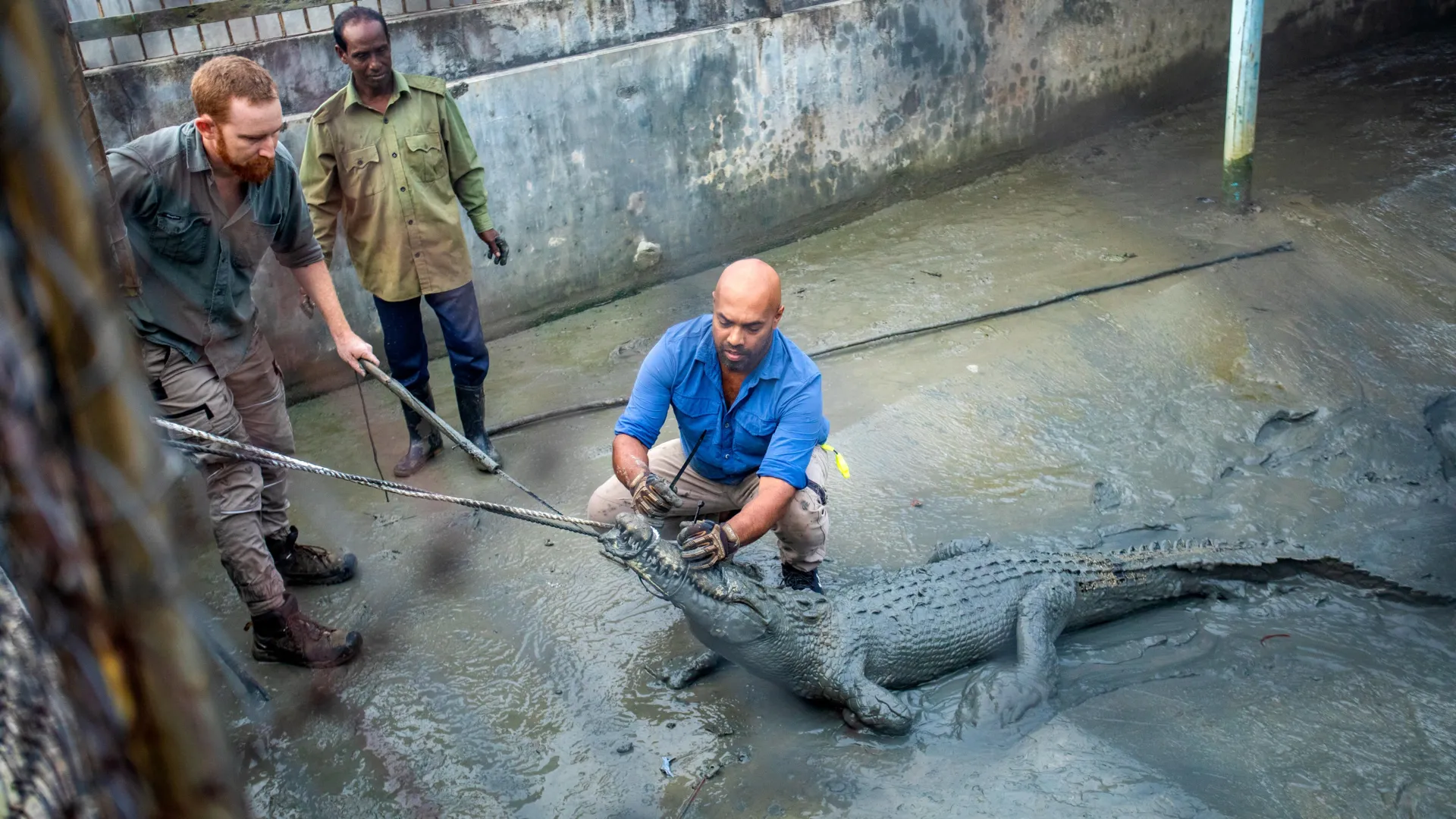
The study deployed advanced satellite tracking technology to monitor the post-release movements of five mature saltwater crocodiles. The test cohort was carefully structured to compare the behaviors of three distinct groups: captive-reared adults, a local wild control crocodile, and a translocated wild crocodile.
The primary subjects of interest were three captive-reared females that had spent between 8 and 22 years of their lives enclosed within breeding facilities. These individuals had never experienced life in the open wild prior to the experiment. To provide comparative benchmarks, the researchers also captured, fitted, and released two wild crocodiles: one local individual that was released immediately back into its capture site, and one translocated wild individual—subsequently named Jongra—that was moved a substantial distance of approximately 132 kilometers away from its home territory before being released.
Satellite telemetry units secured to the scutes of the crocodiles transmitted precise location data over a period of several months following their release, allowing scientists to map their daily movements, home ranges, and directional trajectories.
Divergent Fates: Captive-Reared Resilience Versus Wild Relocation Trauma
When the telemetry data was analyzed, the results provided a clear, albeit contrasting, picture of post-release behavior that challenged long-held assumptions in crocodilian conservation.
The most encouraging discovery centered on the three captive-reared females. Despite having spent up to two decades in controlled, human-managed environments, none of the three animals displayed any behavioral inclination to return to their breeding facilities.
"Instead, they settled into small, well-defined areas and moved in much the same way as the local wild crocodile we tracked, which tells us they are possibly able to adapt to their new environment seamlessly," Professor Somaweera stated.
Rather than panicking, wandering aimlessly, or attempting a long-distance trek back to captivity, the captive-reared crocodiles immediately established home ranges, began foraging independently, and integrated into the spatial dynamics of the Sundarbans ecosystem. This rapid behavioral adaptation indicates that prolonged captivity does not necessarily strip saltwater crocodiles of their fundamental survival instincts, nor does it permanently imprint a homing drive toward the artificial breeding center.
Conversely, the data collected from Jongra, the translocated wild crocodile, highlighted the intense potency of natural homing instincts and the psychological toll of forced relocation.
"Unfortunately, the results weren’t as good for the wild crocodile Jongra, who was translocated about 132km from his home before being released," Professor Somaweera explained. "Although Jongra didn’t make it back to his original capture site during the study, his movements were very clearly going in that direction. He traveled far more each day than any other crocodile we tracked, covered an exceptionally large area, and even recorded single-day movements of more than 30 kilometers: all typical signs of homing behavior."
Jongra’s erratic and exhaustive journey underscored the immense physiological and energetic expenditure associated with homing attempts in wild-adapted adults. While he did not successfully complete the 132-kilometer trek before the study concluded, his purposeful trajectory demonstrated that wild crocodiles possess an unyielding internal compass that can lead to high-stress behavior when they are displaced into unfamiliar waters.
Strategic Implications for Global Crocodile Conservation
The stark contrast between the calm integration of captive-reared crocodiles and the compulsive wandering of the translocated wild crocodile offers immediate, actionable insights for wildlife managers and conservation agencies worldwide.
First and foremost, the findings provide empirical validation for a shift in reintroduction methodologies. Because subadult and adult captive-reared crocodiles do not attempt to return to their breeding centers and are capable of establishing localized home ranges, conservation programs can now consider utilizing older animals in restocking initiatives. Bypassing the vulnerable hatchling phase could drastically improve the success rates of population augmentation projects. Older crocodiles boast significantly higher natural survival rates, possess greater physical defense capabilities against predators, and reach reproductive age much faster, offering a much quicker path toward increasing the wild breeding population.
Second, the study highlights the inherent risks and management challenges associated with translocating adult wild crocodiles. When nuisance animals or predators found in conflict zones are moved to new river systems, their powerful homing instincts often drive them to undertake massive journeys, increasing human-wildlife encounters along the way as the animals traverse populated waterways. The findings emphasize that translocations require meticulous spatial planning, comprehensive pre-release assessments, and, where possible, alternative mitigation strategies that do not involve moving animals across vast distances.
As organizations like the IUCN Bangladesh, the Bangladesh Forest Department, and international partners work to pull the Sundarbans saltwater crocodile population back from the brink of functional extinction, every scientific insight counts. By understanding the psychological and navigational boundaries of these apex predators, conservationists can design smarter, more effective reintroduction protocols.
The complete findings of this critical research, funded by GIZ and executed through collaborative international conservation efforts, have been formally documented in the peer-reviewed journal Wildlife Research, ensuring that the lessons learned in the tidal mangrove forests of Bangladesh can inform crocodilian conservation strategies across the globe.
