
The dense rainforest canopies of Costa Rica are renowned globally for their biodiversity, serving as an ecological haven for countless endemic and migratory species. Among the most iconic residents of these arboreal networks are sloths, slow-moving mammals whose evolutionary design is perfectly tailored for a life spent suspended from branches. However, the rapid encroachment of human infrastructure—specifically uninsulated electrical distribution networks—has introduced a lethal hazard into these ancient habitats. Unlike avian species that navigate the skies or terrestrial mammals that navigate the forest floor, arboreal animals rely heavily on continuous canopy bridges. When these natural pathways are fragmented by utility poles and overhead lines, sloths are frequently forced to traverse man-made cables, resulting in catastrophic outcomes. Surviving a fall from an 11-meter height or withstanding thousands of volts of electrical current is biologically impossible for a mammal, turning the daily commute of a sloth through its native territory into a high-stakes hazard.
The Scale of the Crisis: Analyzing the Hard Numbers
The intersection of wildlife habitats and electrical infrastructure has created an ongoing crisis across Costa Rica. According to data released by the Ministry of Environment and Energy (MINAE) through its environmental divisions, electricity distribution companies reported a staggering 6,703 cases of wildlife electrocutions along power lines in 2024 alone. This figure averages out to more than 18 animals per day falling victim to grid-related trauma over the course of a single year.
While state agencies and utility providers record thousands of incidents annually, wildlife rescue organizations handle only a fraction of the total fallout. For instance, specialized wildlife rescue teams, such as those at the Toucan Rescue Ranch, admitted 17 severely electrocuted animals in 2024—a volume that mirrors just one day of the nationwide statistics. Conservation experts emphasize that for every individual animal that successfully reaches a rehabilitation facility, hundreds more succumb to their injuries immediately in the canopy or perish from slow, systemic trauma without ever being discovered or reported.
The Disproportionate Impact on Arboreal Sloths
Statistical tracking across wildlife clinics highlights a grim reality: sloths are disproportionately affected by power line infrastructure compared to other vertebrate species. Data compiled by rehabilitation centers over a two-year period indicate that sloths account for more than 8 out of every 10 electrocution victims admitted for emergency veterinary care.
Because sloths lack the rapid reflex mechanisms of monkeys or the spatial agility of birds, they often mistake low-hanging, uninsulated electrical wires for sturdy lianas or branches. When a sloth attempts to grasp a live wire to complete its transit across a clearing, the electrical current passes through its body, causing massive thermal burns, severe neuromuscular damage, and internal organ failure. The physical toll is often devastating. Common clinical presentations include severe hair loss, extensive tissue necrosis, and profound skeletal trauma resulting from the subsequent fall to the ground after the shock causes an immediate release of their grip.
Chronology of a Rescue: The Case of Champ
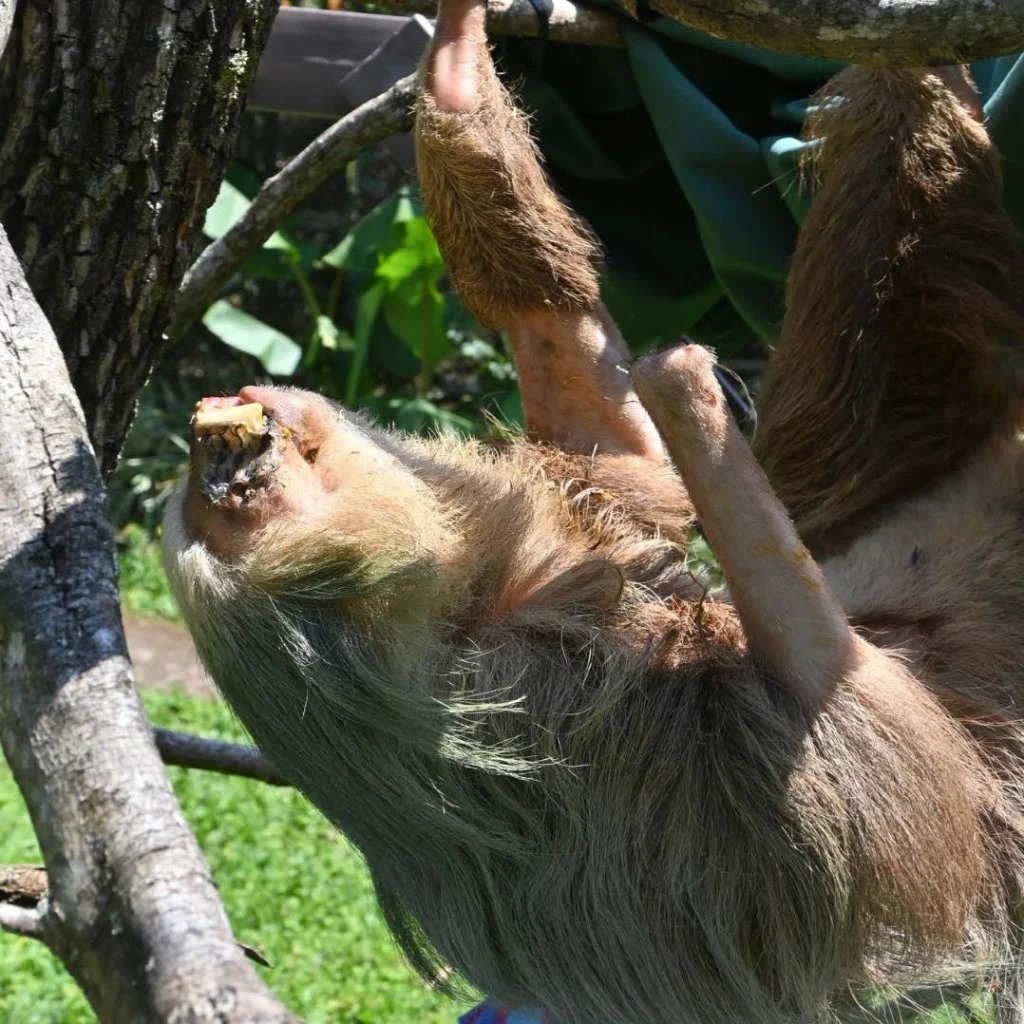
The pathway from trauma to rehabilitation is arduous, requiring specialized medical intervention, extended periods of enclosure, and substantial financial resources. A prominent case exemplifying this struggle is that of Champ, a two-fingered sloth rescued in Guácimo, located in the Limón province of Costa Rica. Discovered by a local police officer following a severe electrical accident, Champ presented with extensive burns across his face, severe trauma to one of his eyes, and catastrophic damage to his limbs.
Upon arrival at the clinic facilities, veterinary surgeons determined that the electrical and impact trauma to one of Champ’s hands was too severe to salvage, necessitating an emergency amputation to prevent fatal systemic infection. The rehabilitation process required months of specialized wound management, pain mitigation, and physical therapy, funded in large part by targeted donor campaigns that raised approximately $1,380 for his specialized care. Cases like Champ illustrate the profound cruelty of infrastructure-related injuries, where survivors are left to navigate permanent physical impairments in an environment that demands absolute physical dexterity.
Institutional Responses and Mitigation Strategies
Recognizing the gravity of the crisis, governmental bodies, utility providers, and conservation organizations have increasingly united to address the structural deficiencies of the national power grid. Historically, the burden of rescue and rehabilitation fell almost entirely on non-governmental organizations (NGOs) and private wildlife sanctuaries. However, collaborative frameworks have evolved to bridge the gap between industrial energy distribution and wildlife preservation.
A key component of this mitigation strategy involves the deployment of anti-climbing devices, insulated cables, and wildlife-friendly infrastructure adaptations. Rescue facilities often serve as testing grounds for utility companies to evaluate the real-world efficacy of various insulation materials and physical barriers designed to deter animals from accessing transformer boxes and high-voltage conductors. These public-private partnerships aim to transform hazardous utility poles into secure zones, thereby reducing the baseline mortality rate across high-density wildlife corridors.
A Legislative Milestone: The National Strategy of 2026
A significant turning point in the national approach to wildlife conservation arrived in June 2026, when the government of Costa Rica officially rolled out a comprehensive national strategy designed to systematically prevent wildlife electrocutions. This legislative and operational framework places binding obligations on public and private electricity providers to systematically insulate dangerous distribution lines, retrofit high-risk transformers, and establish formalized protocols of cooperation with certified wildlife rescue and rehabilitation centers.
The strategy represents a paradigm shift from reactive rescue operations to proactive infrastructure management. By mandating cooperation between energy providers and conservationists, the policy acknowledges that protecting biodiversity is an integral component of national infrastructure maintenance.
Broader Implications for Biodiversity and Public Engagement
The ongoing battle against wildlife electrocutions underscores the broader challenges of balancing technological development with ecological preservation in tropical regions. As urban and agricultural developments continue to expand, the fragmentation of natural habitats will remain a persistent threat to arboreal species unless systemic preventative measures are aggressively scaled.
Conservation leaders emphasize that mitigating this crisis requires a multi-layered approach encompassing structural engineering, legislative enforcement, and public education. Citizen participation plays an indispensable role in the initial survival phase of injured wildlife. Timely reporting of electrocution incidents by private citizens, coupled with proper handling protocols taught to local communities and first responders, directly correlates with higher survival and successful rehabilitation rates.
While the path toward a fully secured electrical grid remains long, the combination of regulatory mandates, institutional partnerships, and grassroots conservation efforts provides a measurable framework for reducing wildlife mortality. Through these sustained interventions, organizations and policymakers continue to work toward an environment where the nation’s diverse canopy dwellers can navigate their historic pathways without encountering life-threatening hazards.
