
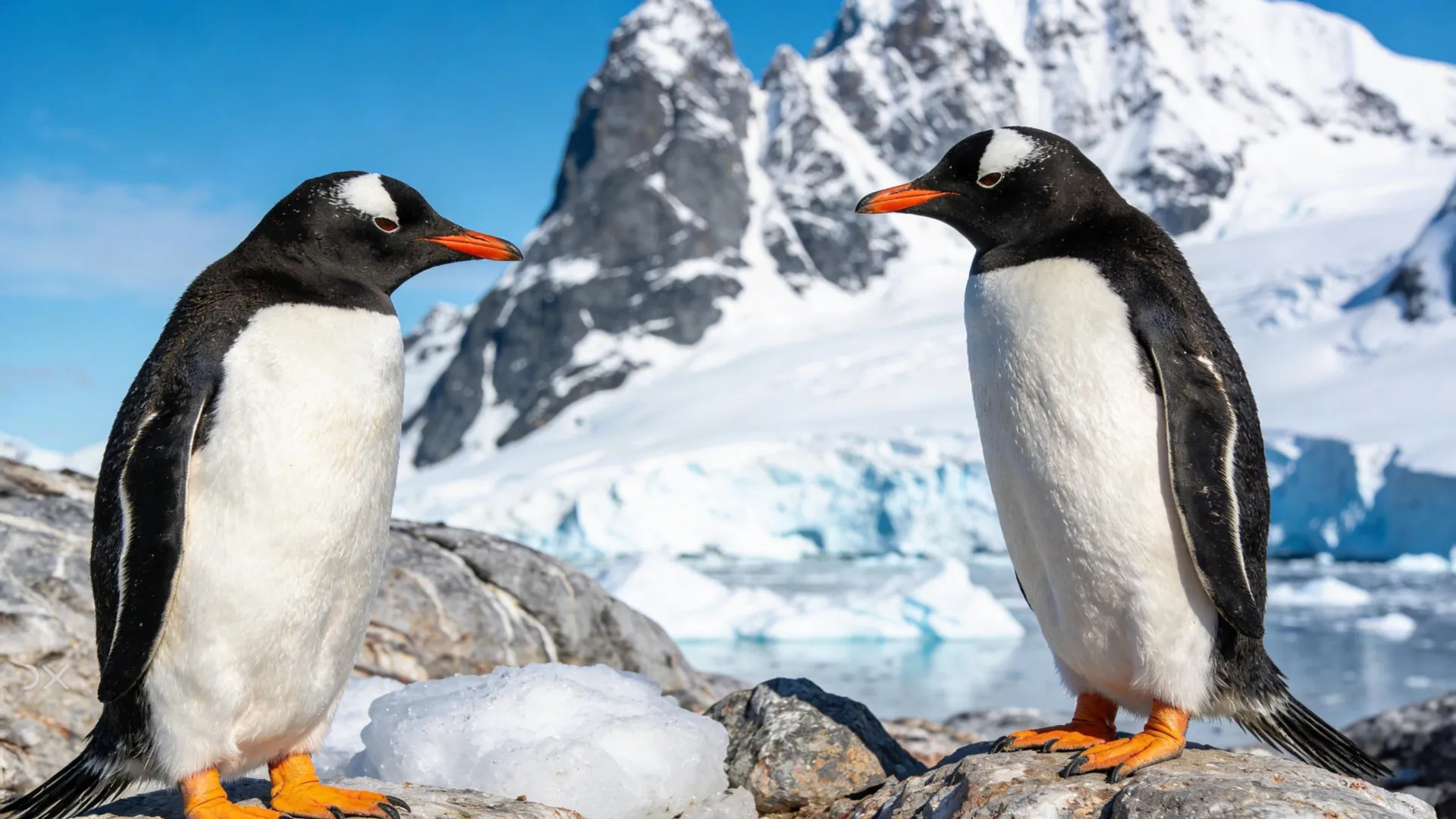
For more than a century, the gentoo penguin (Pygoscelis papua) has stood as an established icon of the sub-Antarctic and Antarctic landscapes. Widely recognized by its characteristic bright orange-red bill, stark white head stripe, and contrasting dark back and white underbelly, the species was long considered a single, cohesive migratory group distributed across scattered archipelagos and the frozen expanses of the Antarctic Peninsula. However, a landmark international genomic study has fundamentally reshaped this classification, revealing that the gentoo penguin is not one uniform species, but four distinct lineages—including one entirely new to science.
Published in the journal Communications Biology, the comprehensive research project brings closure to over a hundred years of intense ornithological debate. Led by an international consortium of scientists from Chile, the United States, and institutions spanning nine other nations, the study utilized whole-genome sequencing to uncover deep genetic divides among populations once thought to belong to a single species. By analyzing thousands of single nucleotide polymorphisms (SNPs) across 64 individual penguins from 10 distinct breeding colonies, researchers have mapped the evolutionary history of the gentoo lineage, highlighting complex patterns of local adaptation, geographic isolation, and the critical conservation implications these newly recognized species face as global temperatures rise.
Resolving a Century of Taxonomic Controversy
The question of how to properly classify gentoo penguins has frustrated evolutionary biologists and taxonomists since the early 20th century. Over the decades, various field researchers proposed anywhere from two to six distinct subspecies based primarily on subtle variations in physical size, geographical distribution, and vocalizations. Yet, without comprehensive genetic sampling covering the entire geographic spread of the birds, a definitive consensus remained out of reach.
To finally settle the debate, a multi-institutional research team joined forces. The effort was spearheaded by senior authors Juliana Vianna, a professor of ecosystems and environment at Andrés Bello National University in Santiago, Chile; Rauri Bowie, a professor of integrative biology and curator at the University of California, Berkeley’s Museum of Vertebrate Zoology; and Elie Poulin, a professor at the University of Chile. Daly Noll, a graduate student at the University of Chile, served as the paper’s first author and directed the intensive genomic data processing.
By securing tissue and blood samples from nearly the entire global range of gentoo penguins, the team constructed the most complete genomic dataset ever assembled for the genus Pygoscelis. When the researchers compared the whole-genome sequences alongside physical traits, dietary preferences, and breeding schedules, the data revealed an undeniable truth: the single gentoo category masked four genetically isolated species.
Three of these groups had previously been classified as regional subspecies, but their genetic divergence is now recognized as deep enough to warrant full species status. Most notably, a fourth population—isolated on the remote Kerguelen Islands, often referred to in French as the Desolation Islands—had never been formally recognized as distinct. Though it closely resembles other gentoos in appearance, its genome tells a different story, making it the first new penguin species formally named in more than a century. Scientists have classified this newly identified bird as a "cryptic species," defined as two or more morphologically similar species that are genetically distinct and do not interbreed.
A Chronology of Speciation and Southern Ocean Dynamics
To understand how these four distinct species emerged, researchers had to look far back into the geological and climatic history of the Southern Hemisphere. Previous collaborative work by Bowie and Vianna, published in 2019, established that the broader penguin family originated near the coasts of Australia and New Zealand approximately 22 million years ago.
Over millions of years, as continental drift rearranged the globe, different lineages diverged. The ancestors of Emperor and King penguins split early, with Emperors eventually becoming tied to the fast ice of Antarctica, while Kings established themselves across sub-Antarctic islands. Around 12 million years ago, a critical oceanographic milestone occurred: the establishment of the Antarctic Circumpolar Current. This massive oceanic conveyor belt helped drive the dispersion of other penguin groups, allowing them to colonize isolated sub-Antarctic archipelagos and eventually reach as far north as the coasts of Africa and South America.
The ancestral gentoo lineage benefited from an evolutionary trait that set it apart from many of its relatives: dietary flexibility. While specialized predators like Emperor and Adélie penguins rely heavily on predictable abundances of Antarctic krill, gentoos evolved as opportunistic generalists. They consume a wide variety of prey depending on local availability, including fish, squid, cuttlefish, and various crustaceans.
Because gentoos are not forced to undertake massive migrations in search of a single preferred food source, they tend to remain relatively close to their breeding colonies year-round. Over hundreds of thousands of years, this localized residency trapped populations on isolated islands and archipelagos. Natural selection, combined with geographic barriers, drove the divergence of these isolated groups. Researchers estimate that the four gentoo species split from one another between 300,000 and 500,000 years ago.
Geographic isolation was further reinforced by the Antarctic Polar Front—a powerful, dynamic oceanographic boundary in the Southern Ocean where cold, acidic Antarctic surface waters meet warmer, saltier sub-Antarctic waters. This sharp thermal and chemical shift acts as a formidable ecological barrier, restricting the movement of marine life and effectively locking different gentoo populations into their respective climatic zones.
The Four Distinct Gentoo Lineages
The genetic and ecological mapping resulting from the study clearly delineates the four species of gentoo penguins across their respective habitats:
- The Southeastern Gentoo (Pygoscelis kerguelensis): This is the newly recognized species. Living nearly 2,000 miles away from any permanently inhabited landmass on the Kerguelen Islands and likely the nearby Heard Island, this population evolved in close proximity to the Antarctic Polar Front. Its small population size and extreme isolation make it a subject of immediate conservation interest.
- The Eastern Gentoo (Pygoscelis taeniata): Distributed north of the Polar Front in warmer, saltier waters, this lineage inhabits the Crozet, Marion, and Macquarie Islands. Genomic data shows this species has developed specific genetic adaptations for efficient carbohydrate metabolism and enhanced diving performance, enabling prolonged foraging in oceans with lower biological productivity.
- The Northern Gentoo (Pygoscelis papua): Restricted to the Falkland (Malvinas) Islands and Martillo Island off South America, this species exhibits genetic enrichments linked to digestion, heart contraction, and muscle excitation, supporting the sustained physical exertion required for its specific foraging behaviors.
- The Southern Gentoo (Pygoscelis ellsworthi): Inhabiting the Antarctic Peninsula, coastal Antarctica, and South Georgia Island, this is the most populous of the four species. It is the only gentoo lineage living in true Antarctic conditions and carries genetic adaptations associated with heat production, specialized fat and lipid storage, and advanced light perception to cope with dramatic seasonal shifts in polar daylight and intense glacial glare.
Local Genetic Adaptations Revealed Through Genomics
The inclusion of thousands of single nucleotide polymorphisms (SNPs) in the genomic analysis allowed the research team to map how each species tailored its biology to survive in starkly different environments. Daly Noll noted that these genetic signatures provide a clear window into evolutionary pressures.
For instance, the southern gentoo (Pygoscelis ellsworthi) displays genomic modifications that enable it to thrive amid freezing temperatures and shifting sea ice. Its genetic profile reveals expansions in pathways governing lipid metabolism, which are essential for maintaining insulation in sub-zero waters. Conversely, the eastern lineage (Pygoscelis taeniata) possesses distinct genetic markers associated with oxygen transport, blood vessel formation, lung development, and mitochondrial activity. These physiological adaptations allow the eastern gentoo to dive deeper and remain submerged longer in nutrient-poorer northern waters to secure sufficient food.
These findings highlight that what was once treated as a single species with a generalized survival strategy is actually a complex mosaic of finely tuned, locally adapted evolutionary units.
Conservation Implications in a Warming Climate
As global climate change rapidly alters polar and sub-Antarctic ecosystems, the formal recognition of these four distinct species carries profound conservation consequences. The research team utilized predictive climate models to project the availability of suitable gentoo habitats through the year 2050.
Under moderate climate change scenarios, the results point toward a stark divergence in fortunes. The island-dwelling sub-Antarctic species—particularly the newly identified southeastern gentoo on the Kerguelen Islands and the eastern gentoo populations—face a precarious future. Climate models suggest these species could lose significant portions of their suitable terrestrial breeding habitat, with few or no alternative islands available for migration due to the immense distances separating sub-Antarctic landmasses.
Juliana Vianna emphasized that island-endemic seabirds are uniquely vulnerable. "In terms of climate change, island species that have really low population sizes could be compared with the sub-Antarctic gentoo penguins," Vianna explained. "Galapagos and other island penguin species, because they’re endemic to these islands, will find no place to go after a change in their environment. Those islands are very isolated, and these penguins cannot adapt easily to colonize any other region."
Conversely, the southern gentoo (Pygoscelis ellsworthi) inhabiting the Antarctic Peninsula and coastal Antarctica may experience different pressures. As regional conditions shift, its suitable terrestrial range is projected to expand farther south onto the continent. While other Antarctic specialists—such as Emperor (Aptenodytes forsteri), Adélie (Pygoscelis adeliae), and chinstrap (Pygoscelis antarctica) penguins—are currently experiencing population declines due to shrinking sea ice and the collapse of sub-ice krill stocks, gentoos have demonstrated resilience by expanding their presence on the Antarctic Peninsula.
However, climate change is far from the only threat confronting these populations. Conservationists warn that sub-Antarctic and Antarctic penguins face a compounding array of anthropogenic pressures, including warming ocean temperatures, industrial fisheries competing for krill, habitat destruction, accidental entanglement in fishing gear, and invasive predators such as rats and dogs introduced to remote islands.
Furthermore, because these isolated sub-Antarctic islands fall under the jurisdiction of multiple nations—including Chile, France, South Africa, Australia, New Zealand, the Netherlands, and the United Kingdom—protecting the newly defined species will require unprecedented international cooperation. Vianna stressed the urgency of this regulatory alignment, noting that conservation institutions across all involved countries must officially recognize the new taxonomic classifications and enact tailored management plans to safeguard the three vulnerable sub-Antarctic species.
The Broader Value of Whole-Genome Sequencing in Wildlife Protection
Beyond resolving a century-old biological debate, the dataset compiled by Bowie, Vianna, Poulin, Noll, and their global collaborators represents a powerful tool for modern conservation science. As wildlife populations face mounting anthropogenic and pathogenic pressures, the ability to read and interpret entire genomes is transforming how scientists assess extinction risks.
Rauri Bowie noted that the methodologies developed during the gentoo study have immediate applications for monitoring other wildlife crises. Currently, Vianna and her colleagues are actively analyzing penguin genomes to identify genetic variations associated with natural resistance or vulnerability to avian influenza, a rapidly spreading pathogen that has devastated wild bird, penguin, and marine mammal populations across the globe. By identifying which populations carry genetic markers for resilience, conservationists can better prioritize intervention strategies and allocate limited resources to the most vulnerable groups.
"Whole genome sequencing has transformed our ability to not only look at adaptation from a perspective of how things diversify, but it has really important conservation value," Bowie said.
As the scientific community formally adopts the classification of four distinct gentoo species, this comprehensive genomic study underscores how much remains hidden within Earth’s most remote ecosystems. By marrying historical taxonomy with cutting-edge genomics, researchers have not only rewritten the family tree of one of the Southern Hemisphere’s most recognizable birds, but they have also provided the essential baseline data required to protect them before a changing planet leaves them stranded.
