
For generations, the conventional wisdom of paleontology and molecular biology was built upon a bedrock of decay. Scientists universally maintained that the process of fossilization—a transformative millennia-long replacement of biological tissues by minerals—utterly eradicated original organic molecules. Under this long-standing paradigm, delicate biomolecules such as proteins, DNA, and soft tissues were mathematically and chemically expected to degrade completely within thousands, or at most a few million, years. The notion that anything more than rock-hard minerals could survive from the Mesozoic Era was widely dismissed as scientifically implausible, chalked up either to wishful thinking or modern contamination.
However, a groundbreaking study led by the University of Liverpool has shattered this decades-old dogma. Providing the most robust and compelling evidence to date, an international team of researchers has confirmed that traces of original organic materials, specifically ancient collagen, can indeed survive inside Mesozoic dinosaur bones and teeth. Published in the peer-reviewed journal Analytical Chemistry, this landmark discovery injects definitive empirical data into a contentious scientific debate that has quietly simmered within academic circles for roughly thirty years.
By employing state-of-the-art analytical chemistry techniques, the research team successfully detected remnants of collagen within the hip bone of an Edmontosaurus, a massive duck-billed dinosaur that roamed North America during the Late Cretaceous epoch. This revelation not only validates earlier, highly contested claims of ancient biomolecule survival but also promises to fundamentally reshape how paleontologists study extinct species, opening a radical new frontier at the intersection of paleontology, mass spectrometry, and molecular biology.
An Exceptional Specimen from the Hell Creek Formation
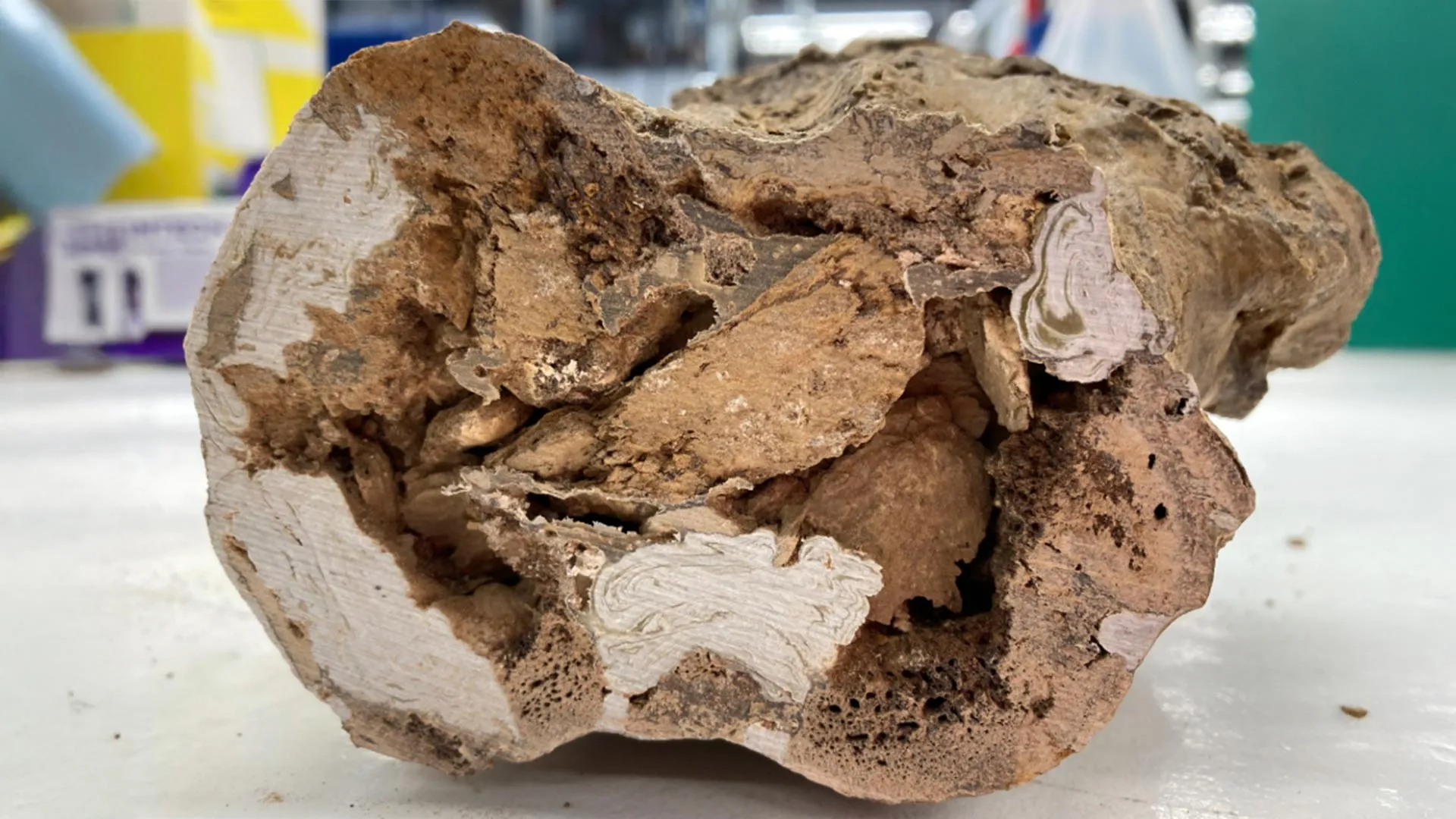
At the heart of this scientific breakthrough is an unusually well-preserved 22-kilogram sacrum—a fused group of vertebrae connected to the pelvis that forms part of the lower spine—belonging to an Edmontosaurus. The fossil was originally excavated from the richly fossiliferous Upper Cretaceous rock layers of the Hell Creek Formation in South Dakota. Famed among paleontologists worldwide, the Hell Creek Formation preserves a diverse ecosystem of flora and fauna dating from immediately before the Cretaceous-Paleogene extinction event, the catastrophic impact that wiped out non-avian dinosaurs approximately 66 million years ago.
Following its excavation, the specimen found its permanent home within the scientific collections of the University of Liverpool. Because of its exceptional preservation—free from the intense structural degradation that affects many other fossils found in the region—the sacrum presented an unprecedented opportunity. It allowed researchers to apply ultra-sensitive modern analytical technologies that were utterly unavailable to previous generations of scientists.
To interrogate the bone matrix, the multidisciplinary research team utilized a combination of advanced methods, prominently featuring protein sequencing, tandem mass spectrometry, and high-resolution chemical assays. Mass spectrometry, a sophisticated analytical technique that identifies molecules by precisely measuring their mass-to-charge ratios and chemical properties, proved instrumental. It enabled the team to hunt specifically for molecular signatures and peptide sequences matching collagen, the primary structural protein that makes up the organic scaffolding of vertebrate bone.
Resolving a Three-Decade Scientific Controversy
The question of whether organic molecules can survive deep time is not new; it has been the subject of fierce debate and skepticism for approximately three decades. When pioneering researchers first reported finding soft tissues and cellular structures in dinosaur bones during the 1990s and 2000s, the broader scientific community reacted with intense skepticism.
The primary critique leveled against these historical discoveries was the "contamination hypothesis." Critics argued with considerable justification that any organic material detected in ancient fossils could not possibly be indigenous to the dinosaur. Instead, skeptics asserted that the proteins were modern interlopers—introduced via microbial biofilms, groundwater percolation, soil contamination, or handling by excavators and museum curators. Because proteins degrade naturally through hydrolysis and microbial attack, the burden of proof required to demonstrate endogenous dinosaur protein was astronomically high.
The new study from Liverpool directly confronts and dismantles this primary objection. Professor Steve Taylor, chair of the Mass Spectrometry Research Group at the University of Liverpool’s Department of Electrical Engineering & Electronics, emphasized the definitive nature of their findings.
"This research shows beyond doubt that organic biomolecules, such as proteins like collagen, appear to be present in some fossils," Professor Taylor stated. "Our results have far-reaching implications. Firstly, it refutes the hypothesis that any organics found in fossils must result from contamination."
By applying rigorous chemical isolation protocols and utilizing cutting-edge detection equipment, the team was able to distinguish between modern environmental proteins and deeply degraded, ancient peptide sequences locked securely within the mineralized hydroxyapatite matrix of the Edmontosaurus bone.
A Multidisciplinary Assault on the Molecular Mystery
Achieving this level of certainty required a massive, coordinated effort spanning multiple specialized research institutions and analytical disciplines. The project combined the expertise of protein chemists, materials scientists, and mass spectrometry experts.
Researchers from the University of California, Los Angeles (UCLA) played a critical role in the investigation by utilizing tandem mass spectrometry to detect and quantify—for the first time in this context—the amino acid hydroxyproline. Hydroxyproline is a major component of the protein collagen and plays a key role in stabilizing its triple-helix structure. Because this specific amino acid is exceptionally rare outside of collagen and related structural tissues, finding it securely embedded within the fossilized bone provided an unmistakable chemical fingerprint confirming the presence of degraded collagen.
Simultaneously, the University of Liverpool’s Mass Spectrometry Research Group conducted rigorous protein sequencing and mass spectrometry tests to map out the surviving peptide chains. Additional analytical backup was provided by specialists at the University’s Materials Innovation Factory, who carried out complementary material analyses to verify the structural integrity of the samples. Furthermore, the Centre for Proteome Research at Liverpool successfully identified specific fragments of collagen alpha-1, the predominant form of collagen found in vertebrate bone tissue.
This convergence of multiple independent analytical pipelines created an airtight evidentiary chain, leaving little room for doubt that the detected molecules were ancient and intrinsic to the dinosaur bone.
Unlocking Archives: A Century of Microscopy Yields New Clues
Beyond validating the existence of ancient proteins in a single Edmontosaurus specimen, the study introduces a powerful predictive tool that could revolutionize how museums and universities select fossils for future molecular testing.
For roughly a century, paleontologists and geologists have utilized cross-polarized light microscopy to examine thin sections of fossilized bone. This specialized lighting technique reveals intricate internal crystalline structures that are typically invisible under standard brightfield microscopies. Historically, these images were used primarily to study histology—the microscopic anatomy of bone growth, vascular canals, and cellular spaces.
However, Professor Taylor and his colleagues suggest that these historical archives of microscopic images should be urgently revisited. The study indicates that specific visual anomalies and intact patches of bone structure visible in century-old cross-polarized light micrographs may actually represent preserved domains of fossil collagen.
If this hypothesis holds true, museums and university departments around the world are sitting on a massive, ready-made trove of pre-identified fossil candidates. Instead of engaging in destructive and time-consuming molecular screens of random bones, researchers could use existing microscopy data to pinpoint specimens with the highest likelihood of yielding preserved organic signatures. This could dramatically accelerate the rate of discovery in the emerging field of molecular paleontology.
The Enigma of Deep-Time Preservation
While the discovery powerfully confirms the reality of ancient biomolecules, it simultaneously deepens one of the most fascinating mysteries in modern science: How on earth do proteins manage to survive intact, or even partially intact, for tens of millions of years?
Under standard laboratory conditions, proteins break down relatively quickly as peptide bonds undergo hydrolysis. Natural background radiation, thermal fluctuations, and bacterial action over 75 million years should theoretically reduce any organic molecule to its constituent amino acids and eventually into simple gases. Yet, against all biochemical expectations, tiny fractions of these molecules persist.
Current theories point toward a process known as "mineral encapsulation." When a bone fossilizes rapidly under specific geochemical conditions, inorganic mineral crystals—specifically hydroxyapatite—can grow tightly around and within the protein fibrils. This physical shielding effectively isolates the delicate organic strands from water, oxygen, and microbes, acting as a microscopic molecular vault. Furthermore, the cross-linked nature of collagen makes it inherently more resilient than other cellular proteins.
Nevertheless, fully understanding the chemical kinetics of preservation over geological timescales remains a major challenge. Theorists and geochemists will need to construct sophisticated models to account for how these peptide bonds withstood the ambient heat and pressure of burial over millions of years.
Broader Impacts and Implications for Evolutionary Biology
The resolution of this long-running debate opens expansive new vistas for the study of extinct life forms. For generations, paleontologists have relied almost exclusively on osteology—the study of bone shapes, sizes, and skeletal architecture—to reconstruct the evolutionary trees of dinosaurs and other extinct creatures. While morphology is immensely powerful, it has distinct limitations, particularly when dealing with fragmentary remains or convergent evolution, where unrelated species develop similar physical traits due to shared ecological niches.
Accessing molecular data changes the equation entirely. By successfully recovering and sequencing ancient proteins from dinosaurs, scientists gain access to a completely independent stream of biological information. Much like modern genetic sequencing has revolutionized phylogenetics—allowing biologists to map out precise family trees based on DNA—ancient protein sequencing (often referred to as paleoproteomics) can reveal deep evolutionary relationships that remain obscure through anatomy alone.
Because proteins are direct translations of genetic code, comparing ancient amino acid sequences across different dinosaur taxa could eventually allow researchers to chart the molecular lineage of dinosaurs with unprecedented precision. It may shed light on metabolic rates, soft tissue adaptations, and the precise evolutionary pathways that connected non-avian dinosaurs to modern birds.
As analytical technologies continue to advance in sensitivity and resolution, the boundary between what is lost to deep time and what can be recovered continues to shift. The University of Liverpool’s definitive detection of collagen in an Edmontosaurus sacrum marks a watershed moment, closing the book on decades of skepticism and opening a brilliant new chapter in our quest to understand the ancient living world.
