
The Canadian province of Manitoba recently hosted an intensive five-day ornithological expedition from March 10 to March 14, 2026, showcasing the region’s unique status as a premier destination for winter birdwatching and raptor research. Organized by Eagle-Eye Tours, the excursion successfully documented a wide array of boreal and prairie species, including several elusive owl varieties that draw international enthusiasts to the Canadian Prairies during the late winter months. This period is particularly significant for avian observation as it marks the transition between deep winter residency and the early stages of spring migration, providing a rare window into the lives of species that are often nomadic or highly secretive.

The expedition commenced on March 10 with a formal orientation and keynote presentation at the Oak and Grain in Winnipeg. The highlight of the opening evening was a lecture by Dr. Jim Duncan, a leading authority on Manitoba’s owl populations and the author of several definitive works on the Great Grey Owl (Strix nebulosa). Dr. Duncan was accompanied by Oska, a captive Great Grey Owl used for educational outreach. His presentation detailed decades of conservation work and population monitoring, emphasizing the ecological importance of the Great Grey Owl, which serves as Manitoba’s official provincial bird. The presence of Oska allowed participants to observe the intricate feather structures and facial discs that enable these raptors to hunt by sound through deep snow—a biological adaptation essential for survival in the subarctic climate of the Canadian Shield.
On March 11, the second day of the tour, the focus shifted to the agricultural landscapes south of Winnipeg. The group traveled to the town of Oak Bluff, an area characterized by vast, open fields that mimic the Arctic tundra, making it an ideal wintering ground for the Snowy Owl (Bubo scandiacus). The morning began with the sighting of a pair of Grey Partridges, a non-native species that has successfully naturalized in the prairie provinces. As the group traversed gravel roads, they encountered numerous Horned Larks, which are among the earliest migrants to return to the region, and a Rough-legged Hawk, a raptor that breeds in the high Arctic and winters in southern Canada.

The primary objective of the morning was achieved near the town of La Salle, where the group observed two distinct Snowy Owls. The first was described as an "all-white ghost bird," likely an older male, while the second was an immature bird with significant dark barring. These sightings are consistent with irruptive migration patterns, where Snowy Owls move south in search of lemmings or other small mammals. The data collected from these sightings contribute to broader citizen-science initiatives like eBird, helping researchers track the health and distribution of these sensitive species.
In the afternoon of March 11, the expedition moved into urban and suburban environments to observe how large raptors adapt to human-altered landscapes. At Bunn’s Creek, the group located a nesting pair of Great Horned Owls (Bubo virginianus). The female was observed on the nest, with downy feathers of newly hatched chicks visible, while the male stood guard in a nearby tree. This sighting underscores the resilience of the Great Horned Owl, which is one of the earliest nesters in North America, often laying eggs in February despite sub-zero temperatures. Additionally, the group observed a pair of Pileated Woodpeckers, the largest woodpecker species in North America, whose presence indicates a healthy forest canopy with sufficient decaying wood for foraging.

The third day, March 12, was dedicated to the boreal transition zones along Highway 317 and the Lac du Bonnet region. The primary target for the day was the Northern Hawk Owl (Surnia ulula), a diurnal raptor that behaves more like a hawk than a traditional owl, often perching on the highest available branches to scan for prey. The group successfully located a specimen that had been frequented by previous tours, providing an opportunity for detailed photography and behavioral study.
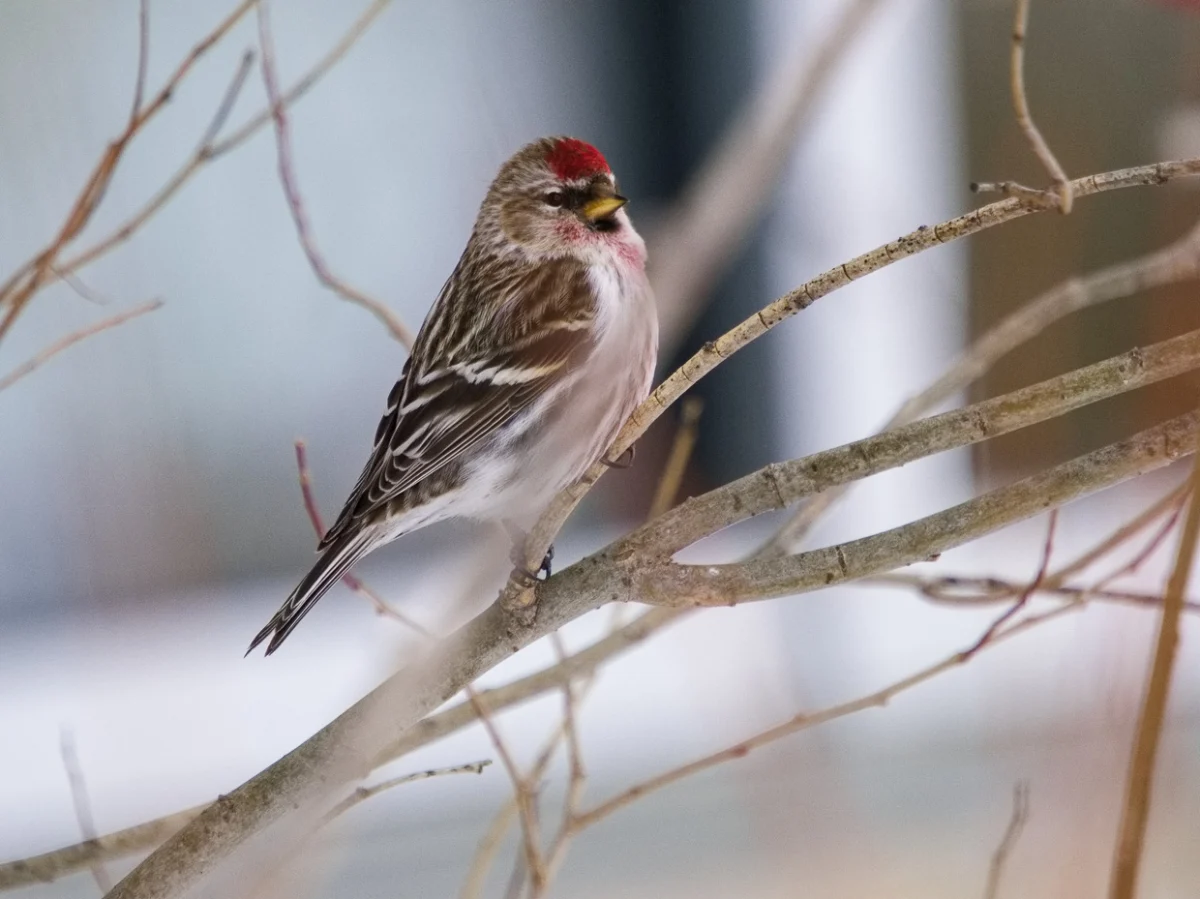
The Lac du Bonnet area, specifically Henry Bellin Road and Silver Falls, served as a hub for observing winter passerines. Bird feeders in these locations attracted a diverse range of species, including Evening Grosbeaks and Pine Grosbeaks—members of the finch family known for their vibrant plumage and heavy bills. The presence of both Hoary and Common Redpolls offered a challenge for the observers, as these two species are notoriously difficult to distinguish in the field. The sightings were supplemented by the appearance of Sharp-tailed Grouse, a lekking species that relies on the brushy edges of the boreal forest. The day concluded with a stop at Powerview, where open water on the Winnipeg River provided a habitat for Common Goldeneyes and a pair of Bald Eagles, illustrating the importance of non-frozen waterways for wintering waterfowl and scavengers.

On March 13, the fourth day of the expedition, the itinerary was adjusted based on local reports and weather conditions to maximize sightings within the Winnipeg metropolitan area and the Interlake region. The morning was spent at Fort Whyte Alive, a reclaimed industrial site that now serves as a major urban nature reserve. While the group monitored feeders for wintering songbirds, they observed 16 Canada Geese in a small patch of open water, a sign of the approaching spring thaw.
The afternoon featured a visit to Oak Hammock Marsh, a globally significant wetland and a designated Ramsar site. The marsh is the headquarters of Ducks Unlimited Canada and serves as a critical educational center for wetland conservation. Along the drive to the marsh, the group encountered a flock of Snow Buntings, often called "snowflakes" due to their white underwings, which forage in large, synchronized groups along snowy roadsides. At the Oak Hammock Marsh interpretive center, participants observed Red-winged Blackbirds, an early-season migrant, and more Redpolls.

The final highlight of the trip occurred late on the fourth day at Assiniboine Park. Following a tip from the local birding community, the group located a Northern Saw-whet Owl (Aegolius acadicus). As one of the smallest owl species in North America, the Saw-whet is notoriously difficult to find due to its nocturnal habits and its tendency to roost in dense evergreens during the day. This sighting provided a comprehensive conclusion to the "owl circuit," as the group had now documented a significant portion of the species known to winter in the province.
The expedition concluded on March 14, with participants departing from Winnipeg. Over the course of five days, the group recorded dozens of species, providing valuable data points for regional biodiversity monitoring. The success of the tour highlights the growing economic and conservation impact of nature-based tourism in Manitoba. According to data from the Canadian Nature Survey, millions of Canadians participate in birdwatching annually, contributing billions of dollars to the national economy through travel, equipment, and support for conservation organizations.

From a scientific perspective, the observations made during this March 2026 window are vital for understanding the phenology of Manitoba’s wildlife. Phenology—the study of cyclic and seasonal natural phenomena—is increasingly important as climate change alters migration patterns and nesting timelines. For instance, the early nesting of Great Horned Owls and the arrival of Red-winged Blackbirds serve as indicators of the "biological spring," which may be shifting earlier in the calendar year.
Furthermore, the involvement of experts like Dr. Jim Duncan underscores the collaborative relationship between professional researchers and the birding public. Citizen science, fueled by platforms like eBird and iNaturalist, has revolutionized ornithology by providing researchers with a massive, real-time database of bird sightings that would be impossible to collect through traditional academic fieldwork alone.

The 2026 Manitoba Owls expedition serves as a testament to the region’s ecological richness. By bridging the gap between the prairie and the boreal forest, Manitoba offers a sanctuary for a diverse array of raptors and passerines that have evolved to survive one of the harshest winter environments on the continent. The documentation of these species not only provides a thrill for enthusiasts but also reinforces the necessity of habitat preservation in both urban parks and rural wilderness areas to ensure the continued survival of these iconic avian predators. As the participants returned home, they left behind a trail of data that will assist conservationists in protecting the delicate balance of the Manitoban ecosystem for years to come.
