
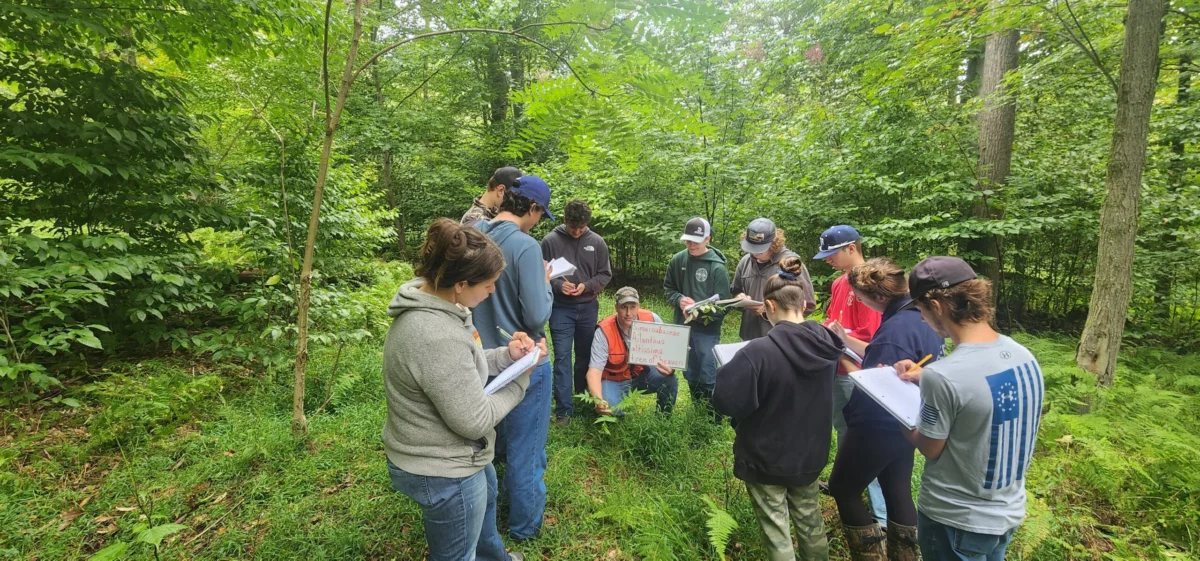
Mike Eckley’s deep connection to the natural world, a journey that began knee-deep in Pennsylvania’s pristine trout streams, has evolved into a leading role in sustainable land stewardship. What started as formative weekends fishing with his father in the "Big Woods" of Central Pennsylvania ignited a profound curiosity for the outdoors, eventually shifting his focus from aquatic ecosystems to the intricate dynamics of forest health. This enduring passion now defines his career in forestry and land stewardship, where he champions an integrated approach to managing private forestlands across central Pennsylvania.
Eckley currently serves as a vital consultant for private forest landowners, guiding them through complex management decisions that meticulously balance ecological integrity, critical wildlife habitat, and long-term stewardship objectives. His expertise is further shared through his lectures within the esteemed Penn State DuBois Wildlife Technology Program, shaping the next generation of conservationists. A self-described "birder in training," Eckley has significantly sharpened his skills and deepened his ecological insight through Audubon Mid-Atlantic’s Forester Training and Endorsement Program. This specialized training has not only enhanced his professional expertise but also fortified his ability to forge stronger, trust-based relationships with landowners, ultimately growing both his impact and his business. His journey exemplifies how a holistic understanding of ecosystems, particularly through the lens of avian conservation, can revolutionize forestry practices, leading to healthier forests and thriving wildlife populations.
The Genesis of a Forester: From Water to Woods
Mike Eckley’s initial fascination with the natural world was undeniably rooted in the vibrant trout streams that crisscross Pennsylvania’s landscape. The countless hours spent alongside his father, casting lines into clear, cold waters, fostered an intimate appreciation for riparian ecosystems. This early immersion, however, gradually broadened to encompass the surrounding terrestrial environment. The towering trees, the dappled sunlight filtering through the canopy, and the diverse understory that characterized the state’s "Big Woods" began to captivate his attention. This slow but sure transition from an interest in water to a passion for land laid the groundwork for his eventual career path.
Pennsylvania, with its rich logging history and extensive forest cover—approximately 58% of the state is forested, totaling over 16 million acres—has always been a critical region for forestry. However, historical practices often prioritized timber extraction over ecological balance. Eckley’s evolving perspective, influenced by his early observations of interconnectedness in nature, positioned him to embrace a more nuanced approach to forest management, one that would later be formalized through programs emphasizing ecological health.
Discovering the "Love Language" of Birds
Eckley’s journey back to his home state in 2008 marked a significant turning point in his professional trajectory. Joining The Nature Conservancy as their first Outreach Forester for the Pennsylvania chapter, he found himself immersed in a community deeply passionate about avian life. He observed that staff members, donors, and volunteers alike shared an intense enthusiasm for birds, often using bird sightings and conservation as a primary means of engagement. It was during this period that Eckley realized bird-friendly forestry was more than just a niche practice; it was a powerful "love language" that could bridge diverse interests and foster broader engagement in conservation efforts.
The importance of this realization cannot be overstated. Birds serve as excellent bio-indicators, their health reflecting the overall health of an ecosystem. Declines in bird populations, particularly migratory songbirds, often signal broader environmental issues such as habitat loss, fragmentation, and climate change. For many landowners, the tangible presence of birds, their songs, and their migratory journeys provide an accessible and emotionally resonant entry point into complex discussions about forest management. By framing conservation efforts around avian needs, Eckley found he could captivate audiences and build rapport more effectively than through purely technical forestry discussions. This understanding became a cornerstone of his approach to engaging private landowners, who collectively own a significant portion of Pennsylvania’s forests, making their participation crucial for large-scale conservation success.
Enhancing Expertise: The Audubon Forester Training and Endorsement Program
Recognizing the growing need for specialized knowledge in avian-centric forestry, Eckley sought to deepen his expertise. The Audubon Mid-Atlantic’s Forester Training and Endorsement Program proved to be an invaluable resource. This program is designed to equip forestry professionals with advanced ecological insights and practical strategies for managing forests in ways that benefit birds and overall biodiversity. It addresses a critical gap in traditional forestry education, which often focuses primarily on timber production, by emphasizing ecological functions and wildlife habitat creation.
The endorsement process provided Eckley with several key benefits. In his private practice, working with a diverse clientele ranging from timber-focused landowners to those prioritizing recreation or wildlife, the Audubon endorsement significantly enhanced his visibility and credibility. For landowners passionate about birds, the endorsement served as a clear signal of his specialized knowledge and commitment to avian conservation, fostering immediate trust. This distinction is particularly important in a competitive field, allowing Eckley to stand out as a leader in ecologically responsible forestry.
The program’s curriculum typically covers topics such as identifying priority bird species, understanding their specific habitat requirements (e.g., nesting, foraging, migratory stopovers), implementing silvicultural practices that create diverse forest structures, and monitoring bird responses to management. By strengthening his understanding of these intricate ecological connections, Eckley gained a comprehensive "playbook" of best management practices. This toolkit is crucial for addressing the needs of declining species and empowering landowners to actively contribute to conservation.
Connecting the Dots: Practical Wildlife Management in Action
The Audubon training has fundamentally transformed Eckley’s approach to wildlife management, enabling him to "connect-the-dots" between forest structure and avian needs with greater precision. He can now provide landowners with concrete, actionable strategies tailored to specific bird species and their habitats.
One compelling example involves the management of overgrown fields adjacent to forested areas. Many landowners view these transitional zones as unproductive or messy. However, Eckley educates them on the immense ecological value of such "scrubby habitat" for specific bird species. With targeted cutting and clearing, these areas can be maintained to benefit species like the Prairie Warbler and the Golden-winged Warbler. These species rely on early successional habitats—areas with dense shrubs, young trees, and open patches—for nesting and foraging. The Golden-winged Warbler, in particular, is a species of high conservation concern across its range, experiencing significant population declines due to habitat loss and successional changes. By proactively managing these edge habitats, Eckley helps landowners create vital refugia for these vulnerable birds.
Bird-Friendly Forestry: A Differentiated Approach
What sets bird-friendly forestry apart from more traditional approaches is its heightened focus on maintaining and enhancing structural complexity within the forest, often with greater intentionality and precision. Eckley refers to this as applying "finesse factors"—targeted management actions that go beyond standard timber harvests to support specific ecological functions vital for birds.
Traditional forestry might focus on uniform stand management for timber yield. Bird-friendly forestry, conversely, emphasizes heterogeneity. This includes creating varied canopy layers, retaining snags (standing dead trees) and coarse woody debris (fallen logs), promoting diverse tree species composition, and managing for varying age classes within a forest stand. These "finesse factors" directly support species that provide essential food and shelter for birds. For example, snags offer nesting cavities for woodpeckers and owls, and perching sites for raptors. Fallen logs create microhabitats for insects, amphibians, and reptiles, which in turn become food sources for ground-foraging birds.
A prime illustration of this nuanced approach involves the identification and prioritization of "champion trees," particularly vigorously growing oak trees that develop broad crowns and produce abundant acorns. Oaks, especially White Oaks, are considered keystone species in many eastern North American forests due to their exceptional ecological value. They provide a critical food source (acorns) for a vast array of wildlife, including deer, bears, squirrels, and numerous bird species. Furthermore, oaks support a remarkable diversity and abundance of insect larvae, particularly caterpillars, which are the primary food source for most songbirds during the breeding season.
To support these champion trees, Eckley might recommend selectively thinning mid-story vegetation. This practice allows more sunlight to reach the forest floor, strengthening the growth of the key oaks and enhancing their ability to produce acorns and support caterpillar populations. This strategic thinning also creates a more open understory, which can benefit certain ground-nesting birds while maintaining a healthy, multi-layered forest structure overall.
Engaging Landowners and Building Trust
A significant portion of Mike Eckley’s career revolves around engaging people in meaningful dialogue about forest management. He understands that for many private landowners, wildlife, particularly game species, has historically been the primary driver behind management decisions. Bird-friendly forestry, however, has provided him with a powerful "engine additive"—a new and compelling narrative to further captivate landowners and foster trust.
By framing management recommendations through the lens of bird conservation, Eckley taps into an often-untapped reservoir of passion and concern. The tangible benefits for charismatic bird species resonate deeply with individuals who might not otherwise connect with abstract ecological concepts. This approach allows him to build relationships founded on shared values, where the landowner’s interest in birds becomes a catalyst for adopting broader sustainable forestry practices. Trust, built on clear communication, demonstrated expertise, and a shared vision for a healthier landscape, is paramount in private land conservation. Eckley’s ability to speak the "love language" of birds has proven instrumental in solidifying these crucial partnerships.
Pennsylvania: A Critical Landscape for Avian Conservation
Eckley finds immense satisfaction in knowing his work is concentrated within the PA Wilds region, an area scientifically identified as a priority for numerous important conservation values, including avian protection. The PA Wilds, spanning over 2 million acres of public and private lands in north-central Pennsylvania, is characterized by its expansive forests, pristine waterways, and relatively low population density. It represents one of the largest blocks of contiguous forest in the northeastern United States, making it an exceptionally important area for interior forest bird species and migratory pathways.
Pennsylvania holds the designation of a "high-responsibility state" for the viability of both game and non-game species. This means that a significant portion of the global or regional populations of certain bird species either breed in, migrate through, or overwinter in Pennsylvania. Consequently, conservation efforts within the state have a disproportionately large impact on the overall health and persistence of these species. For instance, Pennsylvania provides crucial breeding habitat for numerous Neotropical migratory birds, many of which are experiencing alarming declines across their ranges. Efforts within the PA Wilds are strategically channeled to focal areas identified as critical migratory pathways and breeding grounds, maximizing the impact of conservation investments.
The Penn State DuBois Wildlife Technology Program, where Eckley lectures, plays a vital role in this broader conservation context. By educating future wildlife professionals, the program ensures a continuous pipeline of skilled individuals capable of implementing and advocating for scientifically sound wildlife management practices. This synergy between academic training and practical, endorsed programs like Audubon’s creates a robust framework for conservation in a state critical for avian biodiversity.
A Personal Connection: Birds as a Bridge to Understanding
Beyond his professional endeavors, birds have forged a poignant personal connection for Mike Eckley, particularly with his teenage son. In an era where digital distractions often overshadow outdoor exploration, Eckley found a unique way to bridge the generational gap. He recounts a recent outing in the woods where, upon hearing an unfamiliar bird call, his son initially scoffed, exhibiting the typical teenage disinterest. Undeterred, Eckley pulled out his iPhone, activated the Merlin app—a popular bird identification tool—and captured the audio. The app promptly identified the bird as a Rose-breasted Grosbeak, which soon revealed its vibrant presence on a nearby sapling. The transformation in his son’s facial expression, from annoyance to genuine curiosity, was immediate and rewarding. This anecdote highlights the power of technology to enhance nature engagement and the enduring ability of birds to spark wonder, even in the most jaded of observers. It underscores Eckley’s philosophy that conservation often begins with connection and curiosity.
Favorite Species: White Oak and Pine Warbler
Eckley readily admits he is a "birder in training," always seeking to hone his identification skills. Despite his humility, a memorable encounter with a pair of Pine Warblers left a lasting impression. Pine Warblers are insectivorous songbirds that primarily inhabit pine and mixed pine-oak forests, often foraging high in the canopy. Their presence is a good indicator of healthy, mature pine stands, which are also a component of Pennsylvania’s diverse forest types.
His favorite tree species, the White Oak (Quercus alba), holds both personal and ecological significance. He owns several on his personal property, drawn to their aesthetic beauty: their large, sweeping, often quarter-acre sized crowns, and their distinctive ashy gray, flaky bark. Beyond their visual appeal, Eckley appreciates the profound ecological importance of White Oaks, particularly for warblers and a myriad of other wildlife. As previously noted, White Oaks are prolific producers of acorns, a critical hard mast source, and support a vast array of insects, especially caterpillars, making them invaluable for breeding birds. Their longevity and structural complexity further enhance forest biodiversity.
A Model for Sustainable Stewardship
Mike Eckley’s journey, from a childhood fascination with trout streams to his current role as a leading proponent of bird-friendly forestry, underscores a fundamental truth: ecologically responsible forestry practices are as much about astute observation and attentive listening as they are about active management. It involves listening to the subtle cues of the land, understanding the intricate needs of wildlife, and, crucially, engaging with the diverse aspirations of the people who care deeply about both.
Programs like Audubon Mid-Atlantic’s Forester Training and Endorsement are vital in translating this information and passion into actionable conservation strategies. They empower professionals like Eckley to apply scientific knowledge in practical, landowner-friendly ways, demonstrating that thriving bird populations and healthy, productive forests are not mutually exclusive goals but rather deeply intertwined outcomes of intelligent stewardship. The success stories emerging from central Pennsylvania, driven by dedicated foresters like Mike Eckley, offer a compelling model for sustainable land management, promising a future where biodiversity flourishes alongside human well-being. This integrated approach is not just about preserving nature; it is about cultivating a richer, more resilient landscape for generations to come.
