
SAN JOSÉ, COSTA RICA — A comprehensive 17-day ornithological expedition across Costa Rica’s diverse microclimates has concluded, documenting hundreds of avian species and highlighting the critical role of protected corridors and sustainable land management in maintaining the country’s status as a global biodiversity hotspot. The tour, conducted from February 15 to March 3, 2026, traversed the Central Valley, the Pacific lowlands, the high-altitude Talamanca Range, and the northern wetlands of Caño Negro, providing a detailed snapshot of the health and variety of Neotropical ecosystems.

A Journey Through Biological Transition Zones
The expedition began in the Central Valley, where the lush grounds of the Hotel Bougainvillea served as a microcosm of the region’s urban-adjacent biodiversity. Early sightings included the Lesson’s Motmot and the Clay-colored Thrush—Costa Rica’s national bird—alongside a roosting Mottled Owl. These observations underscored the importance of maintained botanical gardens in providing "green islands" for resident species.

As the group moved toward the Central Pacific, the environmental focus shifted to the biological transition between the dry northwest forests and the humid southern Pacific rainforests. This intersection, most notably observed in Carara National Park, is a scientific focal point due to its high levels of endemism. In the Caldera and Tárcoles regions, the expedition documented the threatened and endemic Mangrove Hummingbird, a species strictly dependent on the health of coastal mangrove systems. The Tárcoles River boat survey further identified a dense concentration of waterbirds, including the Bare-throated Tiger Heron and the Double-striped Thick-knee, alongside significant populations of American Crocodiles and Proboscis Bats.

High-Altitude Endemism in the Talamanca Range
One of the most significant phases of the expedition occurred in the Talamanca Highlands, a region known for its "island-like" ecology where high elevation has led to the evolution of unique species found nowhere else on Earth. At the Cerro Buena Vista páramo—a high-altitude tundra-like ecosystem—the group observed the Volcano Junco and the Timberline Wren, both of which are restricted to the highest peaks of the Costa Rica-Panama highlands.

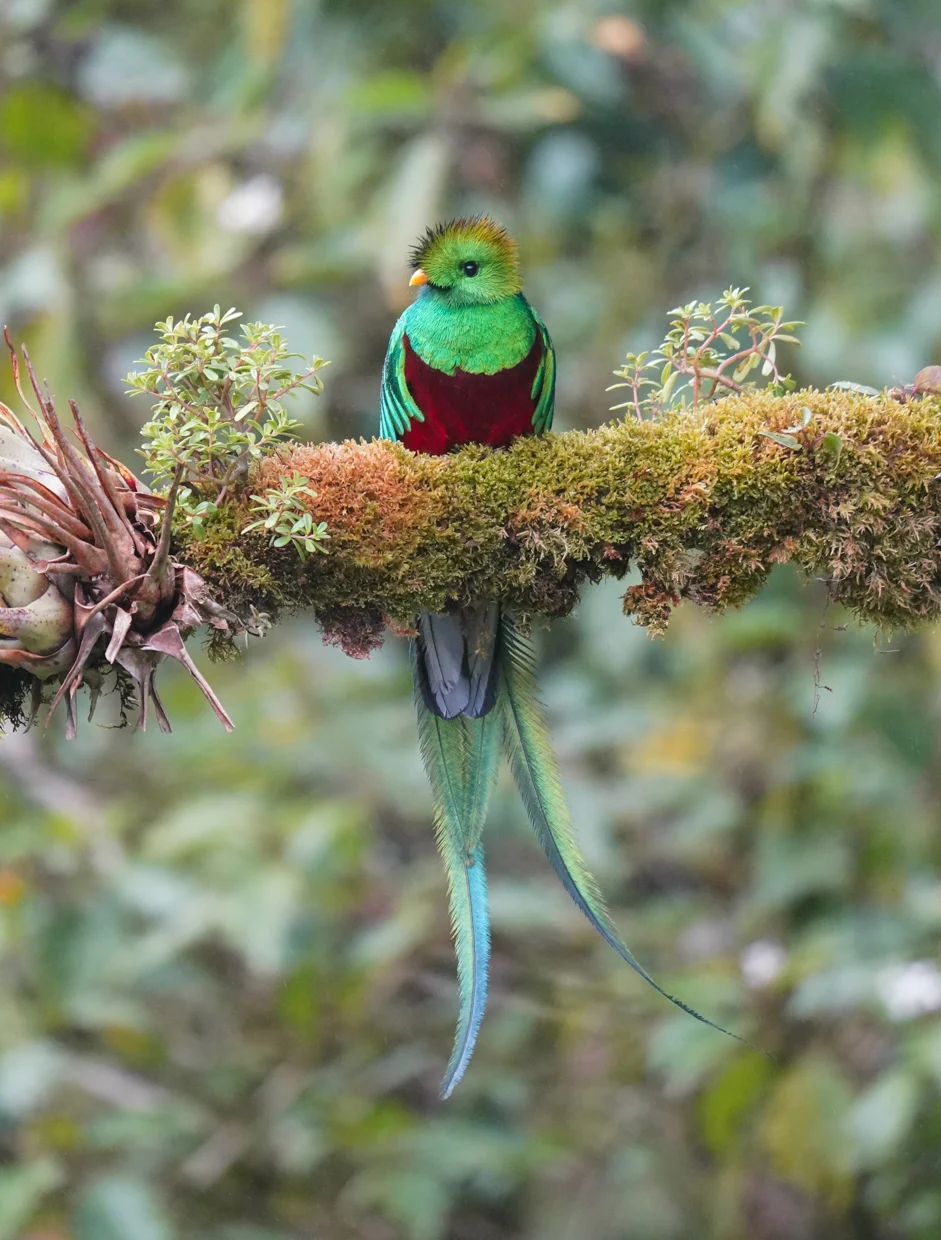
The Savegre Valley served as the backdrop for observing the Resplendent Quetzal, a species often cited as a flagship for cloud forest conservation. The presence of nesting pairs indicates a stable habitat, though these birds remain sensitive to the effects of climate change and deforestation. The Talamanca phase also highlighted the "mixed-species flock" phenomenon, where various tanagers, warblers, and woodcreepers move together to increase foraging efficiency and predator detection.

The Osa Peninsula: A Rainforest Frontier
Moving south to the Osa Peninsula, described by National Geographic as "the most biologically intense place on Earth," the expedition focused on the Golfo Dulce and Danta Lodge. This region provided sightings of the endangered Yellow-billed Cotinga and the White-crested Coquette. The Osa Peninsula is a critical area for conservation because it contains the largest remaining tract of lowland rainforest on the Pacific coast of Central America.

The expedition also observed several primate species, including the White-faced Capuchin, Mantled Howler Monkeys, and the Central American Squirrel Monkey. The health of these primate populations is often viewed as a proxy for the overall integrity of the forest canopy. In the La Gamba region, near the Esquinas Lodge, the group documented the Riverside Wren and the Black-striped Sparrow, further emphasizing the Osa’s role as a sanctuary for regional specialties.

Agricultural Sustainability and Avian Density
A pivotal moment of the tour occurred in Paraíso de Cartago, where the group visited an 11-hectare organic, shade-grown coffee farm. Despite its small size, the farm has recorded over 300 bird species. This data serves as a powerful case study for "regenerative agriculture," demonstrating that sustainable farming practices can provide essential habitats for both resident and migratory birds while remaining economically viable.

The expedition observed species such as the endemic Cabanis’s Ground-Sparrow foraging within the coffee leaf litter. The presence of this range-restricted sparrow in agricultural land suggests that when pesticides are avoided and shade trees are maintained, the boundary between "wildlife" and "farmland" becomes effectively porous, aiding in the survival of vulnerable species.

The Northern Wetlands and Raptor Migration
The latter half of the journey took the group to the Caribbean lowlands and the northern wetlands near the Nicaraguan border. At the La Selva Biological Station, managed by the Organization for Tropical Studies (OTS), the group engaged with one of the world’s premier sites for tropical research. Despite inclement weather, the station’s protected primary forest yielded sightings of the Broad-billed Motmot and the Green Ibis.

In Sarapiquí, the expedition witnessed a massive raptor migration event. Thousands of Turkey Vultures, Swainson’s Hawks, and Broad-winged Hawks were observed utilizing thermals to move northward. This seasonal phenomenon is a spectacular display of the connectivity of the Americas, linking the health of Costa Rican forests to the ecosystems of North America.

The Caño Negro National Wildlife Refuge, a Ramsar-designated wetland of international importance, provided a different perspective on biodiversity. Navigating the freshwater marshes, the group documented the American Pygmy Kingfisher and the elusive Sungrebe. A rare sighting of two Tayras (a large member of the weasel family) foraging in the canopy offered a glimpse into the behavior of the region’s more secretive mammals.

Scientific and Conservation Implications
The expedition’s final highlight occurred in the mountains of San Ramón, where the group located an active army ant swarm. Such swarms are the center of a complex ecological web; "ant-following" birds such as the Ocellated Antbird and the Bicolored Antbird rely on the ants to flush out insects from the forest floor. The crowning achievement of this session was the observation of three Rufous-vented Ground-Cuckoos, a species so rare and elusive that it is considered a "holy grail" for ornithologists.

According to lead guide Jose Pablo Castillo, the success of the tour was not merely measured by the length of the species list but by the quality of the encounters and the diversity of habitats represented. The presence of top predators, such as the Ornate Hawk-Eagle observed at a nest in Rincón Verde and later hunting at the Arenal Observatory Lodge, indicates a healthy, functioning food web.

Broader Impact and Conclusion
The findings of this expedition reinforce the economic and ecological value of ecotourism in Costa Rica. By providing a financial incentive for local communities to protect their natural resources—as seen in the family-run Rincón Verde and the various lodges visited—ecotourism acts as a buffer against more destructive land uses.

However, the expedition also noted challenges. Road construction and persistent heavy rains during certain legs of the trip served as reminders of the ongoing infrastructure demands and the volatile weather patterns that can affect both wildlife behavior and human access.

In summary, the 2026 birding expedition provided robust evidence that Costa Rica’s network of national parks and private reserves continues to support an extraordinary array of life. From the high-altitude volcanic peaks to the coastal mangroves, the country remains a vital corridor for the survival of Neotropical bird species. The documentation of rare endemics and massive migratory events highlights the global importance of the region and the continued need for rigorous conservation and sustainable development strategies.

The data collected during this journey, uploaded to the eBird global database, will contribute to ongoing citizen-science efforts to track bird populations and inform conservation policy across the Western Hemisphere. As the expedition concluded in the Central Valley with the song of a Spot-breasted Oriole, the overarching sentiment among participants and experts alike was one of profound appreciation for the "Pura Vida" philosophy—a commitment to life and nature that remains Costa Rica’s most enduring legacy.
