
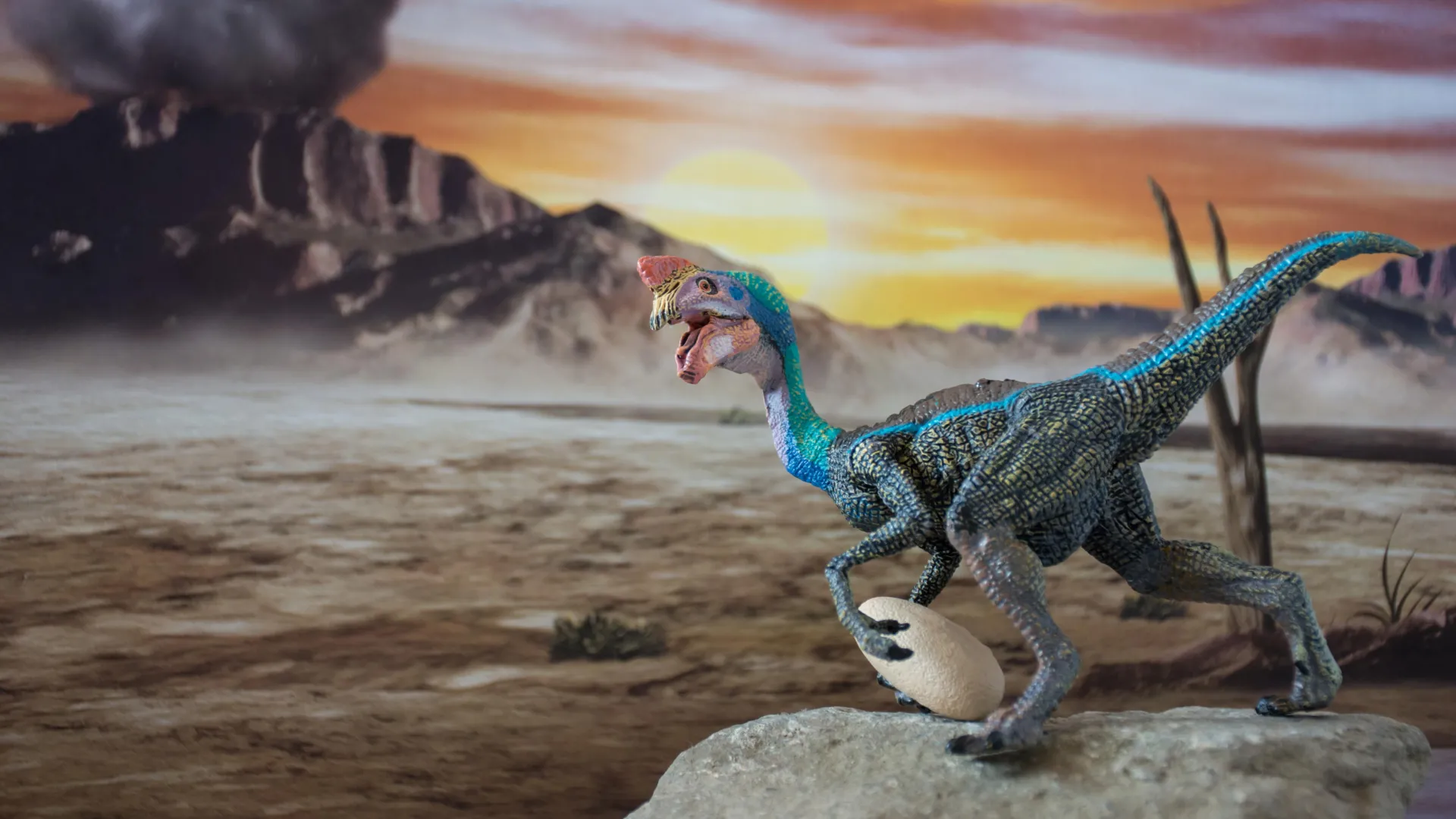
The long-standing enigma surrounding how oviraptors, those intriguing bird-like yet flightless dinosaurs, incubated their eggs has been significantly illuminated by groundbreaking research. For decades, paleontologists have debated whether these creatures relied solely on ambient environmental heat, akin to modern crocodiles and turtles, or if they actively warmed their eggs through direct contact, much like contemporary birds. A new study, meticulously detailed in the journal Frontiers in Ecology and Evolution, delves deep into this critical question by meticulously examining oviraptor nesting behavior and the resulting hatching patterns, ultimately suggesting a sophisticated co-incubation strategy previously underappreciated.
Unraveling the Prehistoric Nursery: A Scientific Breakthrough
The collaborative research, spearheaded by scientists in Taiwan, employed a novel interdisciplinary approach, combining advanced heat transfer simulations with intricate physical experiments. This methodology allowed them to reconstruct and analyze the thermal dynamics within oviraptor nests, offering unprecedented insights into their incubation practices. The findings were subsequently benchmarked against the established understanding of modern avian incubation, providing a comparative framework for evolutionary insights. To achieve this, the team meticulously constructed a life-sized oviraptor model and a remarkably realistic nest replica, enabling precise measurements of heat distribution and movement through the egg clutches.
Dr. Tzu-Ruei Yang, a distinguished associate curator of vertebrate paleontology at Taiwan’s National Museum of Natural Science and the senior author of the study, highlighted a pivotal discovery: "Our research clearly demonstrates that variations in oviraptor hatching patterns were directly influenced by the relative position of the incubating adult in relation to the eggs." This revelation challenges simplistic notions of dinosaur incubation, suggesting a more active and dynamic role for the parent. Complementing this, first author Chun-Yu Su, who contributed to the research while attending Washington High School in Taichung, added, "Crucially, we were able to quantify the incubation efficiency of oviraptors, finding it to be considerably lower than that observed in modern birds, pointing towards a different evolutionary pathway for brooding."
Reconstructing a 70-Million-Year-Old Nest: The Heyuannia huangi Model
The foundation of this ambitious experimental setup was based on Heyuannia huangi, a well-documented oviraptor species that roamed the Earth approximately 70 to 66 million years ago during the Late Cretaceous period in what is now modern-day China. This particular dinosaur was a relatively modest theropod, measuring around 1.5 meters in length and weighing approximately 20 kilograms – roughly the size of a large ostrich or emu. Fossil evidence has consistently shown that Heyuannia huangi constructed distinctive semi-open nests, characterized by multiple concentric rings of eggs, a unique architectural feature among dinosaurs.
To faithfully recreate this ancient parent, the researchers meticulously fashioned the oviraptor’s torso from polystyrene foam, providing a lightweight yet sturdy core. This was then reinforced with a wooden frame and carefully layered with cotton, bubble paper, and fabric to simulate the soft tissues, mimicking the dinosaur’s natural bulk and insulation properties. The eggs themselves posed a significant challenge. Unlike the eggs of any living species, oviraptor eggs have distinct shapes and shell thicknesses. The team ingeniously crafted realistic egg replicas from casting resin, precisely calibrated to approximate the thermal properties and dimensions of actual oviraptor eggs. In the physical experiments, two clutches were meticulously arranged in double rings, mirroring the precise configurations observed in fossilized nests, ensuring the highest degree of paleontological accuracy.
"One of the most formidable aspects of this research was the realistic reconstruction of oviraptor incubation," Su explained, underscoring the innovative problem-solving required. "Their eggs are truly unique, unlike anything seen in extant species. Therefore, we had to invent these resin eggs to mimic real oviraptor eggs as closely as scientifically possible." This dedication to detail was paramount in generating reliable data for the heat transfer simulations and physical trials.
The Interplay of Heat, Nest Architecture, and Hatching Synchronicity
The research team systematically investigated how both the physical presence of a brooding adult and varying environmental conditions influenced egg temperatures and, consequently, the potential hatching outcomes. The results unveiled a fascinating complexity in oviraptor incubation dynamics.
In colder environmental conditions, when the adult oviraptor was positioned over the nest, a significant temperature gradient was observed. Temperatures in the outer ring of eggs varied by as much as 6°C. Such pronounced differences within a single clutch would almost certainly lead to asynchronous hatching, where eggs within the same nest would hatch at staggered intervals over a period of time, rather than simultaneously. This stands in stark contrast to many modern bird species, where synchronous hatching is often an adaptive advantage.
However, the picture changed dramatically in warmer environments. Under these conditions, the temperature variation across the outer ring of eggs plummeted to approximately 0.6°C. This striking reduction suggests that in more temperate or warmer climates, external heat sources, particularly direct sunlight, played a crucial role in buffering and evening out egg temperatures across the entire clutch. This environmental contribution would have significantly influenced the hatching patterns, potentially leading to more synchronized hatching in favorable conditions.
Dr. Yang elaborated on this concept, stating, "It is highly improbable that large dinosaurs, given their size and the mechanics of their bodies, simply sat directly atop their entire clutches in the manner of a hen. The prevailing hypothesis for larger dinosaurs has been that they utilized ambient heat from the sun or geothermal warmth from the soil, much like turtles and other reptiles. Given that oviraptor clutches were characteristically open to the air, it is highly probable that heat derived from direct solar radiation was a far more influential factor than any heat emanating from the soil beneath." This insight further solidifies the notion of a hybrid incubation strategy.
Dinosaur vs. Bird Incubation Efficiency: A Tale of Two Strategies
A critical component of the study involved a direct comparative analysis between oviraptor incubation and the sophisticated strategies employed by modern birds. The vast majority of extant avian species rely on a highly evolved process known as thermoregulatory contact incubation (TCI). In TCI, the adult bird maintains direct, continuous physical contact with its eggs, serving as the primary, highly efficient heat source. For TCI to be successful, several conditions must be met: the adult must be able to touch all or nearly all of the eggs simultaneously, act as the predominant heat source, and possess the physiological mechanisms to maintain remarkably consistent and optimal temperatures across the entire clutch.
The researchers concluded that oviraptors, by virtue of their anatomy and nest design, were likely incapable of meeting these stringent conditions for true TCI. The distinctive ring-shaped arrangement of their egg clutches, while offering protection, inherently meant that a single adult could not possibly maintain direct, constant physical contact with every egg at once. The sheer geometry of the nest and the size of the parent would preclude this.
"Oviraptors, as our findings suggest, were likely unable to perform thermoregulatory contact incubation in the highly efficient manner characteristic of modern birds," Su affirmed. Instead, the evidence points towards a collaborative approach, where the brooding dinosaur and environmental heat sources worked in concert, effectively making them "co-incubators." While this mixed method was quantitatively less efficient in terms of maintaining uniform temperatures and potentially extending incubation periods compared to the specialized TCI of modern birds, it was remarkably well-suited to the oviraptors’ unique nesting style. This style appears to represent an evolutionary transition, moving away from fully buried nests (common in many reptiles) towards the semi-open configurations observed in oviraptors.
Dr. Yang provided an important perspective on this difference, emphasizing that "modern birds are not inherently ‘better’ at hatching eggs. Rather, contemporary avian species and oviraptors simply evolved fundamentally different, yet equally successful, methods of incubation or, more precisely, brooding. There is no ‘better’ or ‘worse’; it is simply a reflection of adaptation to specific environmental pressures and evolutionary pathways." This statement underscores the principle of ecological fitness, where diverse strategies can lead to successful reproduction.
Broader Implications for Dinosaur Parenting and Evolution
The researchers, while acknowledging the inherent limitations of their study—namely, the reliance on a reconstructed nest model and the use of modern environmental conditions, which undoubtedly differed from the Late Cretaceous epoch—emphasize that these factors could subtly influence the findings. The Late Cretaceous period, roughly 70 to 66 million years ago, was characterized by generally warmer global temperatures and higher atmospheric CO2 levels compared to today, which would have impacted ambient temperatures and solar radiation intensity. Furthermore, the team posits that oviraptors likely experienced significantly longer incubation periods than the typically rapid hatching cycles of modern birds, a common characteristic among many reptile species.
Despite these caveats, the study represents a monumental leap forward in our understanding of how oviraptors likely cared for their offspring. By ingeniously combining detailed physical models with sophisticated computational simulations, this work has opened up exciting new avenues for exploring and reconstructing the reproductive behaviors of extinct dinosaurs. It offers a tangible methodology for delving into aspects of dinosaur biology that were previously only subjects of speculative inference.
This research not only provides critical insights into oviraptor biology but also contributes significantly to the broader understanding of dinosaur evolution, particularly the intricate and often debated evolutionary link between dinosaurs and birds. The co-incubation strategy identified in oviraptors offers a potential intermediate step in the evolutionary trajectory from reptilian-style buried nests to the highly active, contact-based brooding of modern birds. It suggests a more complex and adaptive range of parental care strategies among non-avian dinosaurs than previously assumed, painting a richer picture of their behavioral ecology.
A Beacon of Inspiration for Future Paleontological Endeavors
Beyond its profound scientific contributions, the study carries a powerful message of encouragement and inspiration, particularly for the scientific community in Taiwan. "This research truly serves as an encouragement for all students, especially those in Taiwan," Dr. Yang concluded with evident pride. "While it is true that Taiwan itself does not possess indigenous dinosaur fossils, that fact by no means precludes us from making significant, world-class contributions to the field of dinosaur studies." This highlights the global and collaborative nature of modern paleontology, where intellectual curiosity and innovative methodologies can transcend geographical boundaries to unlock the secrets of Earth’s ancient past. The study stands as a testament to the power of interdisciplinary research and the boundless potential for scientific discovery, regardless of local fossil records.
