
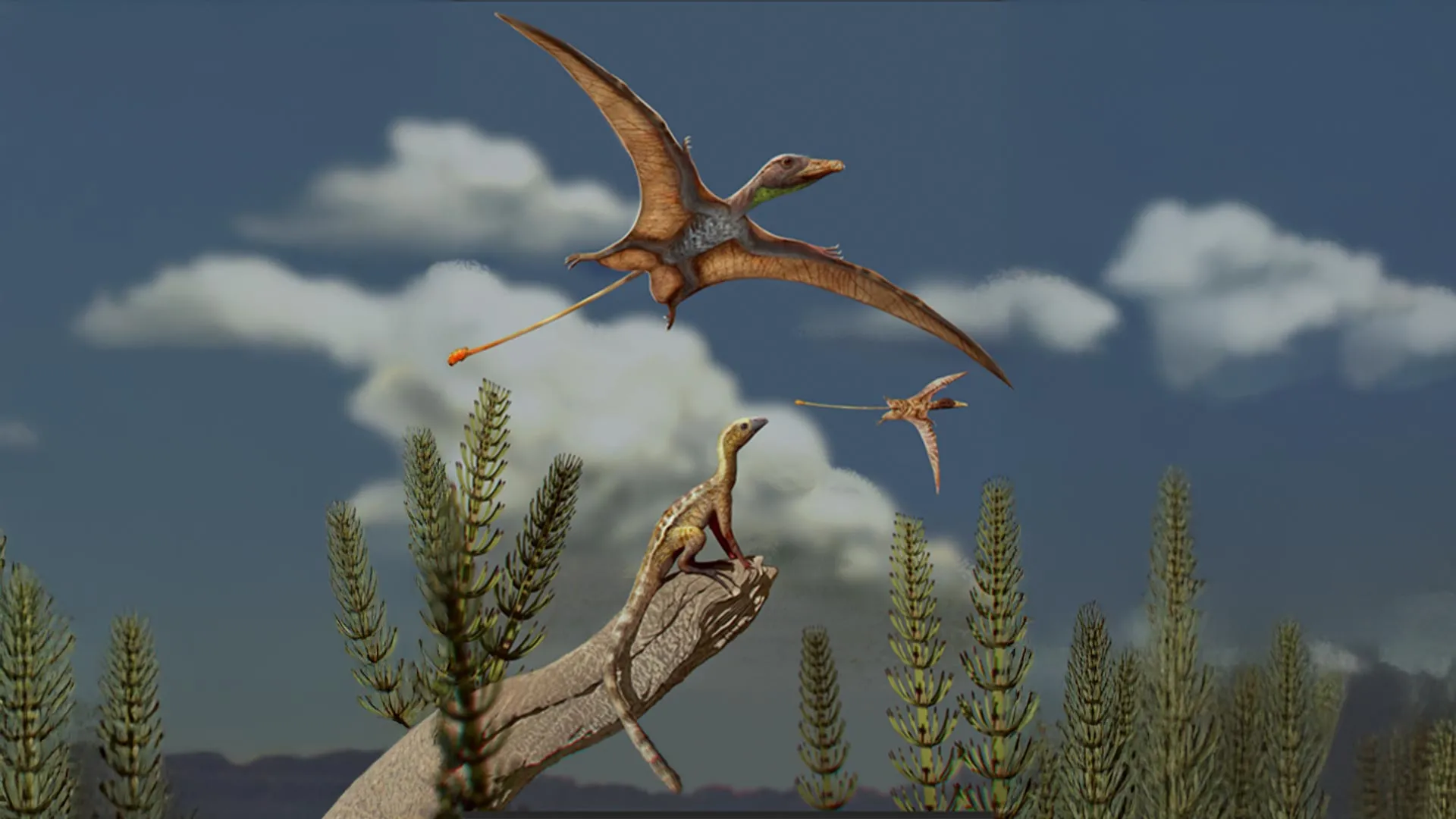
A groundbreaking study led by an evolutionary biologist at Johns Hopkins Medicine has unveiled compelling evidence suggesting that giant reptiles known as pterosaurs may have developed the ability to fly at an unprecedented pace, very early in their evolutionary journey, approximately 220 million years ago. This discovery presents a stark contrast to the evolutionary trajectory of modern birds, whose ancestors are widely believed to have achieved powered flight through a more gradual process, marked by the progressive development of larger and more complex brains. The findings, which relied on cutting-edge advanced imaging techniques to meticulously examine the internal brain cavities of pterosaur fossils, received partial support from the National Science Foundation and were published on November 26 in the esteemed journal Current Biology.
Unveiling the "Burst" Model of Flight Evolution
The research challenges long-held assumptions about the prerequisites for powered flight, particularly the notion that a highly enlarged and complex brain is an indispensable evolutionary precursor. Dr. Matteo Fabbri, an assistant professor of functional anatomy and evolution at the Johns Hopkins University School of Medicine and a lead author of the study, emphasized that these results significantly bolster the hypothesis that the substantial brain enlargement observed in birds and their ancestral lineages was not a prerequisite for pterosaurs to conquer the skies. "Our study shows that pterosaurs evolved flight early on in their existence and that they did so with a smaller brain similar to true non-flying dinosaurs," Fabbri stated, underscoring the divergent paths taken by different vertebrate groups in achieving one of nature’s most complex biomechanical feats. This "burst" model for pterosaur flight evolution suggests a rapid acquisition of flight-related adaptations, rather than a slow, incremental accumulation.
Pterosaurs, often described as the formidable airborne predators of the dinosaur era, were truly colossal creatures. Some species reached an impressive weight of up to 500 pounds and boasted wingspans extending over 30 feet, dominating the Mesozoic skies for millions of years. They hold a unique and pivotal position in evolutionary history as the earliest of the three major vertebrate lineages—alongside birds and bats—to independently achieve powered flight. Understanding how these pioneering fliers gained such an extraordinary ability, and whether their evolutionary pathway differed from that of birds and bats, has been a central question in paleontology and evolutionary biology. To address this, Fabbri’s team embarked on a detailed investigation into the reptiles’ evolutionary history, focusing on temporal shifts in the shape and size of their brains, with a particular emphasis on the optic lobe—a crucial brain region intimately involved in vision and frequently linked to flight capabilities.
Advanced Imaging Illuminates Ancient Brains
The investigative methodology employed by the researchers was critical to their breakthrough. Utilizing sophisticated CT imaging and specialized software, they were able to digitally reconstruct and model the fossilized nervous system structures within the ancient skulls. Their primary focus was on the closest known relative of the pterosaur, an animal called the lagerpetid. This intriguing, flightless, and arboreal (tree-climbing) creature was first formally identified by scientists in 2016. It inhabited the Earth during the Triassic period, a vast span of time roughly between 242 and 212 million years ago. The crucial evolutionary connection between lagerpetids and pterosaurs was further solidified by independent research in 2020, solidifying the lagerpetid’s role as a key ancestral link.
Dr. Mario Bronzati, a researcher at the University of Tübingen, Germany, and the corresponding author of the study, highlighted the significance of their findings regarding the lagerpetid brain. "The lagerpetid’s brain already showed features linked to improved vision, including an enlarged optic lobe, an adaptation that may have later helped their pterosaur relatives take to the skies," Bronzati explained. This indicates that some pre-adaptations for enhanced vision were already present in the non-flying ancestors, laying a partial groundwork for the visual demands of flight.
While pterosaurs also exhibited enlarged optic lobes, Dr. Fabbri noted a crucial distinction: their overall brain shape and size differed considerably from those of the lagerpetid. This disparity, combined with the few similarities, led Fabbri to his compelling conclusion. "The few similarities suggest that flying pterosaurs, which appeared very soon after the lagerpetid, likely acquired flight in a burst at their origin," Fabbri elaborated. "Essentially, pterosaur brains quickly transformed acquiring all they needed to take flight from the beginning." This rapid neurological reorganization, rather than a prolonged period of gradual brain expansion, appears to be the hallmark of pterosaur flight evolution.
A Timeline of Flight: Pterosaurs vs. Birds
To fully appreciate the significance of the pterosaur findings, it is essential to place them within the broader chronology of vertebrate flight evolution.
- Triassic Period (approx. 252 to 201 million years ago): The stage is set for the emergence of both lagerpetids and pterosaurs. Lagerpetids, the flightless, tree-climbing relatives, are present from around 242 to 212 million years ago. Crucially, pterosaurs themselves appear early in the Late Triassic, around 220 million years ago, making them the first vertebrates to achieve powered flight. Their brain structure, as revealed by this study, indicates a rapid "burst" of flight-related adaptations.
- Jurassic Period (approx. 201 to 145 million years ago): Pterosaurs diversify and dominate the skies. Later in this period, the earliest known bird, Archaeopteryx lithographica, emerges, living between 150.8 and 125.45 million years ago. Archaeopteryx, while possessing feathers and wings, still retained many reptilian features and is considered a transitional form, representing an early stage in the avian lineage’s more gradual path to flight.
- Cretaceous Period (approx. 145 to 66 million years ago): Both pterosaurs and early birds coexist and continue to evolve. Modern bird lineages begin to diversify towards the end of this period. The extinction event at the end of the Cretaceous wipes out non-avian dinosaurs and pterosaurs, leaving birds as the sole surviving lineage of flying dinosaurs.
This chronological perspective underscores the striking difference in evolutionary strategies. Modern birds, in stark contrast to pterosaurs, are understood to have evolved flight through a far more protracted and gradual process. Their ancestors appear to have inherited several foundational traits, including the expansion of the cerebrum (associated with higher cognitive functions), the cerebellum (crucial for muscle coordination and balance), and the optic lobes, from their earlier, ground-dwelling relatives. These regions were then further adapted and refined over millions of years specifically for the complex demands of powered flight.
Reinforcing this gradual model for avian flight is recent research from the laboratory of Dr. Amy Balanoff, also an assistant professor of functional anatomy and evolution at Johns Hopkins Medicine. Her 2024 work specifically highlights the critical importance of cerebellum expansion in the origins of bird flight. The cerebellum, strategically located at the back of the brain, plays an indispensable role in regulating muscle coordination, balance, and fine motor control—all essential for the intricate maneuvers of flight. "Any information that can fill in the gaps of what we don’t know about dinosaur and bird brains is important in understanding flight and neurosensory evolution within pterosaur and bird lineages," Dr. Balanoff commented, emphasizing the broader implications of such comparative studies for understanding the diverse pathways of evolutionary innovation.
Comparative Neurological Insights Across Species
To provide a comprehensive comparative framework, the research team extended their analysis beyond pterosaurs and lagerpetids. They also meticulously examined brain cavities from crocodilians (ancestral relatives of modern crocodiles) and early, extinct birds. This broader comparative approach allowed them to identify patterns and divergences in neuroanatomical evolution across different reptilian and avian groups.
Their detailed analysis revealed that pterosaurs possessed moderately enlarged brain hemispheres, a feature that was broadly comparable to other groups of dinosaurs. This included the two-legged, bird-like troodontids, predatory dinosaurs that roamed the Earth between the Late Jurassic and Late Cretaceous periods, approximately 163 to 66 million years ago. Similarly, the brain cavity size of pterosaurs showed similarities to that of Archaeopteryx lithographica, the oldest-known bird. This finding is significant because it further highlights that the substantial brain enlargement characteristic of modern birds—which have significantly larger brain cavities relative to their body size—was not present in these earlier flying forms, nor in pterosaurs. This reinforces the idea that brain expansion was a later, rather than an initial, development in the avian lineage’s journey to advanced flight.
The consistent presence of enlarged optic lobes in both lagerpetids and pterosaurs, despite other significant differences in brain structure, suggests a critical role for enhanced vision in the very earliest stages of flight adaptation, or even pre-adaptation for an arboreal lifestyle that could transition to flight. Vision is paramount for aerial navigation, prey detection, and obstacle avoidance, making its early refinement a logical evolutionary step. However, the unique way pterosaurs achieved their "flight-ready" brain, distinct from the more gradual, cerebrum and cerebellum-focused expansion seen in birds, represents a fascinating case of convergent evolution achieving similar outcomes through fundamentally different neurological strategies.
Broader Implications for Understanding Flight and Neurosensory Evolution
This research significantly enriches our understanding of flight evolution, demonstrating that there isn’t a single, monolithic pathway to conquering the skies. The pterosaur story highlights the remarkable evolutionary plasticity of life, where complex biological traits like powered flight can emerge through diverse and sometimes surprisingly rapid developmental trajectories. For pterosaurs, it appears to have been a swift transformation, optimizing existing visual capabilities and rapidly integrating other necessary neurological components for flight without the extensive, long-term brain reorganization seen in the avian lineage.
The study also contributes valuable insights into neurosensory evolution—the study of how nervous systems and sensory organs evolve to meet environmental and behavioral challenges. By examining the fossilized brain structures, researchers are essentially peering into the ancient minds of these extinct creatures, inferring their sensory capabilities, motor control, and even aspects of their cognitive processing. The finding that a relatively smaller, simpler brain could facilitate powered flight in pterosaurs forces a re-evaluation of the minimum neurological requirements for such a complex behavior. It suggests that efficiency and specific adaptations within particular brain regions (like the optic lobe) might be more critical than overall brain size or complexity in certain evolutionary contexts.
Furthermore, the comparison with avian evolution provides a powerful case study in divergent evolutionary solutions. While birds optimized flight through a gradual expansion of multiple brain regions, allowing for increasingly sophisticated aerial maneuvers and cognitive abilities, pterosaurs took a different route. This comparative approach is essential for identifying the underlying biological principles that govern the evolution of flight across different vertebrate groups.
Looking Ahead: The Future of Paleoneurology
Dr. Fabbri is optimistic about the future directions of this research. He emphasizes that significant future progress will depend on moving beyond simply understanding the size and shape of the brain. The next frontier in this field, he explains, will involve delving into the intricacies of the brain’s internal structure—how different neuronal circuits were organized and interconnected—to fully grasp how these internal architectures enabled pterosaurs to achieve flight. This deeper level of analysis will be absolutely essential for uncovering the broader biological principles that govern the evolution of flight, not just in pterosaurs and birds, but potentially in other extinct or extant flying creatures. Advances in imaging technology and computational modeling will undoubtedly play a crucial role in these future investigations, allowing paleontologists and neuroscientists to virtually dissect and analyze these ancient brains with unprecedented detail.
This multifaceted research was made possible through the generous funding and support from a consortium of international bodies, including the Alexander von Humboldt Foundation, the Brazilian Federal Government, The Paleontological Society, Agencia Nacional de Promoción Científica y Técnica, Conselho Nacional de Desenvolvimento Científico e Tecnológico, the European Union NextGeneration EU/PRTR, the National Science Foundation (NSF DEB 1754596, NSF IOB-0517257, IOS-1050154, IOS-1456503), and the Swedish Research Council.
The extensive collaborative effort brought together a diverse group of scientists from institutions across the globe. In addition to Dr. Fabbri and Dr. Bronzati, key contributors to this landmark research include Akinobu Watanabe from New York Institute of Technology; Roger Benson from the American Museum of Natural History; Rodrigo Müller from Federal University of Santa Maria, Brazil; Lawrence Witmer from the University of Ohio; Martín Ezcurra and M. Belén von Baczko from Bernardino Rivadavia Museum of Natural Science; Felipe Montefeltro from São Paulo State University; Bhart-Anjan Bhullar from Yale University; Julia Desojo from Universidad Nacional de La Plata, Argentina; Fabien Knoll from Museo Nacional de Ciencias Naturales, Spain; Max Langer from Universidade de São Paulo, Brazil; Stephan Lautenschlager from University of Birmingham; Michelle Stocker and Sterling Nesbitt from Virginia Tech; Alan Turner from Stony Brook University; and Ingmar Werneburg from Eberhard Karls University of Tübingen. Their collective expertise in paleontology, anatomy, evolutionary biology, and advanced imaging was instrumental in unraveling this ancient mystery of flight.
