
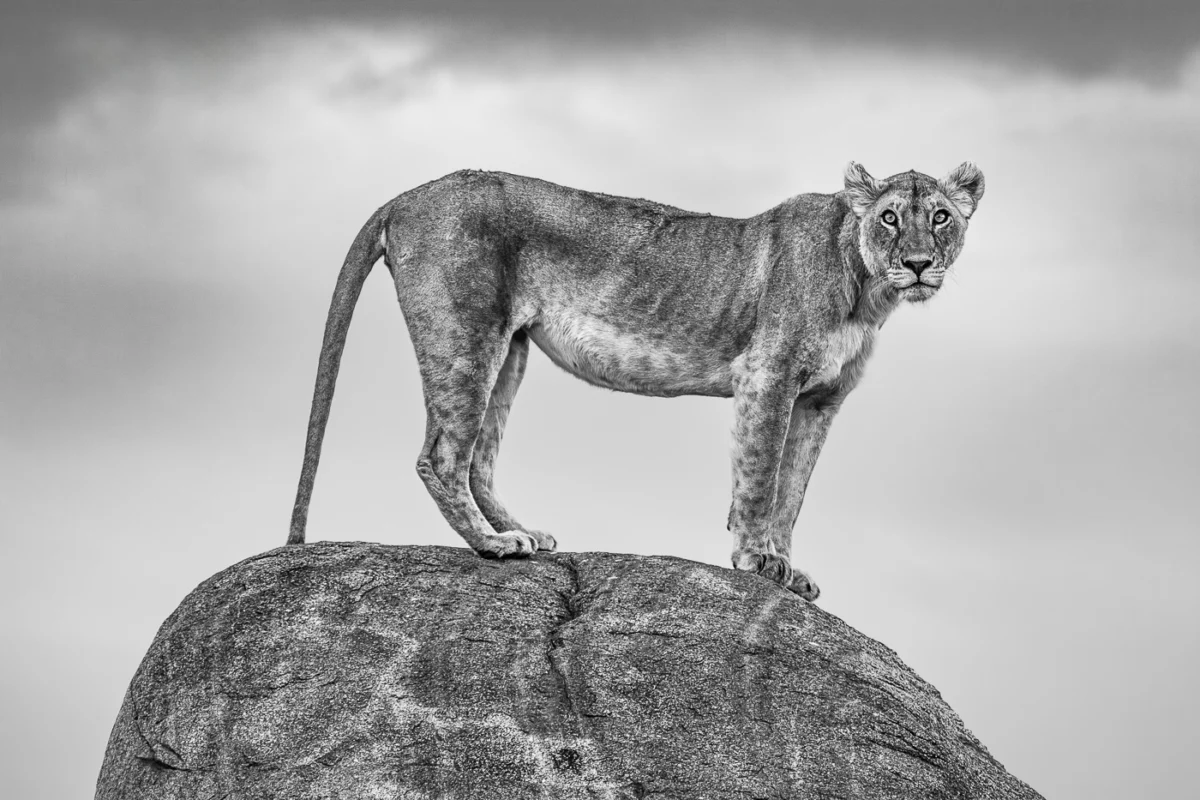
Award-winning photographer Gabi Guiard has carved a distinctive niche in the realm of wildlife photography, eschewing the vibrant palettes often associated with nature imagery in favor of striking black-and-white compositions. Her work, characterized by profound emotional depth and minimalist aesthetics, transcends mere documentation, aiming to connect viewers with the raw essence of the wild. Guiard’s unique approach emphasizes the power of form, texture, and light, transforming fleeting moments in nature into timeless narratives that speak to the core of existence. This deliberate artistic choice positions her as a compelling voice in contemporary nature photography, challenging conventional aesthetics to foster a deeper, more introspective appreciation for the natural world.

An Unconventional Path to Wildlife Artistry
Guiard’s intrinsic connection to the animal kingdom manifested early in life, a natural curiosity that evolved into a guiding force shaping her worldview. From a tender age, she found herself captivated by animal behavior and their innate presence, a fascination that would ultimately define her artistic career. However, her professional journey initially diverged from this innate passion. Guiard first immersed herself in the demanding world of graphic design and art direction within the advertising industry. This period, while seemingly a detour, proved instrumental in honing her visual storytelling skills and developing a sophisticated eye for composition and narrative. Her admiration for legendary black-and-white fashion and advertising photographers, such as Richard Avedon or Helmut Newton, whose mastery of light, shadow, and form defined an era, subtly nurtured her interest in photography. This exposure to high-concept, monochromatic imagery provided a foundation upon which her distinctive style would later emerge, blending her commercial acumen with her profound love for wildlife. The transition was not abrupt but a gradual integration, where her advertising background provided the technical and artistic scaffolding for her burgeoning photographic aspirations, allowing her to bridge two worlds she held dear: the artistry of photography and the untamed beauty of wildlife. This evolution underscores a growing trend among artists who leverage diverse professional backgrounds to forge unique, impactful creative expressions.

Black and White: A Deliberate Artistic Language
For Guiard, black-and-white photography is far more than a mere stylistic choice; it serves as her fundamental artistic language, a powerful idiom through which she articulates stories and conveys the profound emotions stirred by nature. She has stated that her decision to photograph in monochrome is not an attempt to appear "artistic" or "classic," but rather a deliberate strategy to distill an image to its most fundamental components. "By removing color, I eliminate distractions and let textures, shapes, and contrasts speak," Guiard explains. This reductionist approach allows textures to gain prominence, shapes to define narratives, and contrasts to sculpt the emotional landscape of the photograph. In Guiard’s philosophy, black-and-white photography is an exercise in unvarnished honesty, presenting "what remains when everything superfluous disappears." This stripping away of chromatic information, a hallmark of her work, ensures that the viewer engages directly with the subject’s intrinsic form and the interplay of light and shadow, fostering a deeper, more meditative connection. This echoes sentiments expressed by other renowned photographers who have opted for monochrome to emphasize form, light, and narrative purity.

The Essential Over the Superfluous: A Philosophy of Minimalism
Guiard’s artistic credo is rooted in the belief that true impact lies not in comprehensive depiction but in the eloquent presentation of what genuinely matters. Her goal is to "simplify reality and take it to the most essential so that the wild character of nature… takes center stage." This commitment to simplification means that a mere gaze, a distinct silhouette, or a subtle gesture can be sufficient to unfold a compelling story. In her black-and-white world, she seeks to guide the observer towards an unadulterated experience of the moment’s raw power, inviting them to "connect with the strength of the moment without distractions, as if they could hear the silence of the instant." This minimalist approach aligns with a broader trend in fine art photography, where photographers often aim to transcend literal representation, encouraging viewers to engage with the abstract qualities of light, form, and emotion. By focusing on the intrinsic character of her wild subjects, Guiard challenges the conventional, often overwhelming, detail-rich nature photography, instead offering a purified vision that accentuates the subject’s spirit and narrative. This method stands in stark contrast to the visual noise prevalent in much of contemporary media, offering a sanctuary for focused observation.

"Less Is More": Guiding the Viewer to the Core
The principle of "less is more" stands as a cornerstone of Guiard’s photographic methodology. By deliberately simplifying her images, she meticulously removes any element that might divert attention from the central message, thereby directing the viewer’s focus with unwavering precision. She demonstrates how a single, well-placed gesture, a compelling shadow, an intense look, or a decisive line can imbue a photograph with immense power. This reduction of visual elements, paradoxically, often amplifies the compelling nature of what remains. In an era saturated with hyper-detailed, often chaotic imagery, Guiard’s work offers a refreshing counterpoint, inviting contemplation rather than quick consumption. When an image is intentionally simplified, the viewer is not overwhelmed by unnecessary particulars; instead, they are drawn instinctively to the intrinsic essence of the scene. This deliberate creation of "empty" or "noise-free" space is not a void but an invitation, allowing each individual observer to imbue the photograph with their own emotions, memories, and interpretations, thus making the viewing experience profoundly personal and interactive. This approach resonates with art historical movements that valued essentialism and purity of form, demonstrating the enduring power of restraint in visual communication.

Composition as the Unseen Framework
For Gabi Guiard, composition serves as the fundamental "backbone" of every photograph, far exceeding a mere arrangement of elements within the frame. It is, in her view, a sophisticated tool for directing the viewer’s eye, a silent narrator guiding them precisely to the story she intends to tell. In the monochromatic realm, where the guiding cues of color are absent, composition assumes an even more paramount role. Lines, shapes, and the strategic utilization of negative space acquire new significance, becoming critical elements that define the photograph’s structure and emotional resonance. The precise placement of an animal within its vast environment, the delicate equilibrium between illuminated areas and profound shadows, or the evocative quietude of an empty expanse — all these elements coalesce to forge both harmony and an underlying tension within the image. Guiard frequently seeks out inherent simplicity, consciously avoiding superfluous elements that could dilute the message. A strong diagonal line leading directly to the penetrating gaze of a lion, the graceful curve of a tree expertly framing a powerful silhouette, or the expansive negative space enveloping a solitary subject are all techniques she employs to evoke strength and intimacy. Her understanding of good composition transcends rigid adherence to conventional rules; rather, it is about discerning when and how to artfully deviate from them to elicit a more potent emotional response. This invisible, yet powerful, structural framework allows her images to "breathe," simultaneously granting them their profound impact and enduring power.

Contrast as the Painter’s Brush: Sculpting Emotion
In Gabi Guiard’s black-and-white universe, light and shadow are not merely photographic phenomena; they are the fundamental "brushes" with which she meticulously crafts each image. This strategic deployment of contrast extends beyond a purely aesthetic decision; it is, for her, the primary means of giving explicit voice to her artistic message. "The blacks hide what I don’t need to show, and the lights reveal what I want the viewer to feel," Guiard states. This intentional use of darkness and illumination allows her to control narrative focus, drawing attention to critical details while obscuring distractions. In the absence of color, the shadows acquire an extraordinary weight, becoming as integral and communicative as the primary subjects themselves. They sculpt form, create depth, and evoke mood, transforming a two-dimensional image into a multi-layered experience. This masterful manipulation of tonal range allows Guiard to infuse her photographs with a dramatic intensity, drawing the viewer into a world where subtleties of light and dark dictate the emotional narrative. The interplay between stark contrasts and gentle gradients becomes a dynamic force, revealing the raw power and delicate nuances of the wild.

Emotion Behind Every Image: Beyond Mere Representation
While Guiard’s photographs are undeniably born from the diligent observation of wildlife, her ultimate quest extends far beyond simple documentation; it is an ardent pursuit of emotion. She aspires for her images to transcend the mere depiction of an animal or a landscape, striving instead to communicate something profoundly deeper: the inherent power, the poignant solitude, the regal majesty, or even the subtle fragility of her subjects. For Guiard, a lion is never just an animal; it embodies the "king and queen of a territory that breathes at its own rhythm." She envisions each photograph as a vessel preserving a fragment of their untold story: a tranquil gaze that subtly conceals immense strength, a serene gesture that eloquently conveys dignity. This commitment to emotional narrative is significantly intensified by her choice of black-and-white, as the absence of color compels the viewer to concentrate on the raw, unadulterated sentiment, stripping away superficiality to reveal the authentic core of the moment. Her work, therefore, functions as an emotional portal, inviting viewers to empathize with the lives and environments of these magnificent creatures on a visceral level, fostering a connection that can inspire a greater commitment to wildlife conservation.

The Timelessness of Monochromatic Art and Viewer Engagement
A compelling reason behind Guiard’s dedication to black-and-white photography lies in its inherent, almost magical, quality of timelessness. She observes that a monochromatic photograph captured today possesses the remarkable ability to appear as if it could have been taken four decades ago, and conversely, will continue to exert the same profound impact forty years into the future. "This timelessness allows me to show nature as something eternal, a mirror of who we are and who we were," Guiard remarks. By consciously removing the contemporary cues that color often provides, she creates an expansive interpretative space for each viewer, inviting them to project their own cherished memories, deeply held emotions, and personal narratives onto the image. This process transforms every black-and-white photograph into an intimate, introspective dialogue between the visual art piece and its observer, fostering a connection that transcends temporal boundaries. In a world increasingly obsessed with fleeting trends and immediate gratification, Guiard’s timeless images offer a sanctuary for reflection, grounding the viewer in a sense of enduring beauty and universal connection, thereby enhancing the emotional stakes in the conservation narrative.

Technique Meets Sensitivity: The Heart of Guiard’s Craft
Guiard readily acknowledges the indispensable role of technical mastery in her craft. The meticulous search for optimal light, the precise execution of composition, and the unwavering attention to detail are all critical components underpinning every single image she creates. However, she emphatically states that what truly imbues her work with profound meaning and resonant power is the acute sensitivity with which she observes the world. For Guiard, the artistic process is deeply rooted in crucial decisions: knowing precisely what to reveal and what to deliberately shroud in shadows, discerning the opportune moment to press the shutter, and, perhaps most importantly, recognizing when to simply "remain silent," observing without intervention. She firmly believes that "technique without sensitivity tells nothing." It is only when these two essential elements – rigorous technical skill and profound artistic sensitivity – converge harmoniously that a truly impactful photograph is born. Such an image possesses the innate ability to move the viewer, to inspire deep reflection, and to provoke a meaningful engagement with the subject matter, transforming a mere visual record into a powerful statement of art and emotion.

Summary of Guiard’s Enduring Principles
Gabi Guiard’s compelling body of work is anchored in a set of meticulously refined principles that define her unique approach to wildlife photography:

- The Power of Simplicity: Eliminating the superfluous to highlight the essential characteristics and narratives of her subjects.
- Composition as Narrative: Utilizing the arrangement of elements and space to guide the viewer’s eye and tell a compelling story.
- Contrast as Emotion: Masterfully employing light and shadow to sculpt mood, evoke feeling, and reveal the hidden depths of the scene.
- Timelessness through Absence of Color: Creating images that transcend specific eras, inviting personal interpretation and fostering an enduring connection with nature.
For Guiard, black-and-white is not merely a filter or a stylistic preference; it is a profound and vital artistic choice. It represents her deliberate act of requesting "silence" from the world, enabling her to truly listen to and interpret the profound narratives nature perpetually offers. Within this cultivated silence, she consistently unearths and crafts the powerful images that most authentically represent her artistic voice and vision, contributing significantly to the discourse on fine art wildlife photography.
