
Kuwaiti wildlife photographer Mohammad Murad has carved a distinctive niche in the photographic landscape, deliberately moving away from the conventional pursuit of technical sharpness to embrace an art form steeped in motion, light, and profound emotion. As a Canon EMEA Ambassador and an award-winning artist, Murad’s work serves not merely as documentation but as a potent interpretation and expressive invitation into the intricate narratives he perceives within the wild. His photography operates as a unique visual language, articulating stories not just through the subjects themselves, but through their dynamic movement and the ethereal glow they acquire under nature’s ever-shifting light.

The Philosophy of Fluidity: Embracing Motion in the Wild

Murad’s transformative journey in photography began with an unexpected revelation. He recalls a pivotal moment observing a flock of cormorants gliding across water. Driven by curiosity, he lowered his shutter speed, an experimental gesture that unexpectedly dissolved the scene into a fluid, living painting of movement, etched by the rhythmic beat of wings and the gentle ripples on the water’s surface. This experience cemented his understanding that photography could transcend its role as a static record, capable instead of pulsating with the very essence of life.

Since this seminal moment, Murad has meticulously refined techniques such as slow shutter speeds, panning, and Intentional Camera Movement (ICM) to imbue his compositions with an undeniable energy. These methods are not mere technical applications but foundational elements of his artistic narrative, allowing him to convey the vibrant pulse of nature. For instance, in the vast plains of the Masai Mara, a group of zebras, startled by a nearby cheetah, became a canvas for this philosophy. Murad deliberately employed a slow shutter speed, transforming their desperate flight into a swirling abstract of stripes and dust, emphasizing the raw, urgent energy of survival rather than a frozen instant. This technique, when applied to a herd of gazelles racing across the Mara under dramatic clouds, blurred the landscape while keeping the animals’ essence intact, highlighting their incredible speed and the fleeting interplay of light and shadow.

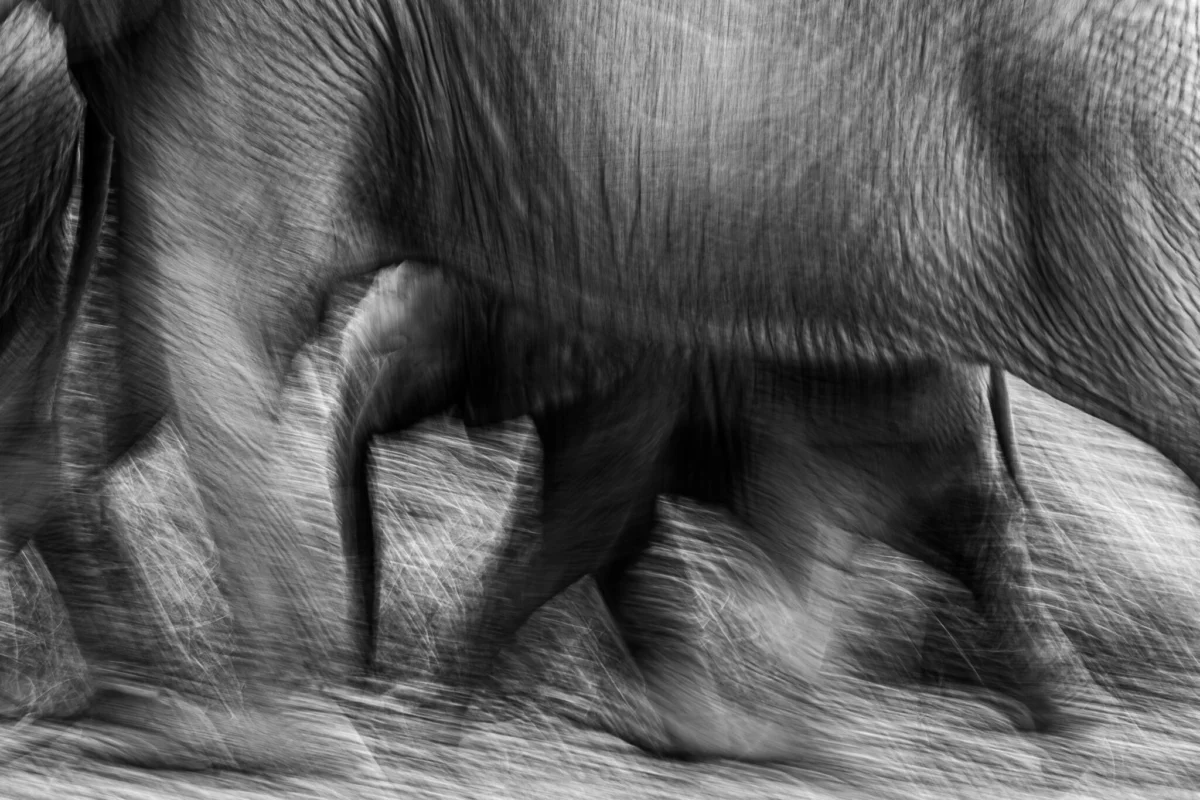
His dedication to capturing movement extends to more serene subjects. A lone Grant’s gazelle, observed walking gracefully one morning, was captured with a slow shutter speed and an aperture of f/5. This choice allowed the soft rim light tracing the gazelle’s form to transform the scene into a painterly rendition of life, inviting viewers to feel the animal’s motion rather than just see it. Similarly, an image of an elephant’s legs, captured with a slow shutter speed, transcends a simple portrait. It underscores the immense power and unique sensory capabilities of these magnificent creatures, whose pillar-like limbs support massive bodies and can even detect low-frequency rumbles from miles away, blurring the background to isolate and celebrate the strength and rhythm of their movement. This approach fundamentally challenges the notion that clarity equals truth, asserting that emotional resonance often lies in the artful abstraction of reality.

Illuminating Narratives: Light as a Principal Storyteller

For Murad, light is far more than a source of illumination; it is an active storyteller, a dynamic element that dictates mood, sculpts form, and evokes deep emotion. He has developed an acute sensitivity to how various qualities of light can reshape a scene: golden hour glow softening harsh landscapes, deep shadows injecting tension and mystery, or powerful backlighting transforming a simple bird into a poetic silhouette. He allows the prevailing light conditions to guide his exposure and inform the emotional tenor of his work, consistently transforming familiar scenes into something sublime or enigmatic. This often involves considerable patience, waiting for hours for the ideal light to filter through a scene, not with the aim of capturing technical perfection, but to render the scene with an emotional honesty that resonates deeply. It is through this deliberate engagement with light that Murad crafts his compelling visual narratives.

A striking example of this mastery is his photograph of a White (Pied) Wagtail, captured at sunset within one of Kuwait’s nature reserves. By positioning the setting sun directly behind the bird, Murad created a stunning, glowing backdrop, accentuating the bird’s form and the surrounding haze of flying mosquitoes, imbuing the image with a sense of magical realism. Another poignant image depicts a full-bellied hyena wandering at sunset, its solitary figure silhouetted against the fading light, conveying a sense of quiet contemplation at the close of the day. Similarly, a herd of blue wildebeest, pausing after a frantic flight from predators, is bathed in the warm, yellow glow of the setting sun, their hooves kicking up dust that catches the light. This dramatic illumination amplifies the raw tension and the brief respite in their struggle for survival on the African plains. These images exemplify Murad’s philosophy: light does not merely illuminate; it shapes the very soul of the story being told.

Urban Wilderness: Arabian Red Foxes in Kuwait City

One of Murad’s most compelling and ethically resonant projects involved documenting a family of Arabian red foxes living surprisingly close to the bustling metropolis of Kuwait City. His images of these foxes, particularly the cubs, framed by the vibrant, multi-colored glow of streetlights along Kuwait’s Doha shore, offer a powerful commentary on nature’s resilience in increasingly urbanized environments. The reflective surfaces of the sea magnified the artificial lights from streets and passing cars, creating a unique ambient setting. To achieve the distinctive rim light that defines these nocturnal portraits, Murad ingeniously utilized two small, handheld flashlights, patiently waiting for the mother fox to unearth food she had cleverly cached for her cubs. This innovative technique allowed him to capture the magical glow of the urban night, highlighting a rare and intimate moment of wildlife thriving within a cityscape.

The dedication required for this project was immense. For over two months, Murad visited the foxes’ den four days a week, spending countless hours after sunset observing their routines. He began by maintaining a respectful distance, allowing the foxes to gradually acclimate to his presence. Over time, an extraordinary level of trust developed; the foxes, particularly the curious kits, began to approach his gear, even licking his camera and feet as he sat quietly. This profound personal connection, further deepened by Murad’s own experience as a father to five children, mirrored the fox family’s dynamic and instilled in him a profound sense of responsibility for their protection. He documented the mother fox’s nightly ritual of burying food – often fish, birds, or scraps – for her kits to discover, capturing intimate moments of the cubs digging up their hidden treasures, their eyes gleaming in the artificial light. This series not only showcases the delicate balance between urban expansion and wildlife survival but also underscores the crucial role of human empathy and careful observation in wildlife photography. It serves as a poignant reminder of nature’s adaptability and humanity’s stewardship.

Global Expeditions: Lessons in Adaptability and Serendipity

Murad’s photographic odysseys have taken him far beyond the deserts of Kuwait, extending to the icy expanses of Mongolia and the rugged landscapes of Iceland. Each expedition has been a crucible for learning, instilling invaluable lessons in patience, adaptability, and an openness to the inherent unpredictability of the natural world. Lost luggage, biting arctic winds, and extreme temperatures, such as the -34°C endured in Mongolia, have all acted as formidable teachers, reinforcing the understanding that nature operates on its own terms. He firmly believes that profound images often emerge not from attempts to control every variable, but from the willingness to surrender to the scene as it naturally unfolds. His philosophy centers on moving with nature, rather than against its unpredictable currents.

In the remote Hornstrandir Nature Reserve in Iceland, a region untouched by human infrastructure since the 1950s and accessible only by a challenging boat journey, Murad encountered an Arctic fox. He captured it in a moment of peaceful slumber, curled behind snow-covered dry plants, its nose tucked under its tail, gazing directly into his lens. This intimate photograph, taken without disturbing the animal, speaks volumes about the undisturbed tranquility of Hornstrandir, a testament to pure nature. Another monumental achievement was the rare sighting of an elusive snow leopard, often dubbed "nature’s ghost," in the Altai Mountains of Mongolia. After enduring extreme cold and fierce winds, Murad was rewarded with a glimpse of this endangered predator, perfectly camouflaged against the fiery orange lichens and rugged rocks. This image is an awe-inspiring reminder of the snow leopard’s resilience in one of the world’s harshest environments and highlights the urgent need for its conservation, given its ‘Vulnerable’ status on the IUCN Red List, with fewer than 10,000 individuals estimated to remain in the wild.

Even closer to home, on Kubbar Island in Kuwait, Murad applied his slow shutter techniques to capture a colony of Greater Crested Terns in flight. Using upward camera movement, he created an abstract, painterly effect, transforming the birds into streaks of light and motion, reminiscent of painting with light. This approach, he explains, allows him to tap into a "mystical oneness" with the universe, transcending the literal depiction of a bird to express a deeper connection. These diverse experiences underscore his commitment to adapting his vision to the unique challenges and inherent beauty of each environment.

The Evolving Canvas: Beyond Technical Perfection to Creative Expression

At the very core of Mohammad Murad’s photographic practice lies a fervent desire to express something far beyond mere visual representation. He strives for his images to evoke a visceral response, to resonate deeply on an emotional level with the viewer. This ambition is precisely why he consistently experiments with techniques that push the boundaries of conventional photography. His aim is to translate the delicate fragility of a bird in mid-flight, the unwavering resilience of a migratory herd, or the silent, complex dialogue between predator and prey. Murad’s body of work is not merely a showcase of wildlife; it is an intimate sharing of his interpretation of life itself, filtered through his artistic lens.

He champions a departure from the pervasive pursuit of absolute technical perfection, advocating instead for photographers to trust their intuitive instincts and courageously embrace their individual creative voices. This philosophy is evident in images such as a powerful lion roaming the African wilderness, which Murad sees as a reflection of his own journey, protecting territory and building a family in a "stunning, wild heaven." This personal identification injects profound emotion into the portrayal of the majestic predator. Another poignant example is his slow shutter shot of a baby elephant and its mother in Tanzania. Far from being a clinical capture, it is, in his words, "my way of reinventing the scene, adding mystery, and expressing my inner self." Like a musician playing a personal melody, Murad uses photography to share his narrative, deliberately leaving ample room for the viewer’s own interpretation and emotional engagement. His work thus stands as a powerful testament to the limitless potential of art to convey complex feelings and unspoken stories.

Conclusion: An Ongoing Dialogue with the Wild

For Mohammad Murad, photography is not a finite pursuit with a definitive endpoint; it is an continuous odyssey, a dynamic interplay between light and shadow, motion and stillness, meticulous precision and serendipitous chance. Through each carefully crafted image, he endeavors to draw viewers into this intricate dance, inviting them to feel the profound heartbeat of the natural world. Every frame he captures is imbued with a fragment of his personal story—his trials, his moments of awe, and his profound, unwavering respect for the wilderness. His unique artistic vision offers a compelling alternative to traditional wildlife photography, pushing boundaries and encouraging deeper emotional engagement. It is Murad’s sincere hope that his work will inspire others to look beyond the immediate surface, to discover their own rhythmic connection with the wild, and ultimately, to perceive photography not merely as a technical craft, but as an ever-evolving, deeply personal conversation with nature itself.
