
The northern hemisphere’s transition from spring to summer marks a critical period for avian life, signaling the onset of breeding season. During these months, countless bird species engage in the intricate process of egg-laying, incubation, and chick-rearing, a cycle underpinned by the construction of specialized structures: nests. These temporary abodes, essential for the survival of the next generation, exhibit a remarkable spectrum of materials, designs, and locations, a diversity eloquently captured and presented by Her Imperial Highness Princess Takamado in the June 2026 edition of Fujingahou Magazine. Her feature, titled "Through the Lens," offers readers a unique glimpse into the architectural marvels of the avian world in Japan, emphasizing both the beauty and the evolutionary ingenuity behind each structure.
Background and Royal Engagement in Ornithology

Her Imperial Highness Princess Takamado, known for her profound passion for ornithology and her dedicated involvement in conservation efforts, regularly contributes to the public understanding of Japan’s rich biodiversity. Her work often combines her photographic talent with insightful commentary, making complex ecological concepts accessible to a broad audience. This particular feature in Fujingahou, a prestigious Japanese women’s lifestyle magazine known for its cultural and royal coverage, underscores her commitment to raising awareness about wildlife. The magazine’s decision to feature Princess Takamado’s observations during this pivotal season aligns with its tradition of presenting high-quality content that educates and inspires. The English version of the article, prepared by BirdLife International, further extends the reach of this important message, highlighting the global relevance of avian conservation and the Princess’s international affiliations. BirdLife International, a global partnership of conservation organizations, frequently collaborates with prominent figures to amplify their conservation advocacy, making the Princess a natural ally in their mission.
The Purpose and Diversity of Avian Architecture
Bird nests are not permanent residences but rather purpose-built nurseries, meticulously crafted to protect eggs and vulnerable chicks from predators and environmental extremes. Their existence is almost exclusively tied to the breeding cycle. The variety observed in nest construction reflects millennia of evolutionary adaptation to specific environments, available materials, and predator pressures. From robust platforms high in trees to camouflaged ground scrapes, each nest type represents an optimized solution to the fundamental challenge of ensuring species propagation.

Spotlight on Japan’s Nest Builders: A Closer Look
Princess Takamado’s article meticulously showcases several fascinating examples of nests found across Japan, each telling a story of adaptation and survival.
The Grey Heron: Adaptability in Nesting Sites
Measuring approximately 95 cm, the Grey Heron (Ardea cinerea) is a common sight near wetlands, rivers, and coastlines across Eurasia and Africa. Typically, these large wading birds construct shallow, dish-shaped nests from sticks high in tall trees, often forming colonies known as heronries. This strategy provides a degree of safety from ground predators and offers an elevated vantage point. However, Princess Takamado’s feature highlights a remarkably rare observation: a Grey Heron nest built directly on a cliff face. This exceptional example, viewed from above, offered an unprecedented look at the heron’s distinct blue eggs and later, the adorable chicks. This deviation from typical arboreal nesting underscores the species’ remarkable adaptability; as long as a site offers sufficient safety from predators, herons may choose unconventional locations. Such flexibility is a crucial survival trait in changing landscapes, demonstrating that birds prioritize security above all else in their nesting choices. The Princess’s photograph of a more typical tree-bound nest further illustrates the standard practice, showing a male heron diligently passing long branches to the female, who incorporates them into the structure, even reinforcing it during incubation. These nests, while appearing small relative to the bird’s size, are robust structures designed to withstand the elements and support several growing chicks.

The Great Spotted Woodpecker: Excavating Life into Deadwood
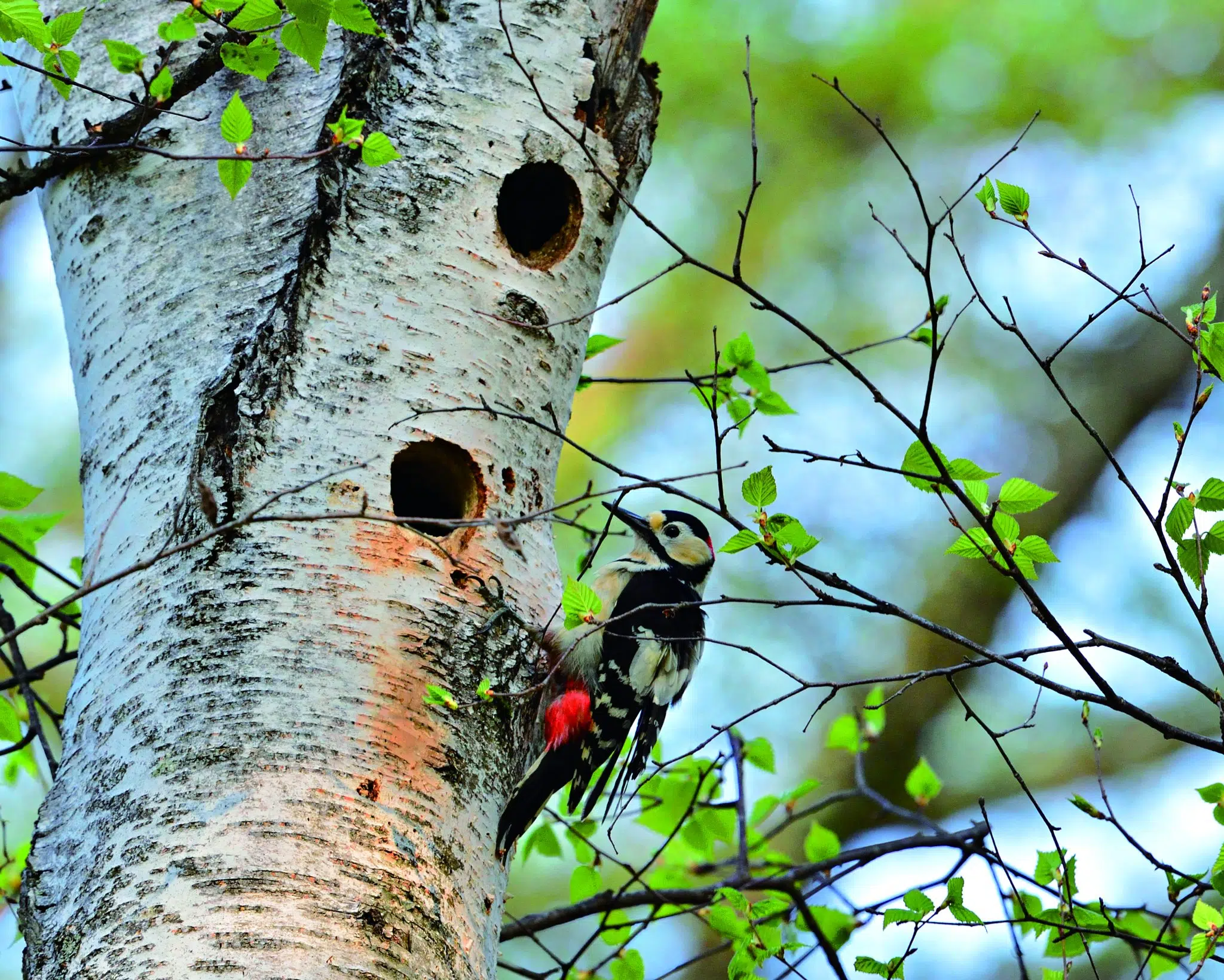
The Great Spotted Woodpecker (Dendrocopos major), a medium-sized bird of 23.5 cm, belongs to the Picidae family, renowned for their ability to excavate cavities in trees. Unlike birds that build open nests, woodpeckers create enclosed chambers within tree trunks, providing excellent insulation and protection. Both male and female woodpeckers participate in the arduous task of carving out their nest holes using their strong beaks. They preferentially select dead trees or those whose interiors have been softened by fungal decay, thus minimizing damage to healthy, living timber. The excavation process typically begins with a horizontal tunnel leading to a downward-sloping vertical shaft, forming a cozy chamber at the bottom. A crucial ecological role played by woodpeckers is that they are primary cavity excavators. Since most woodpecker species construct a new nest cavity each year, their abandoned holes become vital resources for a host of secondary cavity nesters, including various tit species, owls, bats, and even small mammals. This makes them "ecosystem engineers," providing essential housing for numerous other forest dwellers and contributing significantly to forest biodiversity.
The Little Grebe: A Floating Oasis of Life
The Little Grebe (Tachybaptus ruficollis), a small aquatic bird of 26 cm, exemplifies ingenious adaptation to a watery environment. These birds construct floating nests from aquatic plants, underwater weeds, and branches anchored to surrounding vegetation in shallow ponds and lakes. This unique design allows the nest to rise and fall with fluctuating water levels, offering a natural defense against flooding—a particularly vital trait in an era of unpredictable weather patterns. Princess Takamado highlights the grebes’ tenacity: even when faced with rising water, they will continue to breed, piling fresh nesting materials atop the existing structure to keep their eggs dry. Another fascinating behavior is their habit of covering their eggs with surrounding aquatic plants whenever they temporarily leave the nest. This serves a dual purpose: camouflage against predators and insulation, helping to maintain a stable temperature for the developing embryos. The Little Grebe’s approach to nesting showcases a remarkable blend of resourcefulness and parental care, ensuring the continuity of their species in often dynamic wetland habitats.
The Varied Tit: Utilizing Nature’s Ready-Made Shelters
The Varied Tit (Sittiparus varius), a charming 14 cm bird of the Paridae family, demonstrates a reliance on existing structures for its nesting needs. Unlike woodpeckers, Varied Tits lack the ability to excavate their own nest holes. Consequently, they seek out natural tree cavities, abandoned woodpecker nests, or readily adopt artificial nest boxes provided by humans. Once a suitable cavity is found, they meticulously line it with soft, insulating materials such as moss, ferns, and animal hair. This careful preparation creates a warm, secure environment for their clutch. Their willingness to utilize nest boxes makes them an important species in urban and suburban conservation efforts, as providing these artificial shelters can directly support local populations, particularly in areas where natural tree cavities are scarce due to habitat loss or removal of deadwood.

The Asian House Martin: Urban Adapters and Mud Architects
The Asian House Martin (Delichon dasypus), a compact 13 cm member of the Hirundinidae family, is a testament to avian adaptation to human-modified landscapes. Historically, these swallow-like birds nested predominantly on natural cliffs. However, in recent decades, they have increasingly colonized urban areas, becoming familiar sights under bridge girders, pedestrian overpasses, and the eaves of buildings. Their nests are distinctive, hemispherical structures meticulously constructed from pellets of mud mixed with dried grass and other fibrous materials. The birds collect wet mud, often from puddles or riverbanks, and painstakingly apply it layer by layer, creating a durable, enclosed nest with a small entrance hole. This shift to anthropogenic structures provides them with stable, sheltered sites often free from natural predators, although it can also bring them into closer contact with human activities. Their colonial nesting habits mean that multiple nests can often be found in close proximity, a vibrant indicator of a healthy local population.
The Peregrine Falcon: Apex Predators and Urban Frontiers
The Peregrine Falcon (Falco peregrinus), known for its incredible speed and prowess as an aerial hunter, exhibits a minimalist approach to nesting. With males measuring around 41 cm and females larger at 49 cm, these powerful raptors typically do not build elaborate nests. Instead, they lay their eggs in a shallow depression or "scrape" on rocky ledges of steep coastal cliffs, as captured by Princess Takamado. Such locations offer an expansive, open view, which is crucial for detecting both prey and potential predators from a distance, thereby ensuring the safety of their clutch. The Princess’s observation of four growing chicks on such a ledge, practicing wing movements, highlights the precariousness of their early lives and the innate worries of any observer for their safety. In recent years, Peregrine Falcons have shown a remarkable adaptation to urban environments, increasingly nesting on high-rise buildings, communication towers, and other tall man-made structures. This urban shift is driven by the abundance of prey (such as pigeons) and the provision of secure, high nesting sites that mimic natural cliff faces. The species’ recovery from severe population declines in the mid-20th century due to DDT pesticide use is a major conservation success story, further emphasizing their resilience and adaptability.
The Long-tailed Tit: An Intricate Feathery Pouch
Concluding the Princess’s fascinating tour is the nest of the Long-tailed Tit (Aegithalos caudatus), arguably the most intricate and aesthetically pleasing of all the structures featured. This tiny, 13.5 cm bird of the Aegithalidae family constructs a remarkable pouch-shaped nest. It meticulously weaves together moss and lichen, binding them with spider silk to create a flexible yet robust outer shell. The interior is then generously lined with a multitude of soft feathers, creating a wonderfully insulated and comfortable chamber. Long-tailed Tits are known for laying large clutches, often averaging nine eggs, and their nests are observed to expand subtly as the chicks grow, accommodating their increasing size. Furthermore, Long-tailed Tits are one of the few bird species in Japan that exhibit cooperative breeding, where "helper birds"—often individuals from failed breeding attempts—assist the breeding pair in feeding the chicks. This altruistic behavior enhances the survival rate of the brood and allows for larger broods, highlighting complex social dynamics within avian communities.

Broader Implications and Conservation Message
Princess Takamado’s "Through the Lens" feature serves as more than just a pictorial essay; it is a vital educational tool that underscores the importance of observing and protecting Japan’s avian fauna. By showcasing the extraordinary diversity and ingenuity of bird nests, the article implicitly calls for greater public awareness and engagement in conservation.
The intricate adaptations seen in each species – from the Grey Heron’s site flexibility to the Long-tailed Tit’s communal parenting – are products of evolutionary pressures and environmental interactions. As human development continues to reshape natural landscapes, understanding these adaptations becomes crucial. The growing trend of urban nesting, as seen with Asian House Martins and Peregrine Falcons, highlights both the challenges and opportunities for co-existence between humans and wildlife. Providing suitable habitats, whether through preserving natural spaces or deploying artificial nest boxes for species like the Varied Tit, can significantly impact avian populations.

The Princess’s concluding remark, clarifying that a bird’s nest is solely for breeding and not a permanent home, is a simple yet profound distinction that helps demystify avian behavior for the general public. This fundamental understanding is key to fostering respect for wildlife and preventing misunderstandings that can lead to human-wildlife conflict.
From a conservation perspective, the visibility provided by a royal figure like Princess Takamado is invaluable. Her article, published in a widely-read magazine and translated by an international conservation body, amplifies the message of biodiversity protection. It encourages readers to look closer at the natural world around them, to appreciate the delicate cycles of life, and perhaps, to consider their own role in safeguarding these wonders. The timing of the article in June 2026, coinciding with the peak of the breeding season, maximizes its relevance and impact, inspiring readers to observe these natural phenomena firsthand.
In essence, Her Imperial Highness Princess Takamado’s "Through the Lens" is a beautifully curated narrative that transcends mere observation. It is an invitation to marvel at the ingenuity of nature, an educational journey into the world of avian architecture, and a subtle yet powerful call to protect the vibrant biodiversity that enriches Japan and the world.
