
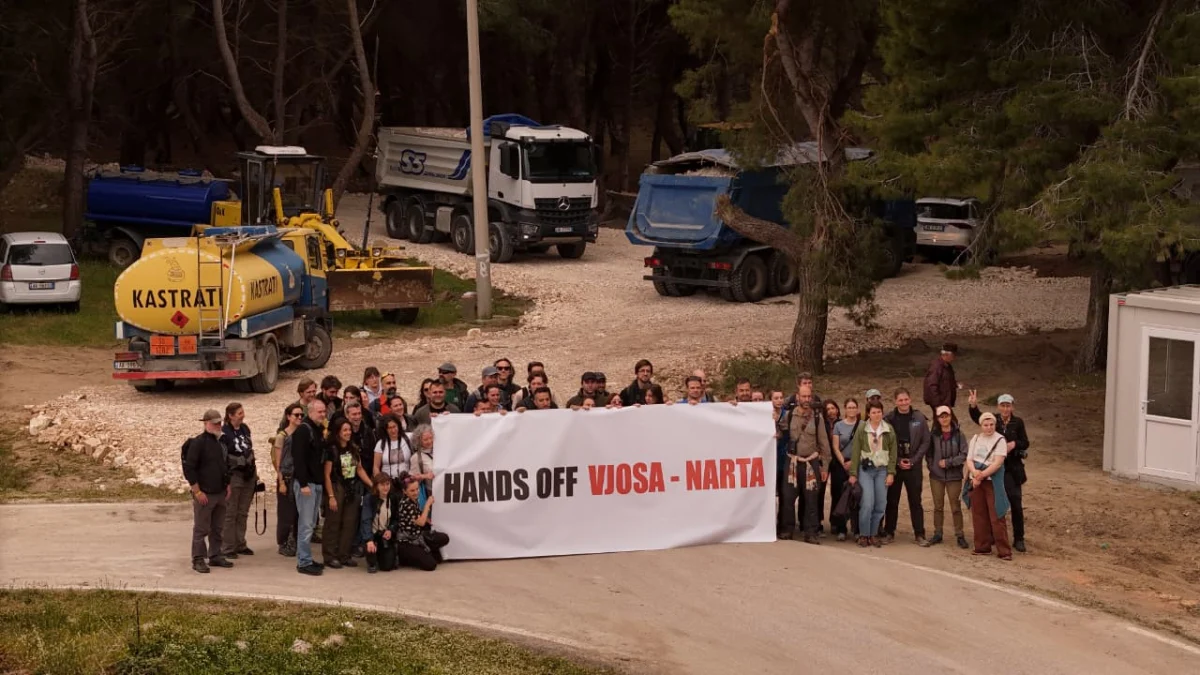
The pristine Albanian coast in spring offers a breathtaking spectacle of natural life, a vital sanctuary where flamingos wade gracefully through serene lagoons, Dalmatian Pelicans glide majestically overhead, and millions of migratory birds find crucial respite within the ancient shelter of a sprawling pine forest before continuing their arduous journeys between the continents of Europe and Africa. This ecological marvel is known as Pishë Poro-Nartë, widely recognized as one of the finest remaining wild coastlines in the entire Mediterranean basin and a site of immense global ecological importance. However, this irreplaceable haven is currently under an unprecedented assault, as bulldozers relentlessly tear through its delicate ecosystems.
An Ecological Jewel Under Threat
Pishë Poro-Nartë forms an integral part of the Vjosë-Nartë Protected Landscape, an expansive and biodiverse region encompassing the delta of the Vjosë, often lauded as one of Europe’s last wild rivers. This broader protected area is a biodiversity hotspot, documented as home to over 70 species listed as endangered and supporting more than 200 distinct bird species, including internationally significant populations of the endangered Dalmatian Pelican (Pelecanus crispus) and the Greater Flamingo (Phoenicopterus roseus). The ancient pine forest, with trees centuries old, is not merely a scenic feature but an irreplaceable ecological component, situated directly on the Adriatic Flyway, one of Europe’s most critical migration corridors. This avian superhighway funnels countless birds across the Mediterranean, making the integrity of Pishë Poro-Nartë paramount. Its destruction would trigger devastating ripple effects far beyond Albania’s national borders, impacting avian populations and ecosystems across an entire continent and beyond.
The Nartë Lagoon, a Ramsar site of international importance, is particularly vulnerable. Designated for its wetlands, which support waterbirds, fish, and other aquatic species, the lagoon’s delicate balance is intricately linked to the surrounding coastal habitats. The flattening of sand dunes, shaped over millennia by natural processes, directly undermines the lagoon’s protective barriers against the sea and destroys unique psammophilous (sand-loving) plant communities, which are often rare and endemic. These dunes also serve as critical nesting grounds for various shorebirds and reptiles. The removal of ancient pine forests, which act as natural windbreaks and stabilizers for the sandy soils, further exacerbates erosion risks and habitat fragmentation. Experts estimate that the loss of even a small percentage of this habitat could lead to local extinctions and significant declines in migratory bird populations, disrupting the delicate ecological network of the Adriatic Flyway.
Unfolding Crisis: A Chronology of Unsanctioned Destruction
The current crisis began at the end of April, when heavy machinery, including bulldozers and excavators, moved into the heart of the protected area. This operation commenced without any apparent legal authorization: there was no publicly approved project plan, no prior public consultation with local communities or environmental stakeholders, no environmental impact assessment (EIA) as mandated by Albanian and international law, and conspicuously, no sign of a valid construction permit. Trees that have stood for centuries are being felled indiscriminately, and ancient sand dunes, vital for coastal stability and biodiversity, are being systematically levelled. The shocking aspect of this unfolding scandal is the profound lack of transparency and accountability; there has been no official explanation from any governmental authority regarding who authorized these works, what is being built, or under what legal pretext.
This covert operation appears to exploit a narrow window of opportunity, a calculated move to establish irreversible facts on the ground. The timeline of events suggests a deliberate rush to pre-empt stricter environmental regulations. For years, environmental organizations and the European Commission have been raising concerns about Albania’s environmental governance and its adherence to international standards. The sudden, unauthorized nature of the current works at Pishë Poro-Nartë indicates a cynical attempt to bypass legal processes and render future protective measures obsolete.
A Legislative Loophole and EU Scrutiny
The context for this audacious environmental destruction is rooted in controversial legislative changes. The Albanian government previously amended its Law on Protected Areas, introducing provisions that explicitly permit the construction of luxury resorts and large-scale tourism infrastructure within designated protected zones. This legislative alteration directly contradicts established European Union nature protection standards, particularly those enshrined in the Birds and Habitats Directives, which are foundational to the EU’s Natura 2000 network – a benchmark Albania is expected to align with as a candidate country.
Albania is currently engaged in crucial EU accession negotiations, a process that demands rigorous alignment with the EU acquis communautaire, including its comprehensive environmental framework. The European Commission has repeatedly and unequivocally made clear that the amended Albanian law on protected areas is a significant impediment to its accession progress and must be reformed to meet EU environmental benchmarks. In its annual progress reports, the Commission has consistently highlighted deficiencies in Albania’s environmental legislation and enforcement, stressing the need for robust protection of its natural heritage. Despite these clear directives and the Albanian government’s assurances that the legislation would be updated to comply with EU standards, works are racing ahead on the ground.
Aleksandër Trajçe, the Director of PPNEA (Protection and Preservation of Natural Environment in Albania), BirdLife’s Albanian partner, has starkly articulated the apparent logic behind these actions: "build now, before a stricter law makes it impossible." This strategy, often referred to as ‘fait accompli’ development, aims to create irreversible changes, making it difficult or impossible for future legal reforms or enforcement actions to restore the original state of the environment. The audacity of the current operations is further compounded by the fact that they appear to be illegal even under the existing, already controversial, legislation. The absence of environmental assessments, public consultation, transparent permitting processes, and any official explanation from authorities underscores a profound breakdown of the rule of law and good governance.
The specter of large-scale development looms large over the area. Reports have indicated plans for a major tourism development project linked to Jared Kushner, a former senior advisor to the US President, in this very region. While it remains unclear whether the current illegal works are directly connected to this specific planned project, their existence certainly raises significant questions about the long-term intentions for Pishë Poro-Nartë and the broader Vjosë-Nartë Protected Landscape. Such high-profile projects often attract significant scrutiny, and any association with unapproved or illegal construction could have severe reputational repercussions.
Voices of Alarm: NGO Response and Demands for Accountability
In response to the escalating crisis, BirdLife Europe’s Regional Director, Ariel Brunner, and Head of Policy, Anouk Puymartin, undertook an urgent visit to Tirana. Their mission was to engage directly with Albanian authorities, convey the international community’s profound alarm, and press for immediate action. While conversations with Albanian officials were described as constructive, yielding assurances that the problematic environmental legislation would indeed be updated within the current year, these verbal commitments offer little solace as the destruction continues unabated.
Ariel Brunner, speaking at a press conference in Tirana, delivered a clear and forceful message: "Bulldozers are operating in a completely illegal way, based on unclear decisions and a total lack of transparency – and this needs to stop." His statement encapsulates the frustration and urgency felt by environmental organizations worldwide. The promise of future legal reform rings hollow when the very ecosystems it aims to protect are being systematically dismantled in real-time. By the time a reformed, EU-compliant law comes into force, the ancient pine forest and critical coastal habitats it was meant to safeguard may already be irrevocably lost.
BirdLife Europe, PPNEA, and a coalition of other environmental organizations are issuing an unequivocal call to action. They demand that Albanian institutions immediately halt all ongoing works at Pishë Poro-Nartë. Furthermore, they insist on the full and transparent publication of every permit, project document, and official communication related to the site, thereby restoring public trust and accountability. Crucially, they are advocating for the launch of a full, independent legal investigation into the circumstances surrounding the commencement of these illegal works, the identification of those responsible for authorization, and the enforcement of appropriate legal consequences.
Broader Implications: Ecology, Governance, and International Standing
The destruction at Pishë Poro-Nartë carries profound implications across multiple dimensions. Ecologically, the immediate loss of habitat for endangered species and migratory birds is catastrophic. The long-term effects could include increased coastal erosion, salinization of freshwater sources, disruption of local fisheries, and a significant reduction in biodiversity. The entire Adriatic Flyway, a critical artery for European bird migration, would be compromised, with cascading effects on bird populations in countries spanning from the Arctic to sub-Saharan Africa. The ecological services provided by this wetland – such as water purification, flood control, and climate regulation – are also being severely undermined, representing an unquantifiable loss for the region.
From a governance perspective, the scandal at Pishë Poro-Nartë highlights deep-seated issues within Albania’s administrative and legal frameworks. The apparent ability of heavy machinery to operate within a legally protected area without proper permits, environmental assessments, or public consultation points to a severe breakdown in the rule of law, transparency, and institutional integrity. This undermines public trust in government institutions and raises serious questions about corruption and vested interests. The lack of clear communication or justification from authorities only exacerbates these concerns, suggesting a deliberate attempt to obscure facts.
Internationally, this incident severely damages Albania’s credibility, particularly in the context of its aspirations for European Union membership. Adherence to environmental acquis is not merely a bureaucratic hurdle but a fundamental commitment to shared European values of environmental protection and sustainable development. The blatant disregard for national and international environmental laws at a site of global importance sends a negative signal to Brussels and other international partners, potentially jeopardizing the pace and success of Albania’s EU accession negotiations. It also undermines Albania’s standing on the global stage as a responsible steward of its natural heritage.
Economically, while proponents of such developments often cite job creation and tourism revenue, the destruction of natural assets like Pishë Poro-Nartë represents a shortsighted approach. Sustainable ecotourism, which leverages Albania’s unique natural beauty, offers a long-term, resilient economic model. The current actions risk destroying the very assets that attract discerning tourists and investors interested in sustainable practices, thereby undermining the potential for long-term, environmentally friendly economic growth. The true economic value of intact ecosystems, often termed ‘natural capital,’ far outweighs the temporary gains from destructive development.
The Path Forward: Calls for Accountability and Sustainable Development
The future of Pishë Poro-Nartë, and indeed Albania’s environmental reputation, hangs precariously in the balance. The demands from BirdLife Europe and PPNEA are not merely pleas for environmental protection but a call for fundamental adherence to the rule of law, transparency, and good governance. Halting the works immediately is the first critical step, but it must be followed by a comprehensive investigation that holds all responsible parties accountable, regardless of their position or influence.
Albania’s wild coast is unequivocally one of its greatest national assets, a treasure trove of biodiversity and natural beauty that benefits not only its citizens but also the global community. Destroying it in secret, without due process, within a legally protected area, is not merely an environmental crime; it is a profound betrayal of the Albanian people, a stark disregard for European commitments, and a devastating blow to the millions of birds and countless other species that depend on this irreplaceable place every year. The international community, through organizations like BirdLife Europe and the European Commission, is watching closely, urging Albania to uphold its obligations and protect its invaluable natural heritage for generations to come. The choice before the Albanian government is clear: protect its natural capital and uphold the rule of law, or face severe consequences for its environment, its governance, and its aspirations for a European future.
