
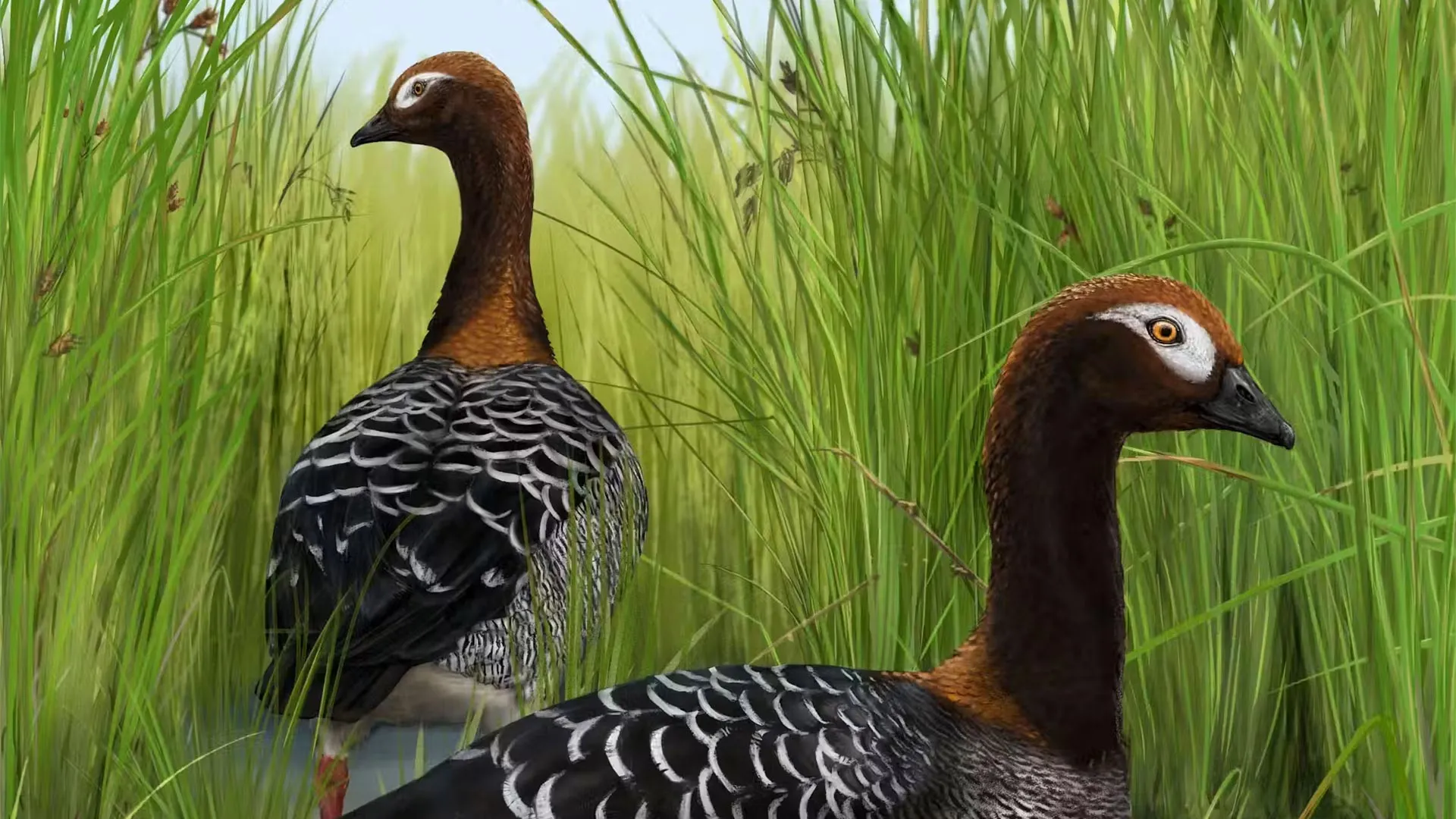
Deep within the sun-baked, fossil-rich badlands of Central Otago, New Zealand, scientists have uncovered the remains of a long-extinct, small-bodied goose that is fundamentally altering our understanding of how the isolated ecosystems of Aotearoa took shape. Recovered from the ancient, Miocene-epoch lakebed known as the St Bathans fossil deposits, this rare avian specimen has been officially described as a brand-new species to science: Meterchen luti.
The discovery is the culmination of meticulous detective work carried out by an international, multidisciplinary team of researchers hailing from the University of Otago (Ōtākou Whakaihu Waka), the Museum of New Zealand Te Papa Tongarewa, and the University of Cambridge in the United Kingdom. Their findings, recently published in the peer-reviewed scientific journal Historical Biology, provide a fresh lens through which paleornithologists can view the biogeographic history of the Southern Hemisphere. By bridging the gap between fossil morphology and modern paleogenomics, the study dismantles long-held assumptions about the continuity of New Zealand’s waterfowl lineages and highlights an evolutionary past characterized by waves of colonization, localized extinction, and astonishingly rapid adaptation.
Unearthing the St Bathans Fossil Deposits
To understand the significance of Meterchen luti, one must first examine the unique geological cradle from which it emerged. The St Bathans Fauna represents a prehistoric window into early Miocene New Zealand, dating back roughly 16 to 19 million years. During this period, much of modern-day New Zealand was submerged or comprised of low-lying islands, forming the unsubmerged peaks of the largely sunken continent of Zealandia.
The St Bathans site preserves a freshwater lake system surrounded by a subtropical or warm-temperate landscape. Over millions of years, the sediments of this ancient lake trapped the bones of animals that lived, died, and washed into its waters. Today, paleontologists working in Central Otago unearth an astonishing array of creatures from these deposits, including early bats, crocodiles, land mammals, archaic reptiles, and a diverse suite of birds.
Waterfowl remains—such as ducks, swans, and geese—are relatively common in the St Bathans fossil assemblage, testifying to the wetland-heavy environment of ancient Zealandia. However, among the thousands of bone fragments recovered over decades of excavation, goose-like remains have consistently stood out for their scarcity. Recognizing this gap in the fossil record, a collaborative team of researchers resolved to conduct a comprehensive audit of every single fossil bone from St Bathans that had ever been tentatively classified as belonging to a goose.
The team cross-referenced these ancient specimens not only against each other, but also against an extensive, global comparative collection of modern and extinct bird skeletons housed in institutional archives across New Zealand and the UK. What emerged from this exhaustive comparative analysis was surprising: among the mixed fragments lay an entirely distinct, undescribed species of waterfowl roughly the size of a modern small goose.
Etymology and the Story of Meterchen luti
Naming a newly discovered prehistoric species is a specialized task that often bridges strict taxonomic rules with a touch of narrative flair. The international research team settled on the binomial nomenclature Meterchen luti, a name steeped in both classical linguistics and literary homage.
The genus name, Meterchen, is derived from ancient Greek and translates directly to "mother goose." This is a playful nod to the famous nursery rhyme character Old Mother Goose, chosen to symbolize an ancient lineage of geese literally emerging from the muddy sediments of a fossil deposit. The specific epithet, luti, is rooted in Latin, meaning "of the mud," directly describing the taphonomic reality of how the fossilized bones were preserved for nearly twenty million years within the fine-grained silts of the ancient Otago lakebed.
According to Associate Professor Nic Rawlence, Director of the Otago Palaeogenetics Laboratory and a co-author of the study, the physical traits of Meterchen luti separate it cleanly from other iconic New Zealand waterfowl. Most notably, the St Bathans goose bears no close evolutionary relationship to the recently extinct giant flightless geese of the genus Cnemiornis, nor is it directly tied to their modern Australian relative, the Cape Barren goose (Cereopsis novaehollandiae). Instead, Meterchen luti represents a distinct, ancient branch of the waterfowl family tree that once inhabited the shores of Zealandia long before the landscapes modern New Zealanders recognize today had even begun to form.
Resolving a Long-Standing Scientific Debate
The discovery of Meterchen luti arrives at a crucial juncture in New Zealand ornithology, helping to resolve a contentious debate regarding the temporal origins of the nation’s endemic bird species. For decades, evolutionary biologists clashed over two competing paradigms concerning how and when Zealandia’s unique fauna established itself.
The traditional hypothesis, often termed the "vicariance" or "long-history" model, posited that many of New Zealand’s modern and recently extinct bird lineages were ancient residents. Proponents of this view argued that these lineages had persisted on the landmass since it broke away from the supercontinent of Gondwana roughly 80 million years ago. Under this theoretical framework, scientists previously hypothesized that the goose fossils found at St Bathans were the direct, unbroken ancestors of the colossal, flightless Cnemiornis geese that once roamed New Zealand before being hunted to extinction following human arrival. If true, this lineage would have maintained a continuous, uninterrupted presence in the region for at least 14 million years.
However, this neat chronological narrative began to fracture with the advent of ancient DNA analysis and modern phylogenetics. Lead author Alan Tennyson of the Museum of New Zealand Te Papa Tongarewa noted that genetic data paints a radically different picture of Aotearoa’s biodiversity.
"Many bird species have reached New Zealand over millions of years, but the ancestors of some of the country’s best known large birds arrived surprisingly recently," Tennyson explains.
Genetic sequencing of various endemic taxa indicates that the ancestors of several iconic New Zealand species—including the takahē (Porphyrio hochstetteri), Forbes’ harrier (Circus dossenus), and the apex avian predator, the giant Haast’s eagle (Hieraaetus moorei)—did not evolve in unbroken isolation from Gondwanan times. Instead, their ancestors made trans-Tasman dispersal flights across the open ocean to reach Zealandia relatively late in the geological game, dating back a mere four to five million years.
Furthermore, genetic clocks suggest that the lineage leading to the giant flightless Cnemiornis geese split from Australian relatives and arrived in New Zealand approximately seven million years ago. This hard genetic date stood in stark conflict with the older theory that linked Cnemiornis directly to the 19-million-year-old St Bathans fossils. For years, traditional paleontologists and geneticists debated the discrepancy, with some camps discarding the DNA evidence as an artifact of incomplete sampling.
The rigorous reassessment conducted by the Otago, Te Papa, and Cambridge research team has finally bridged this divide. By re-evaluating the morphology of Meterchen luti in light of modern genetic frameworks, the study demonstrates that the old theory was incorrect. The St Bathans goose did not evolve into the giant Cnemiornis geese. Rather, the St Bathans goose lineage represents an entirely separate, older wave of colonization that reached Zealandia more than 14 million years ago, only to eventually go extinct without leaving any surviving modern descendants. Meanwhile, the ancestors of the later giant geese arrived independently millions of years later.
DNA, Fossils, and the Dynamic Island Ecosystem
The unveiling of Meterchen luti underscores a broader, paradigm-shifting realization within modern evolutionary biology: Aotearoa’s pre-human bird history was not a static biological museum preserved in amber, but rather a dynamic, ever-shifting theater of colonization, adaptation, and extinction.
Associate Professor Rawlence emphasizes that untangling this complex history requires an interdisciplinary toolkit. "Using all the tools in the toolbox, including DNA and fossils, we can reconstruct how the dynamic geological, climatic, and human history of Zealandia has shaped the evolution of Aotearoa fauna in ever more detail," he states.
The integration of fossil morphology with ancient DNA extraction has allowed scientists to look past misleading physical similarities. Animals evolving under island conditions often undergo convergent evolution—where unrelated species develop similar body plans because they face similar ecological pressures, such as the absence of mammalian predators.
This phenomenon is vividly illustrated by the very creatures that once competed with or succeeded ancient waterfowl lineages in New Zealand: the giant flightless Cnemiornis geese. Standing roughly one meter tall and tipping the scales at up to 18 kilograms, these birds held the title of the largest geese in the entire world. Their massive size and loss of flight represent an extreme and remarkably rapid morphological transformation.
The research team points out that the evolution of Cnemiornis within a relatively short geological timeframe demonstrates how swiftly island ecosystems can mold animal anatomy. Isolated from continental predators and presented with abundant, unexploited niches, avian lineages in New Zealand repeatedly ballooned in size, lost their capacity for flight, or otherwise specialized in ways unseen on mainland continents.
Broader Implications for Conservation and Conservation Paleontology
Beyond academic taxonomy, insights gleaned from discoveries like Meterchen luti carry profound implications for contemporary conservation management in New Zealand. As the Department of Conservation and various non-governmental organizations work tirelessly to restore heavily degraded ecosystems and protect threatened native species—such as the critically endangered takahē—understanding the deep evolutionary context of these birds is vital.
Conservation paleontology provides the baseline data necessary to comprehend what a "natural" ecosystem in New Zealand actually looks like. The historical narrative of Aotearoa is often romanticized as an unchanging primeval paradise prior to Polynesian and European arrivals. However, the St Bathans fossil record and discoveries like Meterchen luti prove that New Zealand’s avifauna was already undergoing continuous, massive shifts driven by natural climate change, sea-level fluctuations, and successive waves of avian immigration long before humans ever set foot on its shores.
By recognizing that lineages like the St Bathans goose could rise, diversify, and ultimately vanish over millions of years, scientists gain a more nuanced appreciation for the resilience and vulnerability of island species. The fossil record serves as a long-term archive of ecological trial and error, demonstrating how rapid environmental shifts can stress even well-established island populations.
As laboratory techniques continue to advance—allowing for the recovery of degraded protein sequences and ancient genetic material from increasingly older fossils—researchers anticipate that more hidden species will emerge from museum drawers and remote field sites alike. The muddy lakebeds of Central Otago still hold countless secrets, and if Meterchen luti is any indication, the history of New Zealand’s feathered inhabitants is far more intricate, surprising, and dynamic than science ever dared to imagine.
