
For more than four decades, pop culture maintained a running joke about the absolute cognitive limits of bovine intelligence. In 1982, legendary cartoonist Gary Larson introduced a famously surreal Far Side panel titled Cow Tools. The single-panel illustration featured a bewildered cow standing proudly beside a bizarre, misshapen assortment of entirely useless, blocky objects meticulously laid out on the ground as "tools." The enduring humor of Larson’s creation relied on a universal, unquestioned cultural consensus: cows simply lacked the intellectual capacity, anatomical prerequisites, and abstract reasoning required to conceptualize, let alone utilize, a tool.
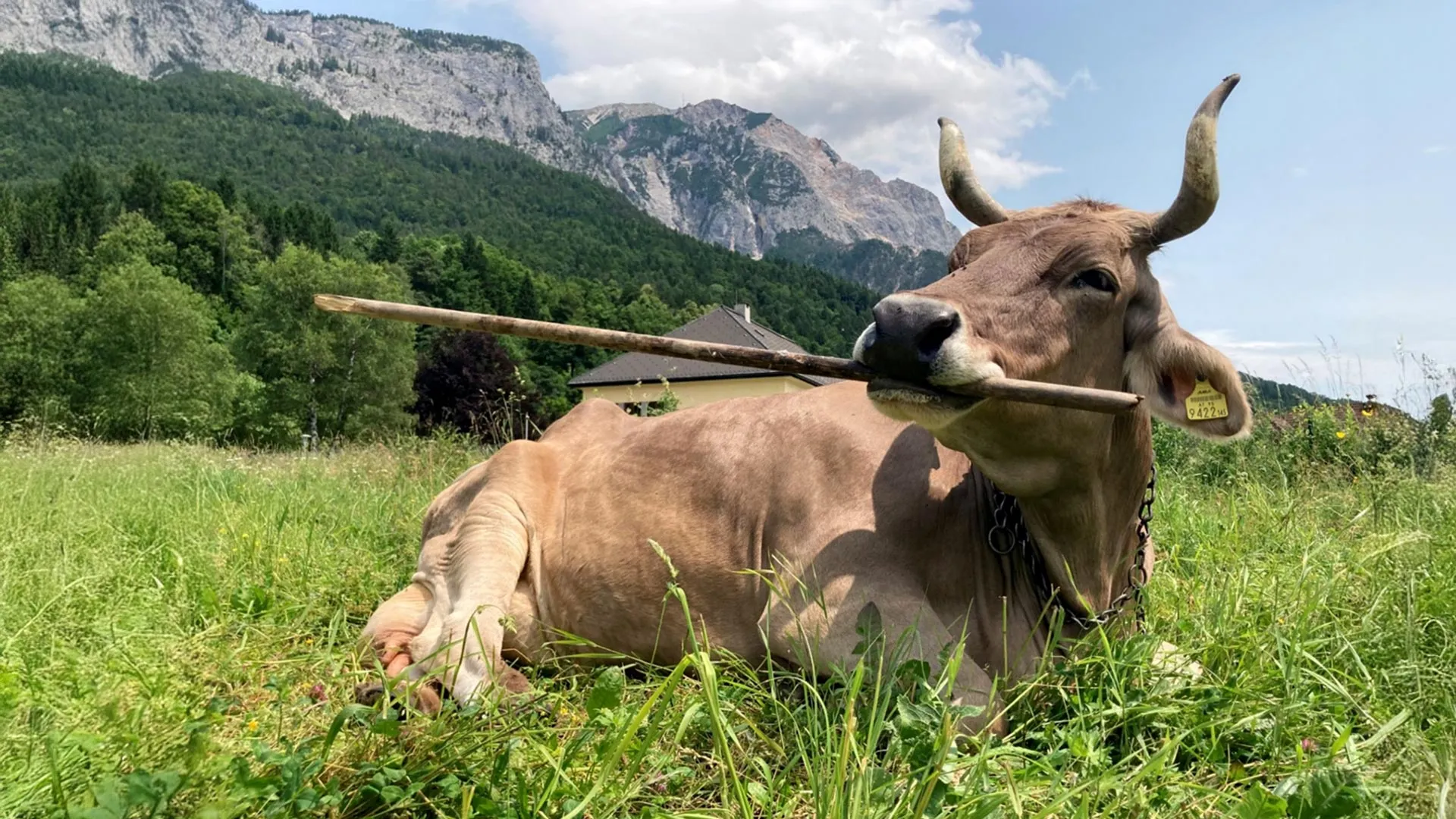
That comforting, decades-old anthropocentric assumption has now been systematically dismantled by a remarkably clever Swiss Brown cow named Veronika. According to a landmark study recently published in the peer-reviewed scientific journal Current Biology, researchers have documented the very first scientifically verified instance of sophisticated tool use in a domestic cow. This revelation provides compelling evidence that cattle possess hidden layers of behavioral plasticity and cognitive capability that have long gone unnoticed, largely due to a historic lack of targeted observation and the constrained environments in which livestock are typically managed.
"The findings highlight how assumptions about livestock intelligence may reflect gaps in observation rather than genuine cognitive limits," explains Dr. Alice Auersperg, a prominent cognitive biologist at the University of Veterinary Medicine in Vienna, whose team spearheaded the investigation into Veronika’s extraordinary abilities.
The Backstory: A Decade of Unnoticed Innovation
Veronika’s journey from an ordinary farm animal to an international scientific anomaly began more than ten years ago in the picturesque rural landscape where she lives. Unlike the vast majority of cattle globally, which are raised within intensive agricultural systems focused strictly on dairy or meat production, Veronika lives as a cherished companion animal. She is owned by Witgar Wiegele, an organic farmer and baker residing in Austria who integrates the bovine into his daily life and treats her as an extension of the family unit.
More than a decade ago, Wiegele first noticed his companion exhibiting bizarre and highly unusual behaviors that clearly deviated from standard bovine instincts. Rather than merely grazing or interacting socially with herdmates, Veronika would occasionally seek out wooden sticks, pick them up with her mouth, and systematically use them to scratch hard-to-reach areas of her anatomy. For years, this idiosyncratic behavior remained an isolated local curiosity, viewed as a quirky quirk of a beloved pet rather than a groundbreaking ethological discovery.
It was not until the footage of Veronika’s stick-handling habits was eventually captured on high-definition video and brought to the attention of professional behavioral researchers that the true scientific significance of her actions came to light. The videos offered researchers a rare, unvarnished look into spontaneous animal innovation outside of a laboratory setting.
"When I saw the footage, it was immediately clear that this was not accidental," Dr. Auersperg notes, reflecting on the moment the video evidence crossed her desk. "This was a meaningful example of tool use in a species that is rarely considered from a cognitive perspective."
Controlled Experiments and Methodical Observation
To move past anecdotal observation and rigorously test the cognitive parameters of Veronika’s behavior, a team of behavioral scientists designed a series of controlled experiments. Rather than merely watching her interact with random sticks, the researchers introduced standardized objects into her environment to systematically evaluate her decision-making process. Specifically, the team placed a heavy deck brush on the ground in various positions and meticulously recorded how Veronika approached, interacted with, and utilized the object.
The results of these structured trials stunned the research team. Across multiple experimental iterations, Veronika did not interact with the deck brush in a random or clumsy manner. Instead, she demonstrated a high degree of deliberate, goal-directed selectivity, consistently choosing specific structural components of the brush depending entirely on which part of her body required relief.
"We show that a cow can engage in genuinely flexible tool use," states Antonio Osuna-Mascaró, a co-author of the study. "Veronika is not just using an object to scratch herself. She uses different parts of the same tool for different purposes, and she applies different techniques depending on the function of the tool and the body region."
Further quantitative analysis of the trials revealed distinct, repeatable patterns in Veronika’s physical mechanics. When she targeted large, muscular, and structurally robust areas of her body—such as her back and shoulders—she unhesitatingly opted for the bristled side of the deck brush, applying broader, firmer, and more powerful sweeping motions. Conversely, when shifting her attention to sensitive, vulnerable regions along her lower abdomen and legs, she deftly transitioned to using the smoother, non-bristled wooden handle. Furthermore, her physical movements mirrored this calculated shift: her strokes directed at lower, sensitive areas were executed with markedly slower, highly controlled, and delicate precision.
Defining Tool Use in the Animal Kingdom
In behavioral ecology, tool use is formally defined as the employment of an unattached environmental object to alter the physical form, position, or condition of another object, another organism, or the user’s own body, through direct mechanical interaction. Veronika’s behavioral repertoire not only satisfies this rigorous scientific definition but actively elevates it into a much rarer category known as flexible, multi-purpose tool use.
This advanced classification requires an individual to utilize different structural features of a single, uniform tool to achieve distinct, tailored outcomes. Among non-human animals, this level of sophisticated cognitive flexibility has historically been documented almost exclusively in highly intelligent primates, such as chimpanzees, and a select few avian species, such as New Caledonian crows and Goffin’s cockatoos. Observing this capability in a ungulate—a hoofed mammal long categorized by agriculture as largely reactionary and stimulus-bound—fundamentally challenges established taxonomic hierarchies of intelligence.
Compounding this achievement is the physical reality of bovine anatomy. Because cows possess hooves rather than articulated hands or digits, Veronika is forced to manipulate her tools entirely with her mouth. This anatomical limitation introduces significant biomechanical hurdles, requiring her to manage weight, leverage, and spatial awareness exclusively through oral dexterity. Despite these inherent physical handicaps, Veronika displays extraordinary motor control, anticipating the mechanical consequences of her actions and adjusting her grip and force dynamically to ensure success.
Because her actions are directed exclusively toward her own body, her behavior falls under the subcategory of "egocentric tool use." While behavioral scientists generally consider egocentric tool use to be less complex than manipulating external objects to alter the environment (allocentric tool use), the sheer dexterity and cognitive planning required for a cow to execute it successfully remain exceptionally high.
Environmental Enrichment and the Roots of Innovation
Why has this behavior never been formally documented in cattle before? The research team points directly to the stark environmental differences between Veronika’s life and the existence of commercially farmed cattle.
The vast majority of modern livestock live in homogenized agricultural environments designed for efficiency, safety, and high-volume production. These settings typically offer minimal environmental complexity, restricted lifespans, and little to no exposure to novel manipulable objects. In contrast, Veronika has enjoyed a long life enriched by a complex, stimulating habitat, continuous access to diverse physical objects, and regular, positive interactions with human caretakers.
These exceptional conditions provided the ideal incubator for behavioral innovation, granting Veronika the time, space, and safety required to explore, experiment, and discover functional solutions to everyday physical discomforts.
"[Veronika] did not fashion tools like the cow in Gary Larson’s cartoon, but she selected, adjusted, and used one with notable dexterity and flexibility," the researchers write in their concluding remarks. "Perhaps the real absurdity lies not in imagining a tool-using cow, but in assuming such a thing could never exist."
Broader Implications for Ethology and Animal Welfare
The documentation of tool use in cattle carries profound implications across multiple scientific and agricultural disciplines. Primarily, it expands the growing catalog of species known to possess high-level problem-solving capacities, forcing ethologists to reconsider how intelligence is distributed across the animal kingdom. It suggests that many domestic species may harbor latent cognitive potentials that remain entirely unexpressed simply because their standard living conditions do not demand or permit intellectual innovation.
Furthermore, this discovery provides fresh ammunition for animal welfare advocates and behavioral scientists who argue for enriched housing conditions in modern livestock production. If animals like cows possess sophisticated inner lives, spatial reasoning, and the capacity for adaptive tool use, providing environments that stimulate their cognitive needs may be far more critical than previously understood.
Building on these findings, the research team at the University of Veterinary Medicine Vienna is actively expanding its investigations. They are currently exploring the specific environmental, social, and developmental conditions that allow such rare behaviors to emerge in non-traditional species. At the same time, the researchers are issuing a global call to action to farmers, veterinarians, rural communities, and animal enthusiasts to document and share similar occurrences.
"Because we suspect this ability may be more widespread than currently documented," Osuna-Mascaró emphasizes, "we invite readers who have observed cows or bulls using sticks or other handheld objects for purposeful actions to contact us."
As science continues to chip away at the arbitrary boundaries once drawn between human intellect and animal instinct, Veronika stands as a living testament to the fact that the natural world still holds plenty of surprises—proving that Gary Larson’s absurd cartoon was perhaps not so far-fetched after all.
