
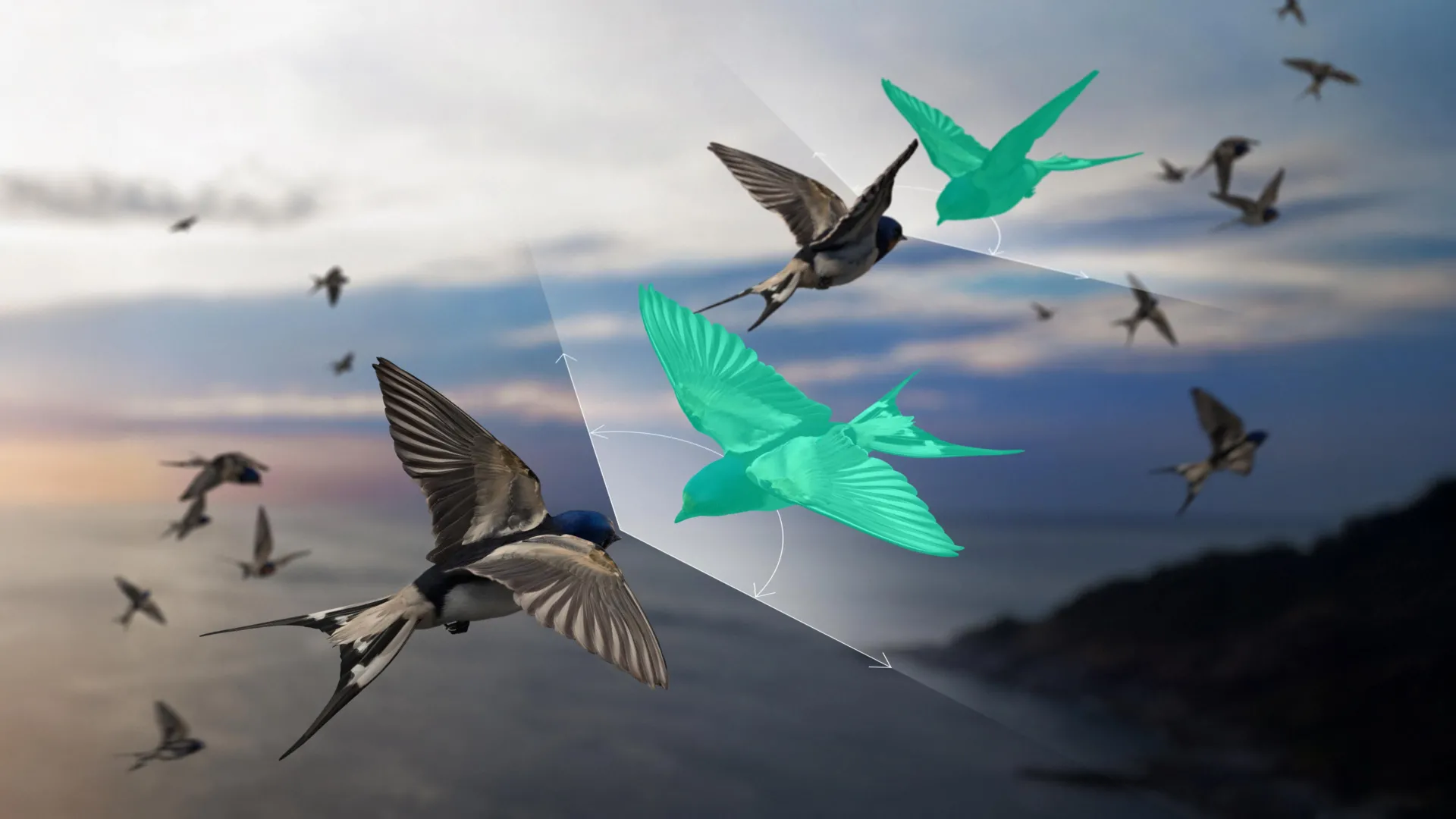
When starlings gather in breathtaking murmuration, twisting and turning in unison across the evening sky, they perform a masterclass in collective intelligence. Observers have long marveled at how thousands of birds can dart, wheel, and dive without colliding, functioning less like a collection of individuals and more like a singular, fluid organism. Yet, a closer look at the physics governing this breathtaking aerial choreography reveals a profound paradox that has baffled scientists for centuries. While birds maintain acute spatial awareness of a vast portion of their immediate surroundings, aerodynamic and behavioral studies show that individuals in flight coordinate their movements strictly with their neighbors and leaders—those beside and ahead of them. Crucially, they pay no heed to the birds trailing behind them.
This localized, directional attention breaks a fundamental rule of classical mechanics: Newton’s third law of motion. Often memorized in classrooms as the principle of reciprocal action and reaction—that for every action, there is an equal and opposite reaction—this foundational pillar of physics dictates that if object A exerts a force on object B, object B must exert an equal and opposite force back on object A. In the case of flocking birds, however, the front bird influences the back bird, but the back bird does not reciprocate that exact mechanical influence in reverse. The interaction flows purely in one direction, rendering the traditional mathematical models of classical physics seemingly obsolete for capturing these natural phenomena.
For more than three centuries, Newton’s third law has served as the bedrock upon which theoretical physics, mechanical engineering, and macroscopic dynamics have been constructed. From the simple act of a runner’s foot pushing against the asphalt to propel the body forward, to the massive thrust generated by rocket engines launching payloads into orbit, reciprocity has remained an indispensable assumption. As Marín Bukov, a research group leader working at the intersection of complex systems and theoretical physics, notes, everything traditionally taught in university-level theoretical mechanics ultimately rests upon this reciprocal action-reaction framework. When an interaction becomes asymmetric—or non-reciprocal—the foundational equations break down, leaving researchers unable to accurately predict or simulate system behavior.
The breakdown of Newton’s third law is not merely a localized quirk of avian behavior; it represents a massive, pervasive class of natural phenomena that physicists have historically struggled to categorize and analyze. Bacterial swarms writhing in a Petri dish, crowds of human commuters navigating a congested railway station, dynamic financial markets, and even collective groups of cells migrating within living biological tissue all share this fundamental characteristic. In these complex adaptive systems, individual components process and respond to only a fraction of their environment. They react to neighbors in their immediate line of sight or proximity, while remaining entirely blind or indifferent to the constituents trailing in their wake. Consequently, the forces and information exchanges governing these systems are fundamentally one-sided, resulting in non-reciprocal interactions where action and reaction are chronically unbalanced.
The Historical Struggle to Model Non-Reciprocal Systems
For decades, the inability to accurately model non-reciprocal systems has stood as a critical bottleneck across multiple scientific disciplines. Traditional theories, differential equations, and computational models were explicitly designed for reciprocal interactions—scenarios where energy conservation and symmetry principles guarantee that forces balance out symmetrically. Because nature is replete with non-reciprocal dynamics, scientists have long been forced to rely on approximations, localized computer simulations, or heavily simplified models that fail to capture the true emergent complexity of living and active matter.
The consequences of this analytical limitation extend far beyond theoretical physics. In biology, understanding how cells coordinate their migration during embryonic development or wound healing requires precise mathematical frameworks capable of handling non-reciprocal signaling. In urban planning and crowd safety management, predicting the sudden, catastrophic stampedes of densely packed human crowds necessitates accurate simulations of non-reciprocal physical forces. Furthermore, in the realm of materials science and active matter physics, researchers have desperately sought robust tools to study synthetic micro-swimmers and active colloids—artificial microscopic machines designed to deliver targeted medications through the human body. Without a reliable mathematical language for non-reciprocal systems, progress in these vital fields has been persistently hindered.
A Breakthrough in Dresden
The turning point arrived through a collaborative research effort based in Dresden, Germany, spearheaded by a team of theoretical physicists working alongside prominent figures in the scientific community. The breakthrough team partnered with Roderich Moessner, a distinguished Principal Investigator of the Würzburg-Dresden Cluster of Excellence ctd.qmat (Complexity, Topology and Dynamics in Quantum Matter) and the director of the Max Planck Institute for the Physics of Complex Systems in Dresden.
By taking a radically fresh approach to the mathematics of active matter, the Dresden research team successfully developed and mathematically proven a comprehensive theory that bridges the historical gap. Their findings, which were officially published in the prestigious journal Nature Physics, demonstrate that non-reciprocal systems—long viewed as intractable anomalies outside the jurisdiction of classical mechanics—can finally be described exactly and simulated precisely using established, conventional methods.
According to Marín Bukov, this development provides the exact theoretical tool that the physics community has been desperately missing in recent years. The implications of the research extend to the very core of education, enabling professors to apply standard theoretical mechanics frameworks to systems that explicitly violate Newton’s third law.
The Mechanics of the Solution: The Case of the Imaginary Bird
To overcome a 300-year-old theoretical barrier, the research team adopted an ingenious mathematical strategy: they extended the traditional action-reaction framework by introducing auxiliary variables, often referred to by physicists as fictitious or virtual partners.
In standard physics modeling, researchers typically assign real, physical variables to natural components—such as the exact coordinates and velocity vectors of a migrating bird, the precise location of a fish within a school, or the spatial trajectory of a vehicle navigating heavy traffic. These real variables inherently capture the one-way, non-reciprocal nature of the interactions, leading to mathematical dead ends.
The brilliant trick behind the newly unveiled theory is the construction of a mathematical partner for every real component within the system. These are fictitious entities that do not physically exist in the natural world. By pairing each real component with an auxiliary degree of freedom, the researchers effectively replaced the troublesome, one-way non-reciprocal interactions with carefully engineered reciprocal interactions involving these newly minted virtual partners.
To visualize this in the context of avian behavior, Ricard Alert, a biophysicist and key contributor to the research, offers a vivid illustration. To simulate the complex, dynamic movements of a bird flock with absolute mathematical precision, researchers describe the system using well-established computational methods, treating it as if it were a standard reciprocal system—even though physical reality dictates otherwise. The elegant solution involves artificially placing a fictitious, imaginary bird directly in front of each real bird, with its directional alignment configured in exact opposition.
These imaginary partners do not correspond to any physical animal breathing air or flapping wings in the flock. Instead, they function purely as advanced mathematical scaffolding. They absorb the asymmetric tension of the one-way interactions, transforming an unmanageable non-reciprocal problem into a familiar, highly structured format that can be seamlessly evaluated using preexisting analytical tools and computational algorithms.
Expanding the Boundaries of Many-Body Physics
While the utilization of auxiliary degrees of freedom is not an entirely novel concept within advanced physics—having seen previous applications in specialized quantum field theories and statistical mechanics—its successful adaptation to macroscopic systems dominated by non-reciprocal interactions represents a monumental paradigm shift.
This innovative methodology grants researchers unprecedented access to the highly developed, robust framework of many-body physics. By leveraging these established mathematical structures, scientists can now generate dramatically more accurate simulations of complex, nonequilibrium systems without inventing entirely new computational architectures from scratch. Furthermore, this methodological bridge grants a deeper, more intuitive understanding of the underlying physical principles governing active matter. In the world of theoretical research, such foundational clarity inevitably lays the structural groundwork for future technological and scientific discoveries.
Implications for Quantum Matter and Beyond
With the theoretical barrier officially dismantled, the scientific community is already turning its attention toward the horizon, eager to explore the uncharted territories that this new framework unlocks. One of the most compelling frontiers lies in the realm of quantum matter—a core focus of the research clusters in Würzburg and Dresden.
In these advanced laboratories, physicists study quantum particles whose collective interactions under extreme conditions give rise to exotic, macroscopic phenomena, such as high-temperature magnetism or lossless current transport (superconductivity). A fascinating, yet largely unexplored, question is whether these quantum systems also harbor exceptions to Newton’s third law under specific conditions, and whether those non-reciprocal quantum dynamics might lead to entirely novel forms of collective quantum behavior.
As Roderich Moessner points out, humanity still knows remarkably little about the intersection of non-reciprocity and quantum mechanics, and it is precisely this profound deficit of knowledge that renders the field so exhilarating. By providing the mathematical keys to unlock non-reciprocal systems across both classical and quantum scales, the Dresden research team has not only resolved an ancient paradox rooted in the days of Sir Isaac Newton, but has also opened a vast, fertile landscape for future exploration in physics, biology, and complex systems science.
