
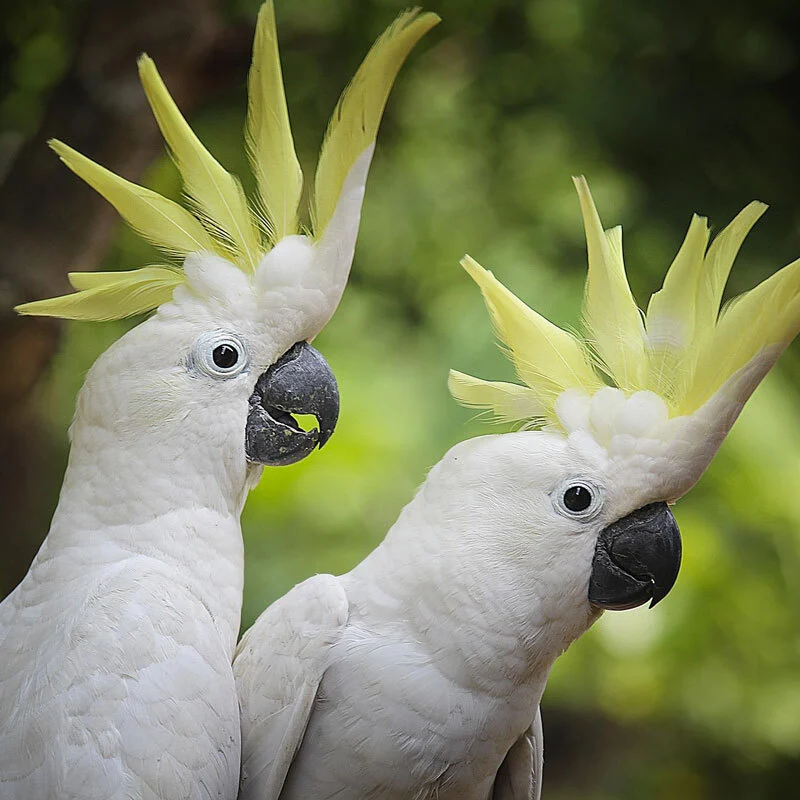
Researchers are delving deeper into the intricate cognitive processes of birds, revealing a surprising complexity in their everyday behaviors that mirrors human social dynamics. A recent groundbreaking study published in PLOS Biology illuminates how wild cockatoos, much like humans, observe and adopt new behaviors, particularly in the realm of food acquisition, through a process of social learning. This research challenges simplistic views of avian intelligence and underscores the sophisticated ways information and behavioral trends can propagate through bird communities.
The study, conducted by a collaborative team of five researchers from prestigious institutions including the University of Konstanz in Germany, The Australian National University, the University of California Davis, and The University of Sydney in Australia, focused on understanding the mechanisms of social learning in wild parrot populations. Their specific interest lay in how these birds develop a willingness to try novel food sources they have never encountered before. The findings suggest a deliberate and observant approach, where individual birds act as social commentators, carefully assessing the actions of their peers before committing to a new behavior. This cautious yet effective method of information transfer is remarkably similar to how human societies adopt new trends, from fashion and language to technological innovations.
The Observational Advantage: How Cockatoos Learn New Foods
The core of the research involved an experimental setup designed to observe how cockatoos in their natural urban environments learned to consume a new food item: almonds presented in their shells, distinguished by distinct colors—blue and red. These colored almonds served as a novel food source, requiring the birds to overcome initial hesitation.
The experimental methodology was systematic. A small group of cockatoos within specific roosts were pre-trained to consume these colored almonds. These "demonstrator" birds then served as social models for the rest of their flock. The researchers meticulously observed the reactions of the non-trained cockatoos, noting their behavior before and after observing the demonstrator birds.
The results were striking. In roosts where demonstrator birds readily consumed the colored almonds, the observing cockatoos showed a significant increase in their willingness to try the new food. This adoption of the behavior was not immediate but followed a period of observation. The non-trained birds would watch their conspecifics for a while before tentatively approaching and eventually accepting the colored almonds. This suggests a cognitive process involving assessment, evaluation, and eventual imitation.
Further reinforcing the social learning hypothesis, a separate roost, situated at a greater distance and not directly exposed to the initial demonstrator birds, exhibited a delayed adoption of the behavior. However, when a bird from one of the "trained" roosts visited this more distant group, the process of social learning was rapidly initiated. The visiting bird, demonstrating familiarity and acceptance of the colored almonds, acted as a catalyst. Within minutes of its arrival and subsequent consumption of the novel food, the other birds in the roost began to follow suit, mirroring the behavior they had just witnessed. This highlights the critical role of social proximity and the influence of knowledgeable individuals in disseminating new information within a bird community.
A Timeline of Adaptation and Influence
The experiment spanned a period of 20 days. By the end of this observational window, a total of 349 cockatoos across five marked roosts were actively consuming and exhibiting a preference for the colored almonds. This widespread adoption indicates that the social learning process was effective in spreading the novel food behavior throughout the studied populations.
A particularly fascinating observation emerged concerning the age of the birds. Similar to patterns seen in human societies, younger cockatoos demonstrated a significantly faster adaptation to the new behavior compared to their older flock members. This suggests that younger birds may be more open to innovation and less entrenched in established routines. The rapid adoption by younger individuals, in turn, appeared to influence the older birds. While older cockatoos initially adopted a more passive stance, waiting to observe the actions of their peers before engaging, the consistent and successful adoption by the younger generation eventually prompted them to try the colored almonds. This dynamic illustrates a subtle yet powerful form of indirect influence, where the behavior of the young can set the stage for the behavioral shifts of the older members of the community.
This finding is crucial for understanding the propagation of behavioral changes. It suggests a multi-generational or at least multi-age-cohort transmission of information, where early adopters, often the younger individuals, pave the way for broader societal acceptance. The implications are significant for understanding how innovations, whether in foraging strategies, predator avoidance, or other crucial survival behaviors, become ingrained within a bird population.
Broader Implications: Societal Behavioral Changes in Avian Communities
The study’s findings extend beyond the simple consumption of a new food. They point to a broader phenomenon of ongoing societal behavioral changes within a group, leading to wider acceptance of similar behaviors by others. The researchers observed that the proximity of roost communities played a significant role in the speed of adaptation. Closer communities, implying more frequent social interactions and a higher degree of interconnectedness, facilitated a more rapid spread of the learned behavior. This mirrors human societies where denser populations and greater interaction often lead to quicker adoption of trends and innovations.
This research provides compelling evidence that birds are not merely instinct-driven creatures but possess complex cognitive abilities that enable them to learn from and influence each other. The implications of this study are far-reaching:
- Understanding Urban Adaptation: As more bird species adapt to urban environments, understanding their social learning capabilities becomes paramount. This study suggests that their ability to learn new food sources and behaviors from each other is a key factor in their success in novel, human-dominated landscapes.
- Conservation Efforts: For conservationists, this research offers insights into how to facilitate the adoption of beneficial behaviors, such as utilizing artificial nesting sites or adapting to new food sources during times of scarcity, within wild bird populations.
- Avian Cognition Research: The study adds to a growing body of evidence highlighting the sophisticated cognitive abilities of birds, challenging traditional hierarchies of intelligence and emphasizing the need for further research into their social and emotional lives.
The colored almond experiment, while seemingly focused on a simple behavior, reveals a profound underlying mechanism of social learning that is remarkably consistent with human patterns of information dissemination and trend adoption. The cockatoos, through their cautious observation and eventual imitation, demonstrate a level of cognitive sophistication that invites a deeper appreciation of avian intelligence and the complex social fabrics that bind their communities. The study serves as a powerful reminder that the natural world is rich with complex behaviors and social dynamics, often mirroring those we observe in our own species.
