
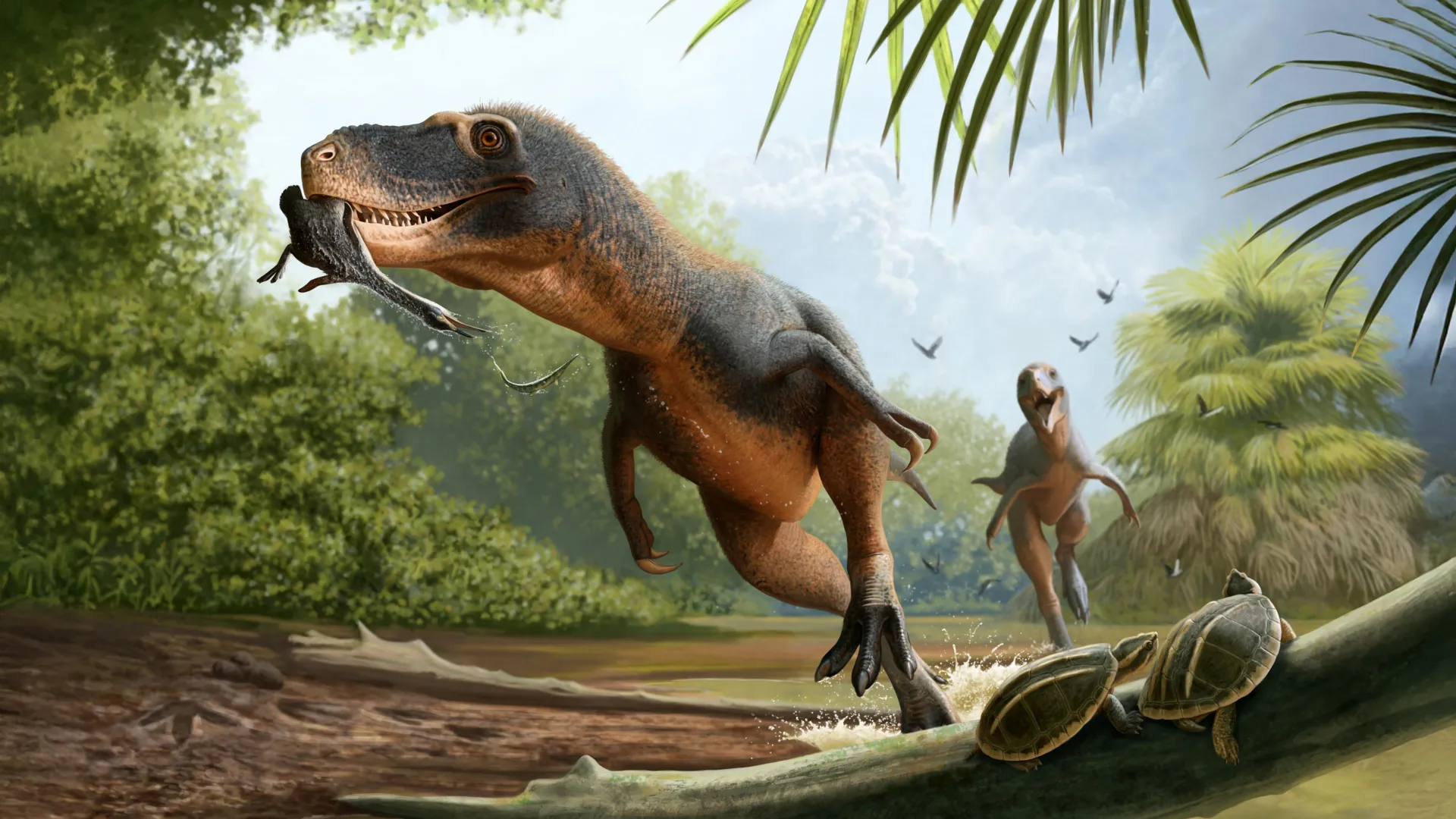
Sixty-six million years ago, in the twilight of the Mesozoic Era, a massive apex predator—potentially a Tyrannosaurus rex or a closely related Nanotyrannus—consumed an unusual meal: a small, specialized aquatic bird. While the predator and prey vanished into the mists of deep time, a remarkable twist of preservation ensured that evidence of this final meal survived. Discovered inside a fossilized deposit of dinosaur dung, or coprolite, is what paleontologists are hailing as the finest, most detailed feather specimen ever recovered from the age of dinosaurs. Reported in the journal Current Biology, this microscopic time capsule is offering scientists an unprecedented glimpse into prehistoric ecosystems and presenting a compelling new hypothesis regarding why avian dinosaurs managed to survive the catastrophic mass extinction that wiped out their non-avian counterparts.
The discovery expands the toolkit of modern paleontology, demonstrating how advanced non-destructive imaging technologies can extract biological treasures from unlikely sources. For decades, researchers seeking pristine feather samples relied heavily on amber deposits—tree resin that occasionally trapped prehistoric organisms in three-dimensional perfection. The new find proves that coprolites, long appreciated for shedding light on dietary habits and trophic webs, may also serve as extraordinary repositories for fragile integumentary structures like feathers, scales, and soft tissues.
A Fortuitous Discovery in the Hell Creek Formation
The story of this exceptional fossil began during the summer of 2016 in the badlands of northeastern Montana, a region globally renowned for its prolific fossil-bearing strata within the Hell Creek Formation. David DeMar, Jr., a research scientist and collections manager for the Hell Creek Project at the University of Washington’s Burke Museum, was conducting routine fieldwork in the area. Rather than targeting vertebrate skeletons or dinosaur bones, DeMar was meticulously crawling across a rocky outcrop, searching for microfossils such as fossilized fish teeth and scales.
It was then that an inconspicuous object caught his eye: a dark, reddish-brown nodule roughly the size of half a golf ball. Intrigued, DeMar picked up the specimen and inspected its exterior through a hand lens. To his profound astonishment, the surface revealed the distinct outline of a tiny fossilized feather.
Given that more than 150 years of intensive prospecting in the Hell Creek Formation had never previously yielded a preserved fossil feather, DeMar approached the discovery with cautious skepticism. Recognizing that the nodule’s shape, texture, and composition strongly suggested a biological origin, the research team initiated a multi-institution analytical workflow to examine the specimen without compromising its structural integrity.
Laboratory analysis began with mineralogical assessments of the rock matrix, followed by high-resolution computed tomography (CT) scanning. By bombarding the nodule with thousands of individual X-rays, the micro-CT scanner at the University of Southern California’s medical campus generated a remarkably detailed, three-dimensional digital reconstruction of the interior.
Nate Carroll, a paleontologist at the Carter County Museum in Ekalaka, Montana, and a co-author of the study, recalls the moment the internal contents came into focus. Although familiar with analyzing feathers preserved in Burmese amber for academic research, viewing a complex structural matrix trapped inside a seemingly unremarkable rock proved to be a watershed moment. Every hour of digital data processing unveiled a deeper layer of the predator’s final meal: additional feathers, microscopic scales belonging to a gar fish, and delicate leg bones.
Reconstructing the Prey: An Ancient Diving Bird
Through meticulous comparative osteology and microstructural analysis, the research team identified the avian remains as belonging to a hesperornithiform bird. Hesperornithiforms were a specialized lineage of Cretaceous aquatic birds, ecologically convergent with modern loons and grebes. Most species within this group were flightless, utilizing powerful, specialized hindlimbs and webbed feet to propel themselves through marine environments in pursuit of fish.
According to Dr. Jingmai O’Connor, associate curator of fossil reptiles at the Field Museum in Chicago and lead author of the study, the anatomical association of the feathers with the hesperornithiform leg bones provides near-certainty that the integumentary remains belonged to the preyed-upon bird.
Hesperornithiforms occupied a distinct evolutionary branch separate from both enantiornithines—the most abundant group of birds throughout the Cretaceous period—and Neornithes, the modern lineage that successfully navigated the end-Cretaceous extinction event and gave rise to all living birds today.
The presence of the hesperornithiform feathers inside the coprolite provides researchers with a rare comparative baseline. Structurally, the fossilized feathers do not neatly align with either the primitive plumage seen in enantiornithines or the fully specialized, aerodynamic and thermal plumage of modern Neornithes. Instead, they exhibit a transitional morphology, displaying features associated with modern waterproof diving adaptations alongside smaller, primitive, fuzzy body feathers traditionally observed in non-avian dinosaurs and enantiornithines.
Unraveling the Mystery of Avian Survival
The survival of Neornithes through the Cretaceous-Paleogene (K-Pg) boundary has long confounded evolutionary biologists. Approximately 66 million years ago, a massive asteroid estimated at roughly 10 kilometers in diameter struck the Yucatán Peninsula, unleashing global ecological devastation. The impact triggered massive earthquakes, tsunamis, continent-wide wildfires, and an ensuing "impact winter"—a prolonged period where atmospheric dust, soot, and sulfur aerosols blocked incoming solar radiation, causing global temperatures to plummet and halting photosynthesis across terrestrial and marine food webs.
While non-avian dinosaurs, pterosaurs, marine reptiles, and the vast majority of archaic bird lineages perished, ancestral modern birds persevered. For years, scientists debated the ecological drivers of this selective survival. A prominent hypothesis suggested that aquatic habitats provided a buffer against the immediate terrestrial catastrophes, allowing semi-aquatic organisms to exploit detritus-based food chains.
However, the discovery of the hesperornithiform feathers complicates this geographical hypothesis. Hesperornithiforms were heavily adapted to aquatic lifestyles, yet their entire lineage went extinct alongside terrestrial dinosaurs. This paradox indicates that habitat preference alone cannot account for why Neornithes survived while other avian groups vanished.
O’Connor and her colleagues propose that the underlying mechanism of survival lies in the microstructural evolution of feathers and the physiological strategies of feather replacement, known as molting. Primitive body feathers—such as the downy, non-interlocking filaments observed in the hesperornithiform specimen—lacked the advanced thermal insulation properties characteristic of modern avian plumage.
During the freezing conditions of the impact winter, animals possessing inferior insulation would have struggled to maintain core body temperatures, succumbing rapidly to hypothermia and metabolic collapse. Furthermore, modern birds possess sophisticated molting strategies that allow them to replace worn feathers without losing flight capability or thermal protection all at once. If archaic birds relied on less efficient molting or insulating systems, their vulnerability during a global thermal collapse would have been critically heightened.
Broader Implications and Future Directions
The integration of coprolite analysis into paleornithology opens an entirely new methodological frontier for researchers studying ancient ecosystems. Traditionally, fossilized droppings were examined for palynological data, bones, or parasite remains. The successful extraction and high-resolution imaging of microscopic feathers from a coprolite demonstrate that soft-tissue preservation in vertebrate waste products is far more viable than previously assumed.
Dr. Gregory Wilson Mantilla, professor at the University of Washington, curator of vertebrate paleontology at the Burke Museum, and a co-author of the study, emphasizes the multi-layered value of the discovery. Beyond elucidating the evolutionary trajectory of avian feathers, the specimen captures a momentary, violent interaction within a Late Cretaceous food web, linking a titanic apex predator to a specialized aquatic bird via the preservation medium of fossilized feces.
Paleontologists involved in the research suggest that thousands of unexamined coprolites housed in museum collections worldwide may harbor similar microstructural treasures. By applying non-destructive micro-CT scanning protocols to existing collections, researchers can prospect for soft tissues, dietary elements, and integumentary remains without altering or destroying the original specimens.
As the scientific community continues to analyze the data recovered from the Montana coprolite, the study stands as a testament to the serendipity of field paleontology and the power of modern imaging technology. By peering inside the digested remains of a Cretaceous meal, researchers are inching closer to resolving one of Earth’s greatest evolutionary mysteries: why a single, delicate lineage of feathered dinosaurs managed to endure the apocalypse and inherit the skies of a changing world.
