
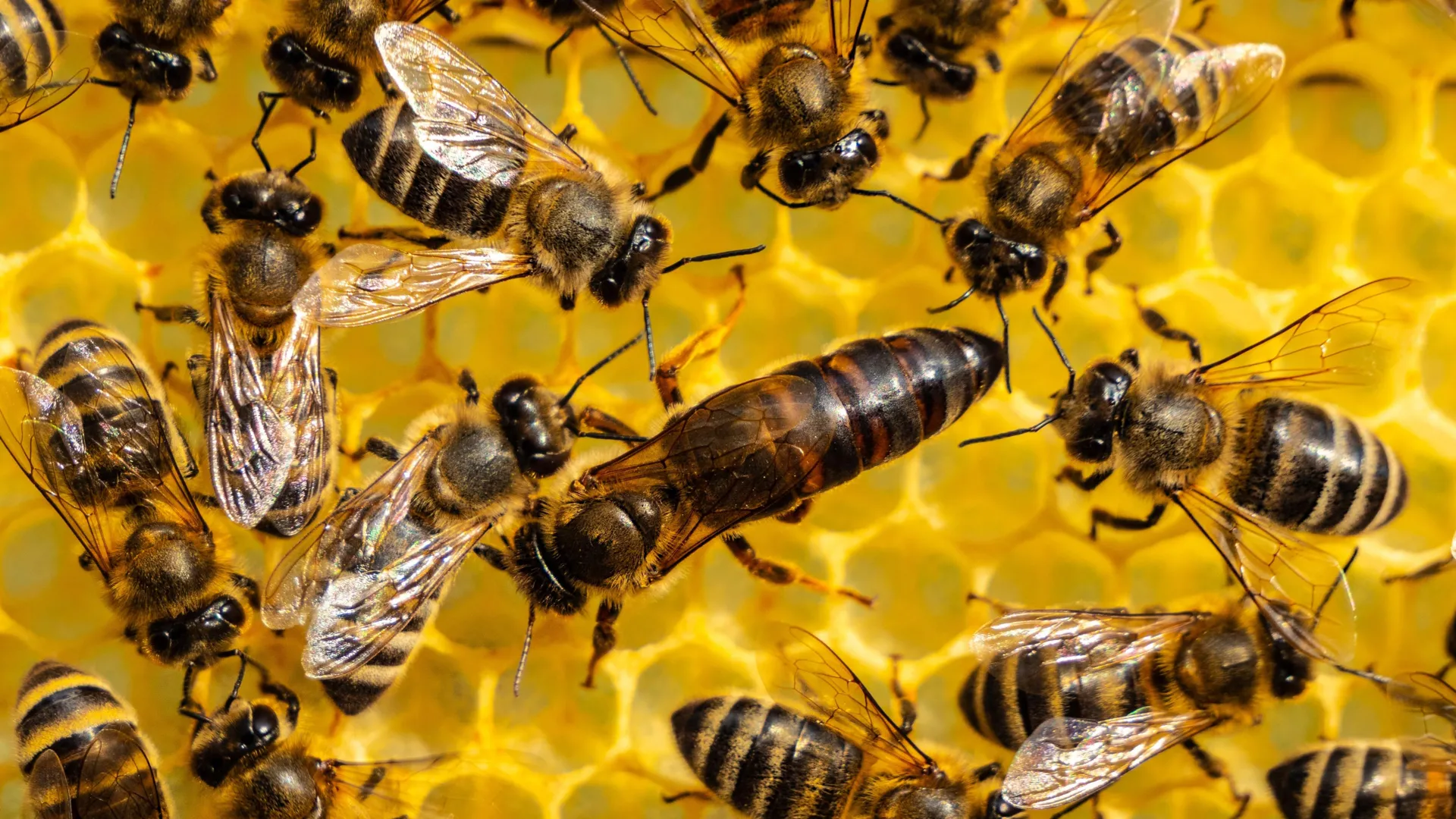
The delicate hierarchy of the honeybee hive relies on a sophisticated division of labor, where worker bees act as both foragers and the primary biological shield against environmental toxins. For decades, entomologists and toxicologists understood that worker bees filter out harmful agricultural chemicals before they can thoroughly penetrate the core of the colony. However, groundbreaking new research reveals that this defensive wall has critical limits. When worker bees become overwhelmed by chronic chemical exposure, honeybee queens deploy an internal, desperate survival mechanism: they systematically transfer accumulated toxins directly into their own eggs.
Published in the journal Current Biology, this revealing study was spearheaded by researchers at the University of California, Davis, in close collaboration with the Lawrence Livermore National Laboratory (LLNL) and the United States Department of Agriculture’s Agricultural Research Service (USDA-ARS). The findings shed alarming new light on how sub-lethal pesticide exposure permeates deep within honeybee colonies, bypassing traditional behavioral defenses and threatening the viability of future generations through a biological phenomenon known as maternal offloading.
The Mechanization of Maternal Offloading: A Self-Preservation Strategy
To understand the severity of this discovery, scientists must examine the physiological burden placed upon the queen. A healthy honeybee queen is an egg-laying powerhouse, capable of producing between 1,500 and 2,000 eggs every single day. This relentless reproduction is the singular engine driving the colony’s survival, replacing aging workers and sustaining the workforce required for foraging, comb-building, and brood-rearing.
However, as agricultural landscapes become increasingly saturated with synthetic pesticides, systemic chemicals inevitably find their way into the hive via contaminated nectar and pollen. While worker bees initially attempt to intercept and detoxify these substances—storing residues safely within the honeycomb wax—their filtering capacity is finite. When prolonged exposure saturates the workers’ biological defenses, the toxins begin to circulate freely throughout the hive, ultimately accumulating within the tissues of the queen herself.
Faced with mounting internal toxicity, the queen utilizes maternal offloading as an emergency detoxification route. Rather than succumbing immediately to systemic poisoning, she routes the harmful chemical compounds through her ovaries, depositing them directly into the yolk of her developing eggs.
"In order to protect herself, the queen bee offloads these chemicals into her eggs to get rid of them," explained Sascha Nicklisch, senior author of the study and an associate professor in the Department of Environmental Toxicology at UC Davis. "No one has shown this in honeybees before."
While this mechanism successfully preserves the immediate life of the queen, it introduces a devastating trade-off. The toxic burden is not eliminated; instead, it is inherited by the developing brood, potentially stunting their growth, impairing neurological development, or causing early-stage mortality before the larvae can ever emerge as adult worker bees.
Chronology and Experimental Design: Replicating the Hive in Miniature
The journey to this discovery required innovative experimental design capable of tracking microscopic traces of agricultural chemicals through complex biological systems. Because observing these dynamics in full-scale, multi-thousand-member commercial hives introduces countless uncontrollable variables, the research team constructed specialized "nanocolonies."
These miniature, highly controlled experimental units consisted of conical plastic containers fitted with netted bottoms. Each nanocolony housed a single laying queen alongside a cohort of approximately 60 worker bees, effectively simulating the core social and functional dynamics of a natural hive in a laboratory setting.
The timeline of the experiment spanned multiple days of closely monitored, controlled exposure:
- Day Zero to Day One: The nanocolonies were provided with water, pollen, and sugar syrup deliberately laced with methyl parathion, a widely utilized organophosphate pesticide. To accurately map the movement of the chemical, researchers tagged the pesticide with a low-level radioactive marker. Upon initial consumption, the resident worker bees demonstrated remarkable defensive efficacy, successfully filtering out approximately 95% of the pesticide from the food supply and sequestering it within the surrounding comb wax before it could reach the queen.
- Days Two Through Nine: As the exposure continued over a sustained period, the daily efficiency of the worker bees began to degrade. The continuous influx of environmental toxins steadily wore down their metabolic filtration capacities.
- Day Ten: By the tenth day of continuous, low-dose exposure, the filtration rate dropped significantly to 86%. With the worker-bee barrier compromised, chemical residues began penetrating the queen’s internal anatomy, accumulating in her tissues, ovaries, and subsequently appearing within the eggs she produced.
Precision Tracking via Advanced Accelerator Mass Spectrometry
Detecting environmentally relevant, non-lethal concentrations of pesticides inside microscopic biological samples presented a formidable analytical challenge. To overcome this, the UC Davis researchers partnered with LLNL, leveraging state-of-the-art technological infrastructure originally developed for biomedical and physics applications.
The team utilized Biological Accelerator Mass Spectrometry (BioAMS), a hyper-sensitive analytical technique capable of detecting minute, parts-per-quadrillion concentrations of radioactive isotopes. This allowed scientists to trace the exact pathway of the methyl parathion marker across various compartments of the nanocolony, including the worker bees, the comb wax, the queen’s ovaries, and her newly laid eggs, without requiring lethal doses of the chemical.
"With BioAMS, we can trace very low levels of a pesticide," noted Bruce Buchholz, an LLNL scientist and co-author of the study. "The pesticide concentrations we used were not lethal and were environmentally relevant to that seen in nature."
This precision confirmed that the phenomenon observed was not the result of acute, catastrophic poisoning—which typically kills bees outright—but rather the consequence of chronic, low-level exposure that mimics the chemical realities agricultural honeybees face daily in modern farming environments.
Broader Implications for Agriculture, Beekeepers, and Global Food Security
Honeybees are foundational to global agricultural productivity, acting as vital pollinators for roughly one-third of the human diet, including essential fruits, nuts, and vegetables. Consequently, any physiological stressor that compromises colony health carries profound economic and ecological consequences.
The study’s findings challenge traditional assumptions within integrated pest management (IPM) and commercial apiculture, which have historically focused almost exclusively on worker bee mortality and immediate hive losses. By shifting the analytical focus to the queen and her reproductive output, researchers have uncovered a hidden mechanism driving long-term colony decline.
Angela Encerrado-Manriquez, lead author of the study and a recent Ph.D. graduate from UC Davis, emphasized that worker bee protection has hard limits. "In our study, pesticides began to accumulate in queens over time, suggesting that worker filtration capacity can be overwhelmed," she stated. "When this happens, queens have their own defense. Maternal offloading allows them to shunt the toxic burden to their eggs."
This dynamic introduces what scientists describe as a "creeping effect" of chemical accumulation. As sub-lethal toxins slowly build up across generations, the cumulative damage can lead to sudden, unexplained colony collapses weeks or months after the initial exposure event has passed.
"When pesticides accumulate to the extent that the queen bee has eggs that are so loaded they may no longer develop properly, there could be a tipping point," warned Nicklisch. "There may be a slow creeping effect of chemical accumulation that will contribute to delayed colony collapse."
Future Directions and Unanswered Scientific Questions
Despite these significant breakthroughs, the research team stresses that numerous critical questions remain unanswered. Toxicologists have yet to determine the exact threshold at which maternal offloading ceases to protect the queen and instead triggers total reproductive failure. Furthermore, researchers must investigate whether different classes of agricultural chemicals—such as neonicotinoids, synthetic pyrethroids, and systemic fungicides—trigger identical offloading responses, or if some compounds are retained more aggressively within maternal tissues than others.
Answering these questions will require extended field studies and cross-disciplinary collaboration between toxicologists, entomologists, and agricultural planners. Ultimately, understanding the limits of maternal offloading will inform better pesticide regulatory frameworks, helping agriculturalists protect beneficial pollinators while maintaining crop yields.
Funding and institutional support for the research were provided by the USDA’s National Institute of Food and Agriculture, the Non-Assistance Cooperative Agreement program, the PAm-Costco USA Scholarship program, and the University of California National Laboratory Fees Research Program. Additional contributions to the scientific work were made by Julia Fine and Eliza Litsey of the USDA-ARS, alongside David Baliu-Rodriguez, Sean Leonard, and Bruce Buchholz of LLNL, under the auspices of U.S. Department of Energy contracts. As researchers continue to untangle the complex chemical pathways within the hive, the findings serve as a stark reminder of the invisible biochemical pressures facing the world’s most vital pollinators.
