
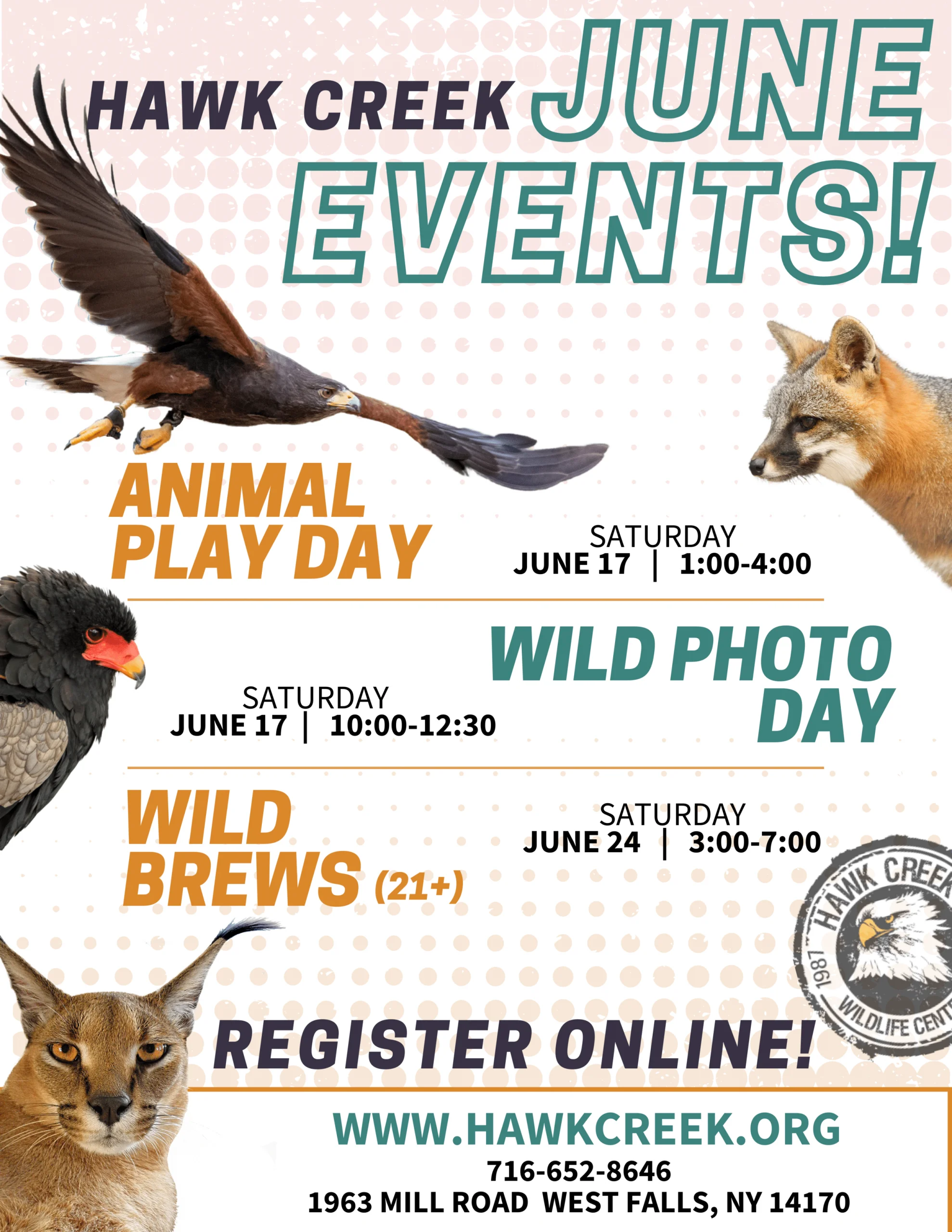
The Hawk Creek Wildlife Center, a prominent institution dedicated to the preservation and rehabilitation of avian and exotic wildlife, has announced a series of three distinct public engagement events scheduled throughout the month of June. These programs, ranging from interactive family-oriented workshops to professional-grade photography sessions and adult-focused fundraising initiatives, represent a strategic effort by the center to bridge the gap between captive wildlife management and public environmental education. By providing controlled, close-proximity interactions with raptors, corvids, and various exotic species, the center aims to foster a deeper understanding of biodiversity and the necessity of global conservation efforts.
Chronological Schedule and Operational Overview
The center’s June programming follows a carefully curated sequence designed to cater to diverse demographics, starting with a focus on wildlife photography, transitioning to family-centric behavioral education, and concluding with a sophisticated fundraising event for the adult community.
The inaugural event, Wild Photo Day, is slated for June 17, operating from 10:00 a.m. to 12:30 p.m. This session is specifically structured to provide photographers of all skill levels with an environment conducive to capturing high-quality, barrier-free imagery of raptors and wild cats. Following this, the afternoon of June 17 will transition into Animal Play Day, running from 1:00 p.m. to 4:00 p.m. This session emphasizes the biological importance of play and behavioral enrichment in animal husbandry. The series concludes on June 24 with the Wild Brews fundraiser, an evening event running from 3:00 p.m. to 7:00 p.m., which integrates social elements with conservation advocacy.
Technical Enrichment and Animal Behavioral Science
The core of the Animal Play Day event centers on the scientific concept of enrichment. In zoological and wildlife rehabilitation contexts, "enrichment" refers to the practice of providing stimuli—such as puzzle feeders, tactile objects, or social interaction—that encourage natural behaviors. For species like the Eurasian Lynx and the serval, which are represented at Hawk Creek by the ambassador animals "Tracker" and "Zane," enrichment is a vital component of captive welfare.
By demonstrating how these animals interact with their environments, Hawk Creek staff aim to demystify the physiological and psychological needs of wild cats. This event also highlights the plight of small wild cat populations globally, many of which face significant threats due to habitat fragmentation, illegal wildlife trade, and human-wildlife conflict. Data from the International Union for Conservation of Nature (IUCN) indicates that numerous small felid species are currently under-studied and under-protected, making public education campaigns of this nature critical for garnering support for international conservation initiatives.
Wildlife Photography as a Conservation Tool
Wild Photo Day represents a partnership between Hawk Creek and Delaware Camera, designed to provide a professional environment for nature photography. The event allows participants to bypass the limitations often associated with zoo settings—such as safety glass, wire mesh, or large crowds—by placing them in a controlled, naturalistic environment.
From an industry perspective, such events serve a dual purpose. They generate revenue through ticket sales to support the center’s ongoing rehabilitation costs, while simultaneously producing a wealth of media that contributes to the public’s appreciation of these species. High-quality imagery is increasingly recognized as a key driver of public interest in conservation. According to recent surveys in environmental communications, individuals who have direct, high-quality visual exposure to wildlife are significantly more likely to support legislative and non-profit conservation efforts. By providing access to eagles, hawks, and owls in flight, Hawk Creek is leveraging the visual impact of raptors to drive deeper public engagement.
Fundraising and Institutional Sustainability: The Wild Brews Initiative
The final event of the month, Wild Brews, serves as a significant fundraising mechanism for the organization. As a non-profit facility, Hawk Creek relies on a combination of grants, private donations, and event revenue to sustain its daily operations. The costs associated with medical care, specialized diets, and facility maintenance for avian and exotic predators are substantial.
The Wild Brews event, restricted to guests 21 and older, offers a unique value proposition: it combines the social atmosphere of a tasting event with the educational value of intimate wildlife encounters. By diversifying their event offerings to include adult-centric programming, the center is adopting a modern approach to philanthropy. Integrating live music, local food, and beverage service creates a social atmosphere that encourages repeat attendance and fosters a sense of community among local wildlife supporters.
Broader Impact and Implications
The impact of these events extends beyond immediate attendance figures. By providing educational programming that highlights the "power of the sky" through flight demonstrations, the center reinforces the importance of birds of prey as apex predators. Apex predators serve as essential bio-indicators; their health and presence in an ecosystem provide data regarding the overall stability of that environment.
When an organization like Hawk Creek facilitates interactions between the public and these species, they are also participating in a broader conversation regarding the ethics of wildlife captivity. Modern facilities are moving away from purely exhibition-based models toward education-driven models. The events scheduled for June are indicative of this shift, as they focus heavily on the "why" and "how" of wildlife care rather than simple viewing.
Analysis of Institutional Strategy
The decision to host these events in a condensed timeframe—two within a single day—suggests a high degree of operational efficiency at the Hawk Creek facility. Managing the logistics of live animal transport, safety protocols, and public flow requires significant coordination. The inclusion of external partners, such as Explore & More and Delaware Camera, further indicates a strategy of community integration. By leveraging the expertise of outside organizations, Hawk Creek enhances the visitor experience, ensuring that the educational content is delivered in a multi-faceted manner.
Furthermore, the focus on specific ambassador animals, such as Zane and Tracker, humanizes the conservation mission. Personalizing the animals allows the public to form an emotional connection, which behavioral psychologists have found to be a primary driver for behavioral change in conservation advocacy. When members of the public associate a specific, named animal with the broader, abstract goal of saving a species, they are more likely to participate in conservation activities, such as habitat preservation or local bird-friendly initiatives.
Future Outlook and Public Engagement
As the summer season progresses, the success of these June events will likely dictate the scope of future programming at the center. The data gathered from ticket sales and attendee feedback will be analyzed to refine future educational outreach. For residents and visitors interested in wildlife, the events represent a rare opportunity to engage with high-level conservation work in a tangible way.
Potential attendees are encouraged to review the specific ticketing requirements for each event through the Hawk Creek website. Given the specialized nature of the Wild Photo Day and the capacity limits associated with the Wild Brews fundraiser, early registration is recommended. These events represent a significant investment by the Hawk Creek Wildlife Center in the future of wildlife education, offering a comprehensive look at the intersection of human recreation and the natural world. By providing a platform for direct engagement, the center continues to fulfill its mission of protecting the integrity of wild populations while simultaneously educating the next generation of environmental stewards.
In conclusion, the June programming at Hawk Creek is more than a series of public gatherings; it is a calculated effort to institutionalize wildlife education through diverse, experiential, and professional channels. Whether through the lens of a camera, the observation of enrichment behaviors, or the social context of a fundraiser, the center is facilitating a necessary conversation about the relationship between modern society and the natural world. As the demand for conservation-based tourism and education grows, the model presented by Hawk Creek serves as a relevant case study for other wildlife facilities attempting to balance financial sustainability with institutional mission.
