
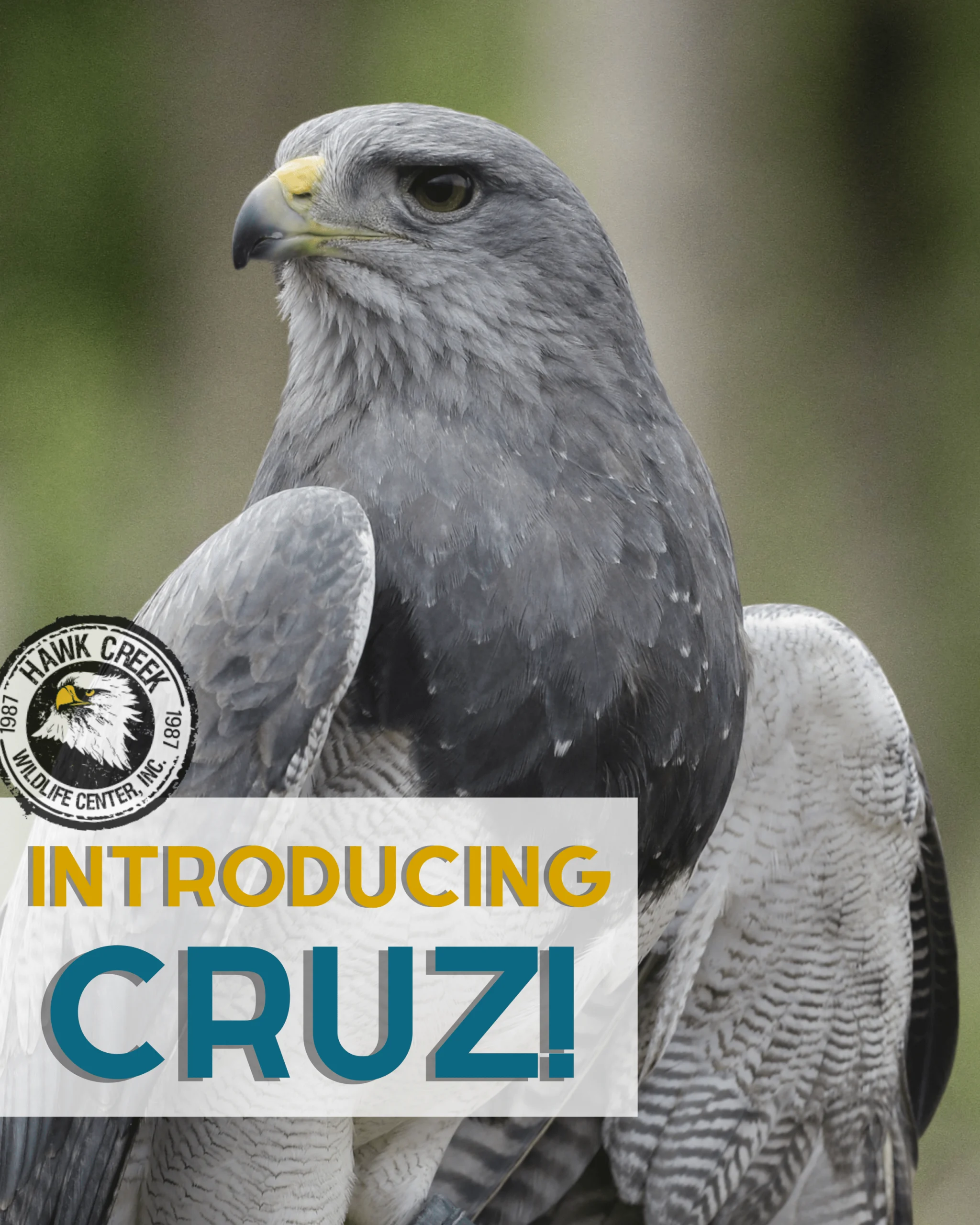
The Hawk Creek Wildlife Center has officially announced the arrival of its newest avian ambassador, a Black-chested Buzzard-eagle (Geranoaetus melanoleucus), affectionately named Cruz. This acquisition represents a significant milestone for the institution, which continues to position itself as a focal point for international raptor education and conservation. The arrival of Cruz is the latest in a series of collaborative efforts between Hawk Creek and the Oklahoma-based Sia: The Comanche Ethno-Ornithological Initiative, an organization dedicated to the preservation of eagle species and the integration of indigenous ecological knowledge.
The Black-chested Buzzard-eagle is a species characterized by its adaptability and specialized role within the ecosystems of South America. While often confused with true eagles due to its size and predatory habits, it is taxonomically distinct. Its presence at Hawk Creek provides a rare opportunity for American audiences to observe a bird of prey that is seldom represented in North American zoological or educational facilities.
Taxonomy and Ecological Profile of the Species
The Black-chested Buzzard-eagle, known variously as the Chilean Blue Eagle, Patagonian Eagle, or Gray Buzzard Eagle, is a robust raptor native to the elevated, open landscapes of the Andes and surrounding regions in South America. From a biological standpoint, the species occupies an essential niche as an apex predator in high-altitude environments, ranging from Argentina and Chile to the northern reaches of the Andes.
Adult birds typically exhibit a striking plumage, with slate-gray upperparts and a distinctively patterned white and black underbelly, which gives rise to its most common moniker. These birds are known for their high-altitude soaring patterns, utilizing thermal currents to survey vast expanses of terrain. Their diet consists primarily of small to mid-sized mammals. In their native habitats, they serve as critical natural population controllers, preying on degus—small, social rodents endemic to the Chilean matorral—and invasive European hares. The control of these invasive species is particularly vital, as the overpopulation of European hares often results in significant agricultural damage and the degradation of native vegetation.
Despite their ecological importance, these raptors remain understudied in the scientific literature compared to their North American counterparts like the Golden Eagle or Bald Eagle. The opportunity to study a specimen like Cruz in a controlled environment allows researchers and educators to gather behavioral data that would otherwise be difficult to document in the rugged, inaccessible mountainous terrain of South America.
A Strategic Partnership for Global Conservation
The addition of Cruz to the Hawk Creek roster is the direct result of a long-standing partnership with William "Two-Raven" Voelker, the founder of Sia: The Comanche Ethno-Ornithological Initiative. Based in Oklahoma, Sia has garnered a reputation for its multifaceted approach to bird conservation, which blends modern ornithological science with traditional ecological knowledge.
This partnership is not a singular event but part of a multi-year effort to curate a collection of rare raptors that highlight the global diversity of the eagle family. Prior to the arrival of Cruz, Hawk Creek successfully integrated other rare species into its program through the same collaborative pipeline. These include Jara, a Short-toed Snake Eagle (Circaetus gallicus), and Onyx, a Verreaux’s Eagle (Aquila verreauxii).
The inclusion of these species serves a twofold purpose: fostering public interest in international biodiversity and providing a platform for the conservation of species that face increasing environmental pressures in their native ranges. By housing these birds, Hawk Creek provides the public with a tangible connection to global ecosystems that are often distant and abstract to the average American visitor.
Chronology of the Initiative
The development of the current exhibit at Hawk Creek has been a deliberate, multi-stage process.
- Initial Engagement: Discussions between Hawk Creek and the Sia Initiative began several years ago, focusing on the need for a more comprehensive public understanding of non-North American raptors.
- Development of Facilities: Hawk Creek underwent rigorous site evaluations to ensure the specialized housing requirements for the new arrivals were met, particularly for species that thrive in specific elevations and climates.
- Arrival of Predecessors: The successful integration of Jara and Onyx served as a "proof of concept" for the partnership, demonstrating that rare raptors could be maintained, trained, and used for educational outreach in a professional setting.
- Acquisition of Cruz: Following the success of the earlier arrivals, protocols were finalized for the transfer of the Black-chested Buzzard-eagle, leading to his recent debut at the facility.
The Role of Public Education and the Wild Earth Event
Hawk Creek has scheduled a high-profile educational event, "Wild Earth," set for May 13. This event is designed to move beyond simple observation, offering attendees a deeper look at the mechanics of eagle conservation. William "Two-Raven" Voelker is slated to be the keynote speaker, providing insights into the intersection of Comanche culture and ornithology, as well as the broader challenges facing raptor populations globally.
The event aims to address the disconnect between urban populations and wild raptor habitats. Through interactive presentations, Hawk Creek and Sia intend to demonstrate how indigenous conservation practices, when combined with modern veterinary and behavioral management, can yield sustainable outcomes for species recovery.
Data-Driven Conservation Implications
The decision to exhibit these species carries significant educational weight. Statistics from the International Union for Conservation of Nature (IUCN) suggest that many raptor species are experiencing population declines due to habitat fragmentation and the use of rodenticides, which lead to secondary poisoning. While the Black-chested Buzzard-eagle is currently classified as a species of "Least Concern" by the IUCN, local populations are increasingly vulnerable to environmental shifts.
Educational institutions like Hawk Creek act as "insurance populations" and, more importantly, as centers for data collection. By tracking the growth, diet, and social interactions of birds like Cruz, the center contributes to a growing body of knowledge that helps conservationists better understand the requirements for healthy raptor populations in the wild.
Furthermore, the introduction of these species serves as a catalyst for local economic engagement. Specialized educational facilities often see an increase in attendance when unique biological specimens are introduced, which in turn generates the funding necessary to support conservation efforts in the field. This "exhibit-to-field" funding model is essential for non-profits that lack large government subsidies.
Official Perspectives and Future Outlook
While specific statements from the Hawk Creek staff emphasize the educational potential of the new exhibit, the broader industry reaction to such partnerships has been largely positive. Ornithologists note that the lack of public awareness regarding South American raptors often leads to a deficit in funding for their protection. By bringing a species like the Black-chested Buzzard-eagle to the forefront of the public consciousness, Hawk Creek and the Sia Initiative are effectively rebranding the species from an obscure mountain dweller to a recognizable, protected asset.
The long-term implication of this initiative is the potential for increased collaborative research. As the relationship between Hawk Creek and Sia matures, there is potential for the exchange of data that could benefit raptor conservation programs in South America. If the center can successfully demonstrate the efficacy of its management techniques, these methods could be shared with local stakeholders in Chile and Argentina, providing them with the tools necessary to manage their native eagle populations more effectively.
As the May 13th event approaches, the staff at Hawk Creek remains focused on the welfare of Cruz. The adjustment period for a raptor of this caliber is extensive, requiring precise control over environmental factors and a gradual introduction to human interaction. However, the success of the facility in acclimating previous raptors suggests that the Black-chested Buzzard-eagle will soon become a staple of their educational programming.
In conclusion, the arrival of Cruz is more than an addition to a collection; it is a testament to the power of international collaboration in the field of wildlife conservation. By bridging the gap between Oklahoma’s indigenous-led conservation efforts and the high-altitude wilds of South America, Hawk Creek is providing a unique service to the scientific community and the general public alike. As these birds continue to serve as ambassadors for their species, the hope remains that the lessons learned within the confines of the facility will echo far beyond its borders, contributing to the health and survival of raptors in their natural habitats worldwide.
