
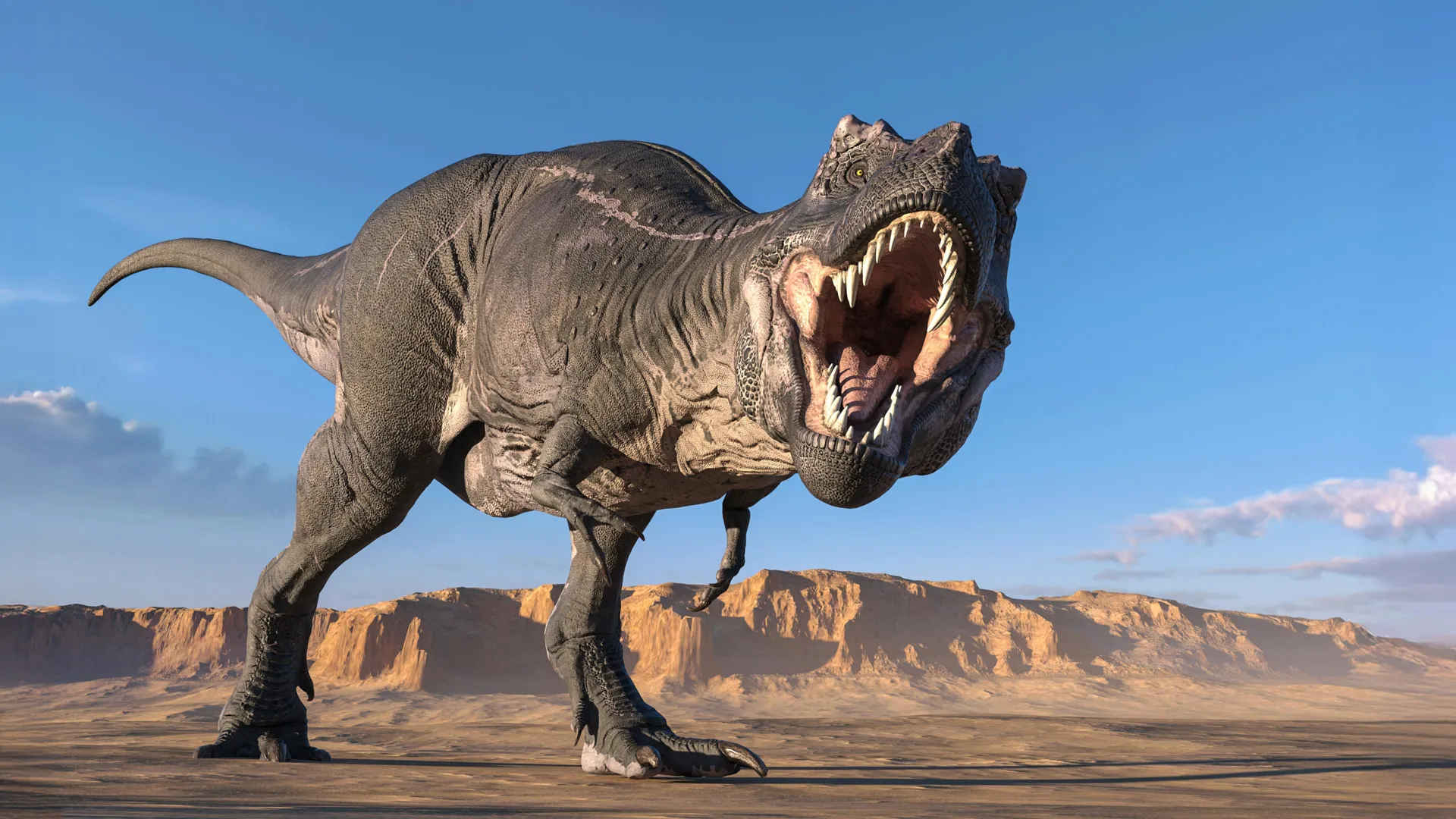
For more than a century, the physiological nature of the Tyrannosaurus rex has remained one of the most vigorously debated topics in vertebrate paleontology. Ever since the species was formally described by Henry Fairfield Osborn in 1905, scientists have attempted to reconstruct the biology of this apex predator using indirect evidence: bones, teeth, footprints, and fossilized trackways left behind more than 60 million years ago. While historical depictions often portrayed the giant theropod as a sluggish, cold-blooded reptilian giant that relied heavily on environmental basking, discoveries of fossils in high-latitude regions such as Alaska suggested a much more dynamic creature. These northern finds hinted that T. rex could endure subfreezing conditions, moving the scientific consensus away from traditional reptilian physiology and toward the warm-blooded, highly active metabolism observed in modern birds and mammals.
Now, a team of researchers at the University of California, Los Angeles (UCLA), has achieved what was once deemed methodologically impossible: they have effectively taken the internal body temperature of a Tyrannosaurus rex.
Utilizing an innovative geochemical technique applied to fossilized dental enamel, the research team determined that T. rex maintained an internal body temperature of approximately 97 degrees Fahrenheit (36 degrees Celsius). This reading places the iconic dinosaur’s metabolic baseline remarkably close to that of a modern human. Published on September 16 in the journal Science Advances, the findings provide the first direct, empirical temperature measurement for the species. The discovery bridges a critical gap in evolutionary biology, offering concrete physical evidence that reinforces decades of behavioral and anatomical theories regarding the king of the dinosaurs.
Refining the Prehistoric Thermometer Over a Decade
The journey toward measuring the body temperature of an extinct apex predator began over a decade ago, when geobiologists at UCLA first conceptualized a paleothermometry technique. The method was designed to investigate the metabolic status of extinct organisms—distinguishing between endothermic (warm-blooded) and ectothermic (cold-blooded) physiologies—by analyzing the structural composition of their mineralized remains.
However, applying this nascent technology to a specimen as scientifically precious as a Tyrannosaurus rex presented a monumental roadblock. The original iteration of the UCLA method required a relatively large volume of skeletal material. Museum curators, charged with protecting irreplaceable natural history artifacts, could not justify sacrificing the substantial amounts of bone or tooth necessary for the analysis.
Undeterred, the UCLA research team spent the ensuing ten years refining and optimizing their analytical protocols. Through rigorous technological iteration, the scientists successfully reduced the required mass of fossilized material for testing by roughly 90 percent. This massive efficiency leap transformed the conversation. Armed with a technique that required only minuscule sample sizes, the researchers approached the Natural History Museum of Los Angeles County (NHM) to propose testing specimens from "Thomas," one of the most complete and structurally intact T. rex skeletons housed in the museum’s exhibition halls.
The Science of Clumped-Isotope Paleothermometry
The underlying mechanism of this breakthrough relies on molecular chemistry preserved at the microscopic level within fossilized tooth enamel. Specifically, the technique examines rare isotopes of carbon and oxygen that bond together within the crystalline structure of the enamel.
The frequency with which these isotopes form bonds is directly governed by ambient temperature during the formation of the mineral. In cooler biological environments, a greater number of these specific carbon-oxygen bonds form; conversely, warmer internal body temperatures result in a lower frequency of bonding. This predictable thermodynamic relationship allows scientists to utilize the chemical signature trapped inside ancient teeth as an atomic-scale thermometer.
"That’s the basis of using the isotopes as a thermometer," explains UCLA geobiologist and study co-author Robert Eagle. "In theory, we can make measurements using any part of the skeleton, but the bones in our body are constantly being remodeled and dissolved and replaced. Tooth enamel has large crystalline structures that are extremely durable, making it the part of the skeleton that most resists chemical alteration by the environment over the eons."
To execute the test, lead author Randy Flores and Professor Eagle utilized a specialized dental micro-drill to harvest microscopic quantities of enamel powder from the museum’s T. rex teeth. This powder was then dissolved in phosphoric acid, liberating carbon dioxide gas containing the targeted isotope bonds. The gas was subsequently processed through a mass spectrometer. By pressurizing the gas sample to create a denser stream of carbon dioxide, the researchers enabled the instrument to acquire precise, usable measurements from quantities of fossil material previously thought far too small for analysis.
Comparative Physiology: Between Reptiles and Birds
The resulting 97-degree Fahrenheit (36-degree Celsius) reading places T. rex in a fascinating evolutionary tier. While the dinosaur remained anatomically a scaly, egg-laying reptile, its internal operating temperature diverged sharply from modern cold-blooded reptiles, such as crocodiles and lizards, which typically maintain internal temperatures ranging from 82 to 86 degrees Fahrenheit (28 to 30 degrees Celsius).
At the same time, T. rex’s body temperature sat lower than that of modern birds—the direct evolutionary descendants of theropod dinosaurs—which routinely exhibit higher core temperatures between 104 and 109 degrees Fahrenheit (40 to 43 degrees Celsius).
"No one’s been able to make a temperature measurement like this before," Eagle notes. "We found T. rex was 36 Celsius (97 Fahrenheit), about the same as humans. The temperature is about what I would have guessed—higher than a reptile or a slow mammal like a sloth, but lower than an avian."
To ensure that geological contamination or ground-water alteration over millions of years had not skewed the chemical signatures, the UCLA team performed a crucial control experiment. They analyzed ancient crocodilian fossils excavated from the exact same fossil deposit: the Hell Creek Formation in Montana. The crocodilian remains yielded a body temperature of 86 degrees Fahrenheit (30 degrees Celsius)—a full 11 degrees cooler than the T. rex specimens found alongside them. This stark physiological divergence confirmed that the isotope signatures reflected genuine biological variables rather than environmental or geological overprinting.
Curatorial Decisions and Destructive Analysis
Granting permission for destructive analysis on a high-profile museum specimen is never a routine administrative choice. Museums balance the mandate to preserve irreplaceable natural history treasures against the scientific imperative to unlock new knowledge about the past.
Luis Chiappe, curator of the Dinosaur Institute and head of research and collections at the Natural History Museum of Los Angeles County, described the deliberative process that preceded the sampling of Thomas the T. rex.
"We’re asked for fossils for use in destructive analysis all the time," Chiappe said. "The museum contains tens of millions of specimens of minerals, animals, and fossils that are irreplaceable. We have to make decisions that balance the damage to the specimen against gaining knowledge about the natural world. Sacrificing small portions of two teeth to learn about T. rex’s body temperature is definitely worth the trade-off."
Because the sampled teeth were safely maintained within the museum’s research collections rather than its public display spaces, the aesthetic integrity of the exhibit remained undisturbed while yielding historic scientific data.
Ecological Implications: Surviving the Cretaceous Winters
The confirmation of a warm-blooded metabolism carries profound implications for understanding how Tyrannosaurus rex interacted with its ecosystem during the Cretaceous Period. Earth’s climate 66 million years ago was significantly warmer than it is today—global temperatures averaged roughly 11 to 25 degrees Fahrenheit higher than modern baselines, and dinosaurs had enjoyed millions of years of evolutionary adaptation to this greenhouse world.
Yet, even within a globally warm climate, high-latitude environments presented severe ecological challenges. Winters in ancient regions such as polar Alaska featured prolonged periods of darkness and freezing temperatures that would have immobilized typical cold-blooded reptiles.
This environmental barrier is clearly visible in the fossil record, where paleontologists note a total absence of Cretaceous-era lizards, turtles, and crocodilians in northern Alaskan strata. In stark contrast, tyrannosaur fossils are prominently present.
Alessandro Chiarenza, a paleontologist at University College London and co-author of the study, emphasized how the new temperature data illuminates these geographic distributions. "Now we have empirical evidence using this geologic thermometer," Chiarenza stated. "Using paleoclimate models of the past, we were able to reconstruct a range in North America 66 million years ago that stretched from Mexico to Alaska, based on where T. rex could have survived with a 97-degree Fahrenheit body temperature."
An internally regulated, higher metabolic rate provided T. rex with the metabolic stamina required to hunt efficiently, traverse vast territories, and maintain an active lifestyle that a sluggish ectotherm could never sustain. Furthermore, this physiological buffer gave the apex predator exclusive access to cooler ecological niches where competitors could not venture, solidifying its dominance across diverse North American landscapes.
As researchers continue to refine isotope geochemistry techniques, the successful application of the fossil thermometer to Thomas the T. rex opens a new frontier in paleobiology. By moving past morphological speculation and into direct chemical measurement, science has taken another definitive step toward bringing the ancient world back into sharp, empirical focus.
