
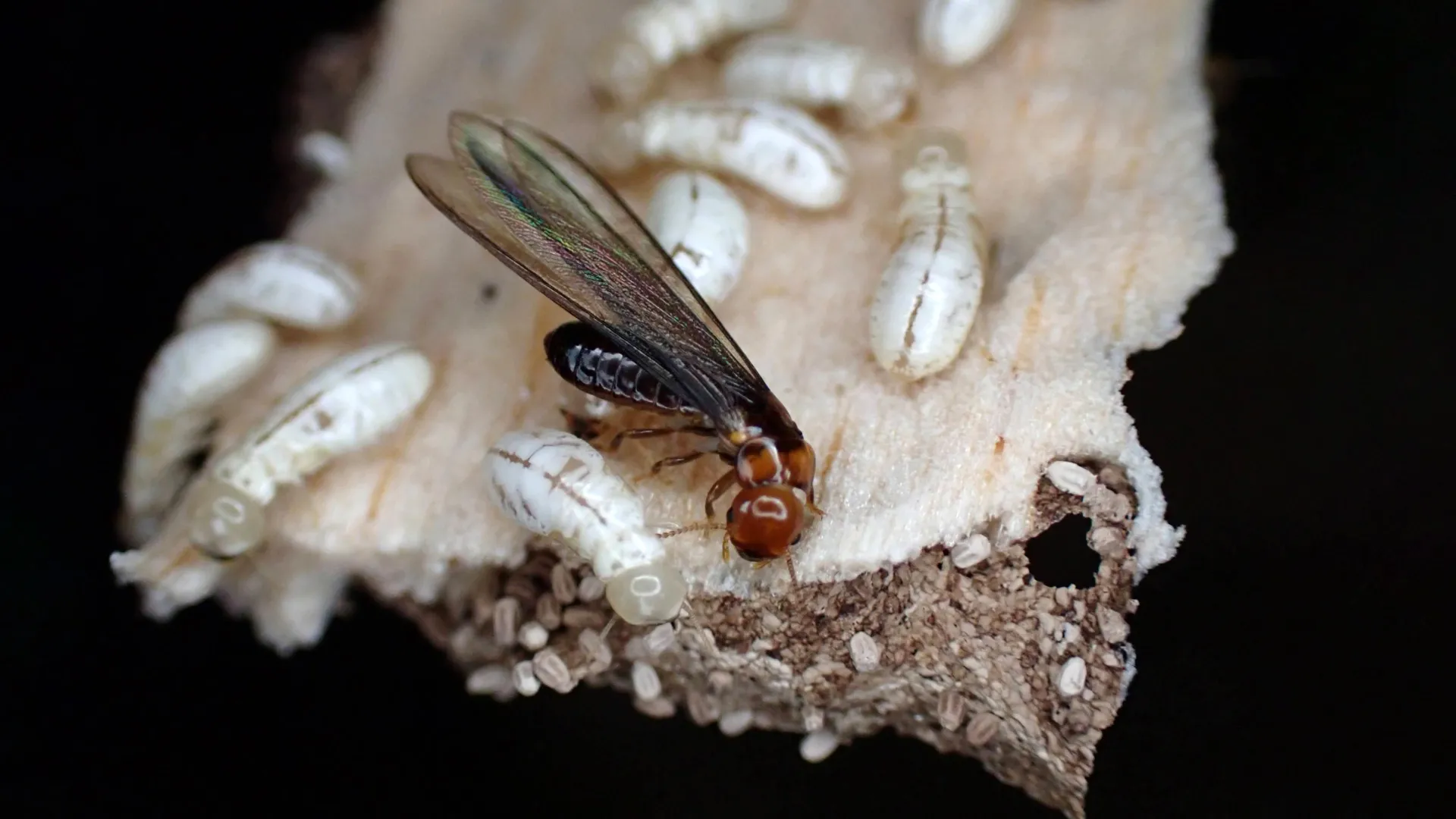
Drywood termites have long perfected the art of living in total obscurity, spending virtually their entire lifecycles entirely enclosed within structural beams, framing elements, furniture, and other dry wood. Unlike their subterranean counterparts, which require constant contact with the soil to maintain moisture and construct visible mud tubes, drywood termites require no external infrastructure. They silently carve out intricate galleries as their colonies expand, leaving homeowners and pest control professionals entirely unaware of an infestation until significant structural damage has already occurred. This hidden existence has historically made these pests exceptionally difficult to locate and eradicate.
However, recent scientific breakthroughs achieved by entomologists at the University of California, Riverside (UCR) have identified a fundamental, unavoidable biological vulnerability in these destructive insects: they are physically bound to the process of molting. By weaponizing this biological requirement alongside the termites’ own complex social behaviors and unique microbial footprints, researchers are laying the groundwork for a generational shift in how drywood termite infestations are detected, managed, and ultimately eliminated.
The Turning Point: Targeting the Inevitable Molting Process
The foundation of this emerging pest control strategy centers on a 2025 study published in the Journal of Economic Entomology. Led by doctoral student and corresponding author Nicholas Poulos, alongside senior author and entomology professor Dong-Hwan Choe, the research team investigated the efficacy of bistrifluron against western drywood termites (Incisitermes minor). Bistrifluron belongs to a specific class of chemical compounds known as chitin synthesis inhibitors, functioning as an insect growth regulator (IGR).
Unlike conventional, fast-acting neurotoxins that kill insects almost instantly upon contact, bistrifluron operates through a delayed, highly targeted mechanism. Insects, unlike mammals, possess no internal skeletal system. Instead, they rely on a rigid outer covering called an exoskeleton, which provides both structural protection and sturdy attachment points for muscle movement. A crucial component of this exoskeleton is chitin—a remarkably durable natural polysaccharide that is also found in fungal cell walls, fish scales, and the anatomical structures of cephalopods like squids and octopuses.
Because a growing termite cannot simply stretch its rigid armor, it must periodically shed its old exterior through a process called ecdysis, or molting. Western drywood termites typically molt approximately seven times throughout their lifetimes. Bistrifluron turns this unavoidable biological milestone into a fatal trap. By disrupting the insect’s physiological ability to synthesize sufficient chitin for a new exoskeleton, the chemical ensures that when the termite reaches its scheduled molting stage, it sheds its old armor without a functional replacement ready to protect it.
Controlled laboratory experiments demonstrated the devastating effectiveness of this approach. When termites were given a continuous exposure window to wood treated with bistrifluron, the chemical produced a staggering 99 percent mortality rate. Even when given a choice between treated and untreated wood, the insects suffered a 95.7 percent mortality rate. Furthermore, the chemical profile offers significant environmental and safety advantages over traditional treatments; because it targets a biological structure unique to invertebrates, it is fundamentally non-toxic to humans and other mammals.
A Timeline of Innovation at UCR
The recent publication regarding bistrifluron is part of a broader, sustained chronological effort by the UCR Department of Entomology to rethink pest management paradigms from the ground up.
- May 2024: The research laboratory published foundational findings regarding pinene, a naturally occurring fragrant chemical released by many trees, identifying its potential to act as an olfactory beacon for western drywood termites.
- 2025: The Journal of Economic Entomology published the landmark study detailing bistrifluron and its 95 to 99 percent mortality rates via chitin synthesis inhibition.
- April to October 2025: A University of California patent application was filed and subsequently published, outlining a novel methodology that incorporates alpha or beta pinene into localized insecticide injections to lure termites toward treatment zones.
- 2026: The research team released high-resolution images and video documentation capturing western drywood termites engaging in proctodeal trophallaxis—a specialized social feeding behavior wherein individuals exchange hindgut fluids containing vital nutrients and wood-digesting microbes.
- Post-bistrifluron study (2025–2026): Researchers completed subsequent microbiological analyses tracking the exponential decay of bacterial DNA in discarded termite fecal pellets, establishing a biological clock to differentiate active infestations from historical damage.
Leveraging Social Structure and Trophallaxis for Complete Colony Eradication
One of the most profound discoveries of the UCR research program involves how the chemical agent moves through a colony. Drywood termites are intensely social insects that routinely share food and vital bodily fluids. To track this internal dynamic, researchers utilized colored food markers to monitor the physical transfer of materials between colony members.
When a small subset of a termite colony—as little as 5 percent of the total population—was exposed to bistrifluron and subsequently reintroduced to untreated nestmates, a cascading lethal effect occurred. Within 24 to 48 hours, materials from the exposed individuals had successfully transferred to previously untouched colony members. By day 90, groups starting with a mere 5 percent exposure rate ultimately reached 100 percent mortality. Groups with a 50 percent initial exposure rate mirrored this devastating trajectory.
This phenomenon is heavily reinforced by the unique biology of termite nutrition. Western drywood termites rely on gut microbes to break down cellulose. To maintain these essential microbial populations, they engage in proctodeal trophallaxis, passing hindgut material directly from one individual to another. While this intense cooperation typically ensures the survival and resilience of a wild colony, UCR researchers realized it could be weaponized against them.
Because bistrifluron operates slowly, it prevents the immediate death of contaminated termites, granting them ample time to return to the heart of the colony, interact with nestmates, and unwittingly distribute the lethal dose. This localized, social dissemination strategy bypasses the need for massive, indiscriminate chemical applications.
Challenging Whole-Structure Fumigation Paradigms
For decades, the standard remedy for severe drywood termite infestations has been whole-structure fumigation. While fumigation remains undeniably effective at eradicating pests across an entire building simultaneously, it comes with severe logistical drawbacks. Residents are forced to temporarily vacate their homes, sensitive food items must be meticulously sealed or removed, and the gas offers zero residual protection against future infestations introduced by flying reproductives or newly imported lumber.
"Low-impact strategies like this one will become an attractive option in many cases," noted Professor Dong-Hwan Choe. "Furthermore, the chemical may stay active in the wood for some time, potentially providing protection from future infestations."
By utilizing targeted spot treatments powered by chitin synthesis inhibitors, pest control technicians could eventually offer homeowners a less disruptive, highly localized alternative. However, researchers are careful to contextualize their laboratory findings. The controlled environment of small-group laboratory trials does not automatically translate to guaranteed field success without addressing practical obstacles. Chief among these barriers is the chemical solvent used in the study—acetone. While ideal for dissolving bistrifluron in a laboratory setting, acetone’s high flammability and strong odor render it impractical for residential application, prompting ongoing efforts by the UCR team to formulate safer, consumer-ready delivery vehicles.
Luring Termites with Natural Attractants
To maximize the efficiency of localized treatments, the UCR laboratory has simultaneously explored ways to actively guide termites toward poisons rather than waiting for them to stumble upon treated zones. Their research into pinene—the aromatic tree compound—demonstrated that when introduced to an aqueous insecticide treatment like fipronil, mortality rates jumped dramatically from roughly 70 percent with the insecticide alone to over 95 percent when paired with the pinene lure.
This concept materialized into a University of California patent application published in late 2025. The application proposes injecting alpha or beta pinene alongside localized insecticides to actively draw foraging termites toward the treatment site. If successfully commercialized, this approach could allow pest control professionals to space their treatment injection holes significantly farther apart, minimizing structural drilling, reducing labor costs, and lowering the overall volume of chemical agents required to achieve total eradication.
Solving the Diagnostic Puzzle: Fecal Pellet Microbiology
Even the most potent insecticide is useless if technicians cannot accurately determine where an active colony resides. For generations, pest inspectors have relied on the presence of tiny, hard, six-sided fecal pellets ejected by drywood termites from their galleries as a primary diagnostic indicator. The critical flaw in this method, however, is persistence: old fecal pellets can remain structurally intact inside wall voids and framing for years after a colony has naturally died out or been eradicated. Finding droppings has never guaranteed an active infestation.
To solve this diagnostic dilemma, Nicholas Poulos and his colleagues investigated the bacterial communities residing within the fecal pellets themselves. By examining fresh pellets alongside samples aged for three, six, and twelve months, the research team discovered a dramatic biological clock.
Bacterial DNA within the pellets degraded exponentially over time, plummeting by up to 190-fold between fresh samples and those aged for a year across multiple wood diets, including natural hardwood and Douglas fir. Furthermore, specific bacterial families identified consistently in fresh pellets completely vanished as the samples aged. These distinct microbial signatures pave the way for the development of rapid, field-deployable diagnostic tools, enabling technicians to verify whether visual evidence of termites is recent enough to justify immediate intervention.
Broader Geographic Impacts and Implications
The urgency of these scientific advancements is underscored by the expanding global footprint of Incisitermes minor. Native to the southwestern United States and northwestern Mexico, the western drywood termite has historically been recognized as a primary structural pest throughout California. However, continuous global trade and the routine transport of infested lumber, antique furniture, and wooden packaging materials have enabled the species to establish thriving introduced populations far beyond its native range, including Hawaii, Florida, New York, parts of Canada, China, Japan, Korea, and Australia.
As global climate patterns shift and international shipping volumes grow, the risk of these concealed colonizers establishing footholds in new regions increases correspondingly. Because colonies travel completely unseen inside wood products, intercepting them requires sophisticated, biologically driven methodologies rather than brute-force chemical applications.
By decoding the intricacies of insect molting, tracking the microbial decay of fecal waste, exploiting social trophallaxis, and harnessing natural olfactory lures, the research team at the University of California, Riverside is forging a comprehensive new playbook for structural pest management. For an organism that has spent millennia successfully hiding within the very material it consumes, these multi-layered biological insights are effectively running out of places to hide.
