
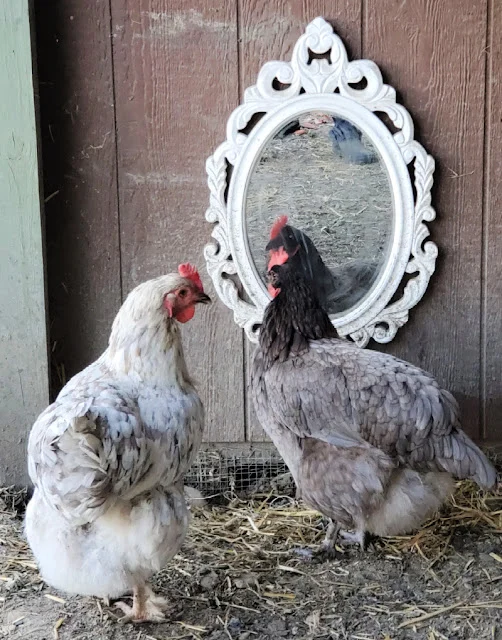
Recent scientific inquiries into avian cognition have challenged long-standing assumptions regarding the intellectual limits of domestic poultry, specifically focusing on whether chickens possess the capacity for self-recognition. For decades, the "mirror test" has served as the gold standard for determining self-awareness in the animal kingdom, and recent adaptations of this test suggest that chickens—specifically roosters—may understand that their reflection is an image of themselves rather than a rival or a separate individual. This discovery carries significant implications for animal welfare, ethology, and our broader understanding of the evolution of consciousness.

While the traditional mirror self-recognition (MSR) test involves placing a mark on an animal’s body that is only visible via reflection, researchers have found that this method may not be suitable for all species. In the case of chickens, a modified approach utilizing their natural social behaviors and alarm-call systems has provided more definitive evidence. By observing how roosters respond to perceived threats in the presence of their own reflection versus the presence of other live birds, scientists have uncovered a level of cognitive sophistication that aligns chickens with a select group of highly intelligent species, including great apes, dolphins, and elephants.
The Evolution of the Mirror Self-Recognition Test
The concept of mirror self-recognition was first pioneered by psychologist Gordon Gallup Jr. in 1970. The original experiment involved anesthetizing an animal and applying a scentless dye or mark to a part of its body it could not see directly, such as the forehead or ear. Upon waking, the animal was placed in front of a mirror. If the animal used the mirror to investigate or touch the mark on its own body, it was deemed to possess self-awareness—the understanding that "that individual in the glass is me."

Since its inception, only a handful of species have consistently passed the MSR test. These include chimpanzees, orangutans, bottlenose dolphins, Eurasian magpies, and Asian elephants. Human children typically do not pass the test until they are approximately 18 to 24 months old. Conversely, many animals that rely heavily on non-visual senses, such as dogs and cats, often "fail" the test. These animals frequently respond to their reflections with indifference or aggression, likely because the reflection lacks the olfactory cues (scent) they require to identify a living being.
For chickens, the visual mark test has historically yielded ambiguous results. Some birds would peck at the mirror or the mark, but it was unclear if they were reacting to themselves or simply investigating a foreign object. This led researchers to develop a more ecologically relevant test based on the "audience effect"—a complex social behavior where an animal alters its communication based on who is watching.

Methodology: The Rooster Alarm Call Experiment
In a landmark study published in the journal PLOS ONE in late 2023, researchers from the University of Bonn and MSH Medical School Hamburg sought to bypass the limitations of the traditional mark test. The study focused on the natural behavior of roosters (Gallus gallus domesticus), which are known to emit specific vocalizations—alarm calls—when they spot a predator, such as a hawk.
The biological purpose of the alarm call is to warn the flock of impending danger. Crucially, roosters typically remain silent if they believe they are alone. Sounding an alarm when no companions are present would needlessly draw a predator’s attention to the rooster himself without providing any benefit to others. This "audience effect" provided the perfect framework for a cognitive test.

The Experimental Setup
The researchers placed roosters in a controlled environment divided by a fence or a mirror. The experiment involved three primary scenarios:
- The Social Scenario: A rooster was placed in a compartment where he could see another rooster through a clear partition.
- The Solitary Scenario: A rooster was placed alone in the compartment with no other birds visible.
- The Mirror Scenario: A rooster was placed alone in the compartment but was provided with a mirror, allowing him to see his own reflection.
To simulate a threat, the researchers projected the silhouette of a hawk flying overhead. The results were striking. When a rooster could see a companion, he emitted an average of 1.33 alarm calls per trial. When the rooster was alone, the call rate dropped significantly to nearly zero. Most importantly, when the rooster was alone with a mirror, he also remained silent, emitting only 0.01 calls on average.

Data Analysis and Scientific Implications
The data from the PLOS ONE study suggests that the roosters did not perceive their reflection as another bird. If they had believed the reflection was a different rooster, they would have sounded the alarm to warn the "other" bird of the hawk. The fact that they remained silent—just as they did when they were truly alone—indicates they recognized the image as themselves, or at the very least, as an entity that did not constitute a "social audience."
Further testing confirmed that this lack of calling was not due to the mirror being a distraction or causing fear. To ensure the roosters were still capable of recognizing other birds by sight, the researchers placed a live bird behind the mirror where it could be heard but not seen. In these instances, the roosters also remained silent, suggesting that for chickens, visual identification is the primary driver of the audience effect.

These findings suggest that chickens possess a form of "conspecific recognition" that extends to the self. While some skeptics argue that this does not prove a "philosophical" sense of self, it does prove that chickens can distinguish between their own movements and images and those of others, a high-level cognitive function once thought to be the exclusive domain of "higher" mammals.
Contextualizing Avian Intelligence
The discovery of self-recognition in chickens is part of a broader shift in how scientists view avian brains. For decades, the term "bird brain" was used pejoratively, based on the anatomical observation that birds lack a cerebral cortex—the area of the brain responsible for complex thought in humans. However, modern neurology has revealed that birds possess a structure called the nidopallium, which functions similarly to the mammalian prefrontal cortex.

Other avian species have already demonstrated remarkable cognitive abilities:
- Corvids (Crows and Ravens): Known to use tools, solve multi-step puzzles, and even hold "grudges" against specific humans they perceive as threats.
- Parrots: Capable of understanding abstract concepts like "zero," "same," and "different," as famously demonstrated by Alex, the African Grey parrot.
- Pigeons: Capable of distinguishing between different styles of art (e.g., Monet vs. Picasso) and recognizing human faces.
Chickens, as descendants of the red junglefowl, evolved in complex social environments where recognizing individuals and maintaining a "pecking order" was essential for survival. This social complexity likely drove the evolution of the cognitive faculties required for self-recognition.

Practical Applications: Enrichment and Welfare
Understanding that chickens are self-aware and capable of boredom or curiosity has led to significant changes in how poultry are managed in both backyard and commercial settings. The use of mirrors is increasingly recommended as a form of environmental enrichment.
Benefits of Mirror Enrichment
- Boredom Mitigation: In confined spaces like brooders or coops, mirrors provide a dynamic stimulus that changes as the bird moves. This can prevent negative behaviors such as feather pecking or cannibalism, which often stem from stress and lack of stimulation.
- Social Buffering: For a solitary bird (such as a chick that hatched alone or a hen in recovery), a mirror can provide the illusion of company. While the bird may recognize the image as itself, the presence of "another" bird—even a reflected one—can lower cortisol levels and reduce the distress associated with isolation.
- Preening and Grooming: Observations from poultry keepers suggest that hens often use mirrors to assist in preening. By seeing areas of their plumage they cannot otherwise observe, they may maintain better feather health.
However, the response to mirrors can vary by individual and gender. Some roosters, despite the findings of the Bonn study, may exhibit aggression toward mirrors if they are in a highly territorial state or if the lighting conditions prevent them from clearly identifying the reflection as themselves.

Broader Impact and Ethical Considerations
The revelation that chickens may be self-aware adds a layer of complexity to the ethical debate surrounding industrial poultry farming. If chickens can recognize themselves, they likely possess a higher capacity for suffering and a more complex internal life than is currently accounted for in many agricultural regulations.
Advocates for animal welfare argue that these scientific findings should lead to more stringent requirements for living conditions, including more space, opportunities for natural behaviors, and cognitive stimulation. The recognition of chickens as sentient beings with a sense of self challenges the "commodity" view of poultry and encourages a more compassionate approach to their care.

Conclusion
The scientific consensus is steadily moving toward the acknowledgment of chickens as cognitively complex individuals. The 2023 rooster mirror study serves as a pivotal piece of evidence in this transition, suggesting that the ability to recognize oneself is not a rare anomaly in the animal kingdom but perhaps a more common trait among social, visually oriented species.
As research continues, it is likely that we will find even more evidence of sophisticated thought processes in domestic birds. For the backyard enthusiast, this research confirms what many have long suspected: that the birds in their coops are not merely egg-producers, but intelligent creatures with a unique perspective on the world—and themselves. Whether they are curiously peering into a mirror in a brooder or preening in the coop, chickens are demonstrating a level of awareness that demands our respect and continued scientific curiosity.
