
Thousands of years ago, the subterranean darkness of a limestone cavern on the Caribbean island of Hispaniola played host to a fatal nocturnal encounter. A giant barn owl—a formidable avian predator now long vanished from its former habitats—silently patrolled the tropical canopy before plunging toward its unsuspecting prey. Its target was a hutia, a stout, herbivorous rodent native to the West Indies. Striking with surgical precision, the raptor secured the animal and carried it back to the secluded gloom of Cueva de Mono, located in what is now the southern Dominican Republic. There, sheltered from the elements, the owl fed its voracious young, eventually scattering the bone fragments of the unfortunate rodent across the cave floor.
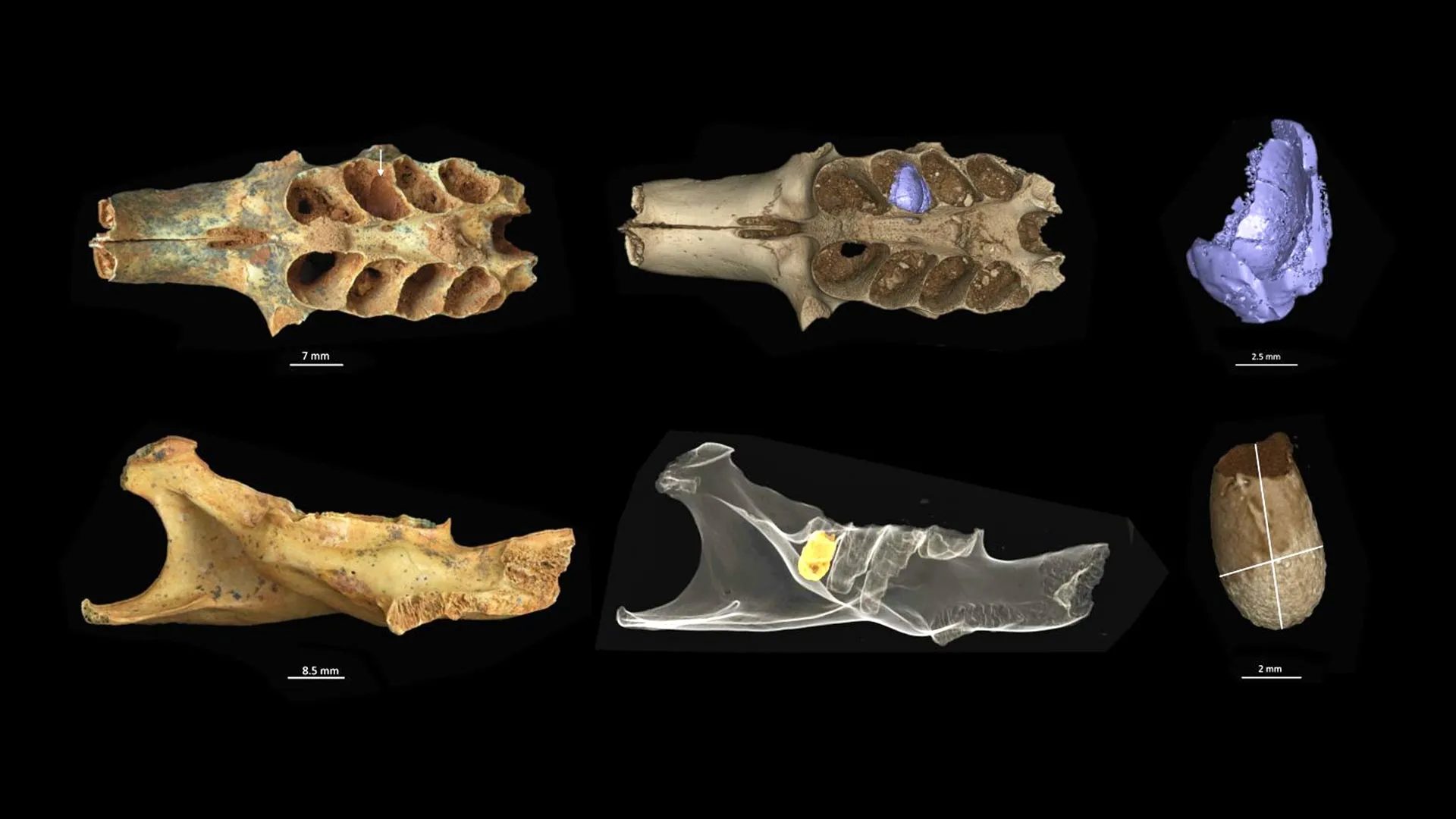
Millennia later, this gruesome scene of predation gave rise to an astonishing ecological adaptation. Long after the owl and the hutia had vanished from the immediate landscape, a burrowing bee ventured into the cavern. Searching for a secure, sheltered environment to lay its eggs, the insect encountered the sun-bleached, sediment-dusted skeletal debris left behind by generations of raptors. Rather than digging out a traditional subterranean burrow, the insect made a remarkable evolutionary pivot: it claimed the empty tooth sockets of the extinct rodent’s jawbone as a ready-made, pre-engineered nursery.
This unusual discovery, recently detailed in the Proceedings of the Royal Society B, provides a rare and unprecedented window into prehistoric paleoecology. Documented by paleontologists from the Florida Museum of Natural History, the finding highlights how extreme environmental pressures can drive organisms to repurpose the biological architecture of other species in entirely novel ways.
A Chance Discovery Etched in Stone
The remarkable finding might have been entirely overlooked were it not for rigorous, meticulous fieldwork and an unwavering attention to detail during the cleaning and preparation phases of excavation. Lazaro Viñón-Lopez, who spearheaded the fieldwork as a doctoral student at the Florida Museum of Natural History, was primarily focused on cataloging an extensive cache of hutia fossils recovered from Cueva de Mono. The cave system, researchers deduced, had served as a multi-generational roosting and feeding site for giant barn owls, accumulating thousands of fragmented vertebrate remains over centuries, if not millennia.
Typically, the preparatory protocol for fossilized skeletal material involves systematically clearing away all accumulated sediment, clays, and silt from the delicate hollows and foramina of the specimens. Viñón-Lopez, however, paused before blindly scrubbing the interior of a hutia mandible. One specific cavity caught his eye because its inner perimeter possessed a polished, remarkably smooth texture, standing in stark contrast to the rough, porous surface characteristic of untreated bone.
The visual cue instantly triggered a memory from years prior. In 2014, while participating in a dinosaur fossil excavation expedition in Montana, Viñón-Lopez had encountered fossilized wasp cocoons intimately intermingled with prehistoric bonebeds. Initially, he suspected he was looking at a similar phenomenon—fossilized insect nurseries deposited by prehistoric wasps. Excited by the prospect, he approached his colleague and fellow doctoral student, Mitchell Riegler, proposing they document the unusual occurrence.
Riegler, weighed down by a dense schedule of ongoing academic commitments, was initially skeptical. "I was like, Lazaro, that’s a niche project, and I have a lot of other things to do," Riegler recalled. The observation was shelved, treated as an interesting biological curiosity rather than a high-priority research breakthrough.
The One-Week Research Challenge and a Case of Mistaken Identity
The trajectory of the research shifted dramatically when Riegler accepted an academic challenge issued by a former advisor: draft and finalize a complete, publishable scientific paper within a span of seven days.
"He and I played this game back and forth in which we tried to write a paper in a week," Riegler explained. Turning his attention to the mysterious bone-hosted cavities collected by Viñón-Lopez, the pair began diving deeply into the scientific literature surrounding ichnofossils—geological records of biological activity, such as footprints, burrows, coprolites, and nests, rather than the preserved bodies of the organisms themselves.
As they cross-referenced their findings against established ichnological benchmarks, a crucial discrepancy emerged. Standard wasp nests are characteristically constructed from masticated plant matter mixed with salivary secretions, resulting in a rough, textured, papery, or earthen wall lining. The structures embedded within the Hispaniolan rodent jaws, however, featured smooth, polished, and meticulously sealed interiors.
Further consultation with modern apicultural and entomological experts illuminated the truth. Bees—specifically solitary, cavity-nesting burrowing bees—frequently line their subterranean or sheltered brood cells with specialized waxy or resinous organic secretions. This impermeable coating serves a dual purpose: it creates a waterproof microclimate to protect vulnerable larvae from ambient moisture fluctuations and provides a polished finish.
The researchers realized they were not looking at wasp architecture at all. They were documenting the trace fossils of ancient, subterranean-dwelling bees.
Unprecedented Biological Behavior in the Fossil Record
The correction elevated the study from a minor anatomical curiosity to a significant paleontological milestone. A comprehensive review of historical and contemporary scientific literature revealed that documented instances of burrowing bees nesting inside caves are exceedingly rare. Furthermore, no prior scientific literature had ever recorded bees utilizing pre-existing, unmodified skeletal cavities—such as mammalian alveolar sockets—as prefabricated nesting chambers. While past studies had occasionally noted insects boring into human skeletal remains or soft woods, utilizing natural osteological hollows without any structural excavation represented an entirely novel ecological behavior.
Recognizing the broader implications of their discovery, the research team immediately expanded the scope of their investigation. They brought in outside specialists in modern bee biology, initiated rigorous multi-layered geological stratigraphy assessments of Cueva de Mono, and returned to the field to secure additional material before environmental threats compromised the site.
The urgency of the return expedition was underscored by local human pressures. At one point during the excavation timeline, the cave and its surrounding karst terrain faced imminent destruction when a local developer attempted to clear the property with the intention of converting the cave system into a functional septic tank. Although swift legal and administrative intervention halted the project, the incident served as a stark reminder of the fragility of paleontological heritage in rapidly developing regions.
"We had to go on a rescue mission and get as many fossils out as possible, and we got a lot of them," Viñón-Lopez noted, reflecting on the frantic race against time to salvage the fragile historical record embedded within the stone.
Beyond Rodent Jaws: Nests Across Diverse Skeletal Elements
As the research team broadened their analytical scope through high-resolution computed tomography (CT) scanning and microscopic imaging, they discovered that the bees’ utilization of skeletal real estate was not isolated to hutia mandibles.
Inside the cavern’s rich fossil matrix, nests were identified embedded within a diverse array of skeletal elements belonging to various endemic Caribbean fauna. Notably, a nest was discovered tucked securely inside the deep pulp cavity of an extinct tree sloth tooth. Large arboreal sloths were once a prominent component of the Antillean megafauna before disappearing from the fossil record following human arrival on the islands. Another distinct nest was uncovered inside the neural canal of a hutia vertebra—the precise anatomical tunnel that once housed the animal’s spinal cord.
CT scans provided an even more intimate look at the density and efficiency of this biological reuse. Rather than constantly foraging for fresh cavities, individual bees repeatedly returned to favored, secure locations. In several instances, scans revealed multiple distinct generations of brood cells stacked end-to-end within a single alveolar socket, arranged with the precision of traditional Russian nesting dolls. Up to six distinct nest layers were documented within a single tooth socket, illustrating a high degree of site fidelity and spatial optimization.
Geological Pressures: Why the Bees Moved Underground
To understand why bees would abandon traditional soil-burrowing habits in favor of avian predation debris, the researchers had to examine the regional geology of the southern Dominican Republic.
The landscape surrounding Cueva de Mono is characterized by extensive karst topography—a rugged, highly soluble terrain composed primarily of sharp, jagged limestone formations. Natural soil accumulation in such environments is notoriously sparse, as wind, heavy tropical rainfall, and rapid drainage sweep loose sediment away from exposed surfaces.
"The area we were collecting in is karst, so it’s made of sharp, edgy limestone, and it’s lost all of its natural soils," explained Riegler, adding a personal note on the terrain’s unforgiving nature: "I actually fell on it at one point, so I can tell you all about it."
In a landscape starved of stable, fine-grained earth, any accumulated soil on the surface tends to wash downward during heavy precipitation events, eventually funneling into subsurface cave systems like Cueva de Mono. There, the silt settles into sheltered pockets, creating localized deposits of fine-grained clay-rich sediment. For ground-nesting or burrowing insects, these cave-floor deposits represented rare, viable anchor points for excavation. Combined with the ready-made structural support offered by the scattered bones of owl prey, the environment presented an opportunistic, highly efficient nesting alternative.
Broader Implications and Future Horizons
The publication of these findings in the Proceedings of the Royal Society B offers far more than a localized biological quirk; it demonstrates the remarkable elasticity of ecological interactions over evolutionary timescales. The discovery paints a vivid picture of a dynamic prehistoric ecosystem where the trophic outputs of one apex predator—the giant barn owl—directly subsidized the reproductive success of an entirely unrelated invertebrate population.
Furthermore, the study underscores the value of looking beyond primary research targets. By treating cave sediment and cleaning waste not as debris to be discarded, but as a potential archive of micro-behavioral data, the researchers have opened new avenues for paleoichnological research.
As Viñón-Lopez, Riegler, and their collaborators continue to process the vast quantities of fossil material rescued from Cueva de Mono, additional discoveries are anticipated. The cave, once a localized slaughter site for raptors, continues to yield complex, multi-layered narratives of survival, adaptation, and ecological recycling—proving that even in the deepest subterranean darkness, life continually finds a way to build anew from the remnants of the past.
