
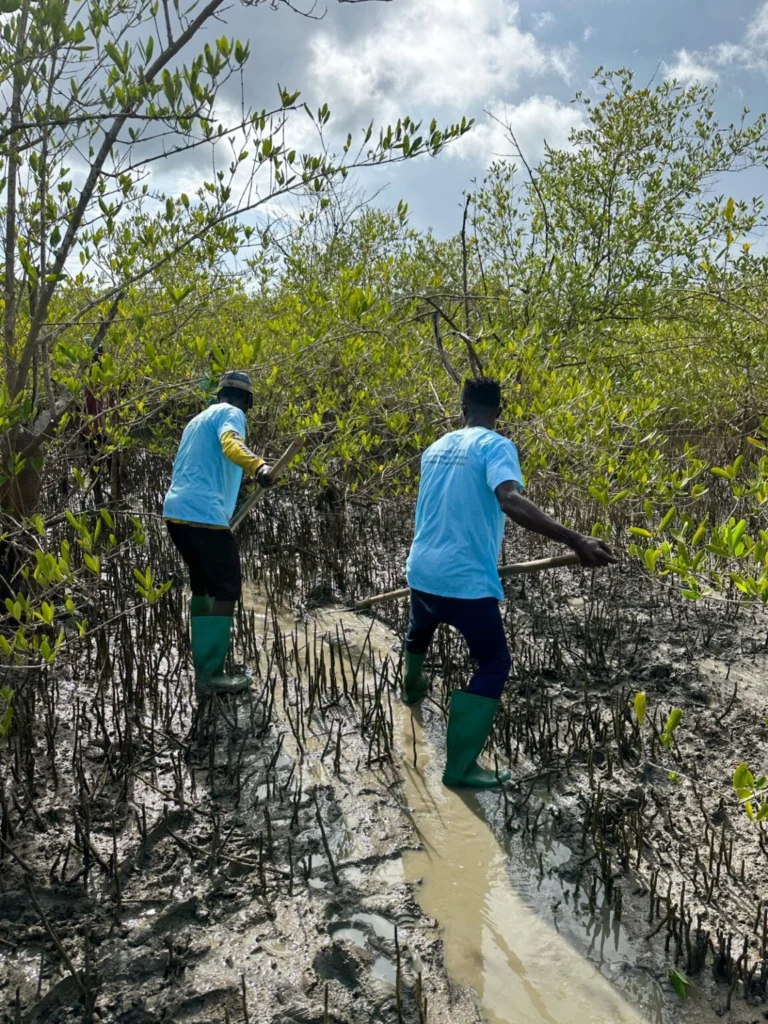
The coastal landscapes of Guinea-Bissau are undergoing a profound ecological transformation as Wetlands International, alongside regional teams, government bodies, and local community members, officially launches its 2026 mangrove restoration campaign. Running from August 27 to September 10, this year’s intensive two-week field initiative targets 270 hectares across 18 carefully selected sites within Cantanhez National Park and its surrounding buffer zones. The ongoing campaign marks a critical milestone in a larger, ambitious national strategy aimed at reclaiming 1,000 hectares of degraded coastal wetlands, ultimately pushing the cumulative scope of the long-term program to an impressive 3,500 hectares of restored mangrove ecosystems.
Mangroves serve as the biological heartline of Guinea-Bissau’s coastal territories. These dynamic intertidal forests provide essential ecological services, acting as natural nurseries for a vast array of marine fisheries, buffering fragile shorelines against severe storms and coastal erosion, and sequestering staggering amounts of atmospheric carbon. For generations, the nation’s coastal populations have relied directly on these ecosystems for their livelihoods, food security, and protection from rising sea levels. However, decades of anthropogenic pressure, shifting land-use patterns, and altered hydrological regimes have severely compromised these vital habitats, making coordinated ecological intervention an urgent priority for both environmental conservationists and local communities.
A Shift from Tree Planting to Ecological Healing
Rather than relying on conventional reforestation methods—which frequently involve planting mass quantities of seedlings in areas unsuited for their survival—the 2026 campaign is rooted in a science-backed methodology known as Community-Based Ecological Mangrove Restoration (CBEMR) or Assisted Natural Regeneration (ANR). This progressive approach rejects the notion that simply planting trees guarantees forest recovery. Instead, CBEMR prioritizes diagnosing and rectifying the root causes of mangrove degradation, with a primary focus on restoring disrupted water flows and tidal hydrology.
When natural tidal channels are blocked by infrastructure, abandoned agricultural dikes, or accumulated sediment, mangrove seeds and propagules are physically prevented from reaching mudflats, and existing root systems suffocate from hypersalinity or stagnant water. By meticulously clearing these blockages and re-establishing natural hydrological connectivity, project engineers and local participants allow the mangrove ecosystem to harness its own formidable regenerative capacities. Pioneer species, such as Avicennia, naturally reoccupy the cleared zones, drastically increasing long-term survival rates compared to traditional planting efforts.

Community Integration and Collaborative Launch Events
The execution of the 2026 campaign relies heavily on grassroots engagement, ensuring that local stakeholders transition from passive observers to active stewards of their natural heritage. The initiative was formally inaugurated through high-profile community mobilization events held in three distinct local settlements: Cassumba in Cacine, Kauntchintchi in Yemberem, and Weldekeia Wangha. These launch events drew substantial local participation, serving as dynamic platforms for field demonstrations where community members could observe hydrological restoration techniques firsthand.
During these gatherings, villagers, local non-governmental organization (NGO) workers, and park rangers collaborated to discuss the historical drivers of mangrove loss in their regions. More importantly, participants received hands-on training regarding the ongoing maintenance and monitoring tasks required to keep tidal channels open. Following these initial launches, community-led committees have assumed daily operational responsibilities, working alongside Wetlands International field staff to identify new restoration zones, execute physical interventions, and track biological recovery metrics across all 18 target areas.
Rigorous Site Selection Criteria
A cornerstone of Wetlands International’s methodology in Guinea-Bissau is the stringent screening process applied to every potential restoration site. Recognizing that not all degraded land is suitable for mangrove recovery, the program enforces strict criteria to ensure ecological additionality, social equity, and long-term sustainability.
Under these guidelines, target locations are predominantly confined to former rice fields situated within tidal wetlands or severely deforested tracts that have been abandoned from agricultural production for a minimum of two years. Furthermore, selected plots must exhibit clear evidence of human-induced hydrological disruption that prevents natural vegetative recruitment. To prevent operational overlap or social friction, candidate sites must also be completely free from concurrent restoration interventions and active land or resource-use disputes.
Crucially, no intervention proceeds without obtaining the prior and informed consent of local landowners and resource users. This rigorous adherence to social inclusivity ensures that food security is not compromised and that customary land rights are fully respected, fostering a deep sense of local ownership over the restored landscapes.

Systematic Monitoring and Adaptive Management
To evaluate the efficacy of the CBEMR approach, Wetlands International has established a comprehensive monitoring framework across all restored areas. Field teams regularly track key environmental indicators, including vegetation density, soil composition, hydrological flow rates, and the density of natural seedling recruitment.
This data-driven feedback loop enables scientists and project managers to assess whether the ecosystems are rebounding according to ecological projections. If localized bottlenecks are identified—such as unexpected sedimentation or residual salinity spikes—the program can rapidly adapt its strategy, deploying additional targeted interventions. This adaptive management model guarantees that financial and human resources are channeled precisely where they are most needed, maximizing the overall return on environmental investment.
Broader Socio-Economic and Environmental Implications
Beyond the immediate ecological metrics of hectares cleared and hydrology restored, the Guinea-Bissau mangrove initiative carries profound socio-economic implications for the West African subregion. Healthy mangrove forests directly bolster artisanal fisheries by providing sheltered breeding grounds for commercially and culturally vital fish and crustacean species. For rural communities facing the immediate economic fallout of declining fish stocks, the return of thriving mangrove habitats translates directly to improved food security and enhanced household incomes.
Furthermore, as coastal West Africa faces escalating vulnerabilities associated with global climate change—including intensified storm surges, coastal erosion, and saltwater intrusion into freshwater aquifers—the restoration of natural green buffers represents a cost-effective, nature-based adaptation strategy. By locking away substantial quantities of blue carbon within their dense root systems and organic-rich soils, these restored ecosystems also contribute meaningfully to international climate mitigation targets.
Institutional Partnerships and Multi-Stakeholder Collaboration
The complex logistical and scientific demands of the 2026 restoration campaign are met through a robust network of institutional partnerships. The initiative is spearheaded in close collaboration with the Government of Guinea-Bissau, specifically through the Ministry of the Environment, Biodiversity and Climate Action, alongside the Institute for Biodiversity and Protected Areas (IBAP).

On-the-ground implementation is further strengthened by key civil society organizations and national networks, including Face the Future, Proativos, REDE AGIR, AJUTS, and the national mangrove platform PLANTA. Strategic alignment is maintained with regional and international conservation heavyweights such as the BioGuinea Conservation Trust Fund, the International Union for Conservation of Nature (IUCN), the Regional Partnership for Coastal and Marine Conservation (PRCM), and the World Bank’s West Africa Coastal Areas Management Program (WACA).
Financial backing for these expansive conservation efforts is provided by dedicated philanthropic donors, notably Greenchoice and DOB Ecology, whose sustained investments enable Wetlands International and its local partners to scale up their operations across Guinea-Bissau’s vital coastal frontier. Through this unified coalition of government agencies, international conservationists, and local resource users, Guinea-Bissau is demonstrating a scalable model for coastal resilience that bridges community empowerment with cutting-edge ecological science.
