
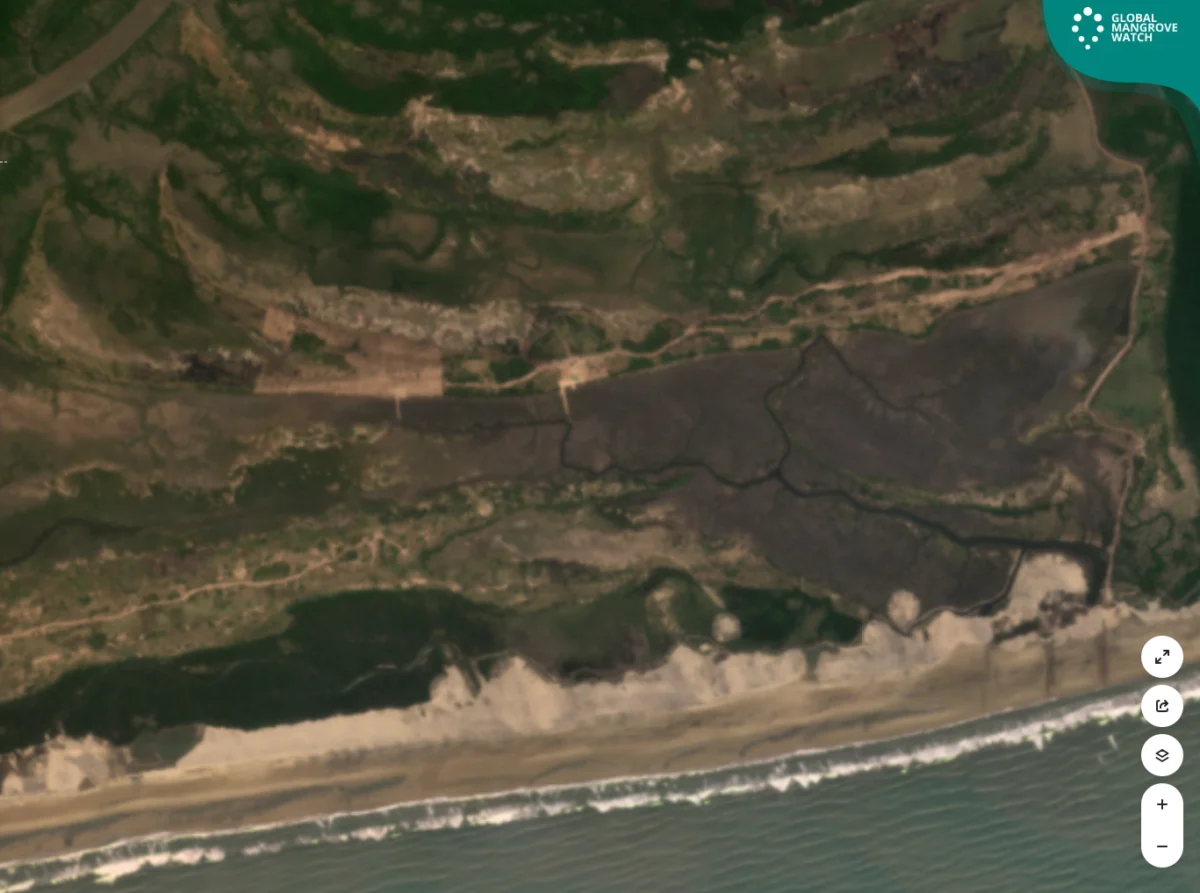
Mozambique’s globally significant Zambezi Delta is facing an escalating environmental crisis following the detection of widespread mangrove habitat loss. Recent satellite data analyses, powered by the Global Mangrove Watch (GMW) platform, have pinpointed alarming degradation across one of Africa’s most expansive and ecologically vital coastal ecosystems. Investigative reports published by Mongabay have since linked this localized environmental collapse to heavy sand mining operations conducted by a leading Chinese mineral extraction firm operating within the region.
The findings have intensified global scrutiny regarding the unregulated extraction of marine and coastal sand—currently the second-most exploited natural resource on Earth after water. As global demand for construction aggregates surges, the lack of binding international standards governing sand mining leaves vulnerable developing nations susceptible to severe ecological and socio-economic fallout. Environmental watchdogs, conservation scientists, and international bodies are calling for an immediate re-evaluation of industrial practices in the region to safeguard irreplaceable carbon sinks and protect the livelihoods of hundreds of thousands of coastal residents.
Chronology of a Crisis: Environmental Pressures on Mozambique’s Coastline
For decades, Mozambique’s coastal ecosystems have been subjected to a compounding array of environmental stressors. Historically, the degradation of the country’s mangrove forests was driven primarily by subsistence pressures and localized commercial developments. Communities reliant on timber have long utilized mangrove wood for firewood and construction. Simultaneously, the rapid expansion of aquaculture ventures, saltpan developments, logging operations, urban encroachment, and port infrastructure projects steadily chipped away at the nation’s green belt.
These localized pressures were further compounded by the intensifying impacts of global climate change. Mozambique occupies a frontline position regarding extreme weather events in Southern Africa. Over the past twenty years, the region has endured a relentless succession of high-intensity tropical cyclones, prolonged droughts, and severe inland flooding. These climatic shocks have repeatedly battered the coastline, eroding sediment and disrupting hydrological flows essential for mangrove survival.
The most recent chapter in this ongoing ecological deterioration unfolded via remote sensing telemetry. In late August and early September 2026, automated alerts generated by Global Mangrove Watch detected sudden, sharp reductions in canopy cover and biomass within specific sectors of the Zambezi Delta. Cross-referencing these spatial anomalies with concession maps and industrial footprints led investigators directly to heavy sand mining operations. The extraction of heavy minerals from coastal and riverine deposits has drastically altered local topography, severed tidal inundation routes, and accelerated land-loss rates far beyond natural baselines.
The Ecological and Economic Weight of the Zambezi Delta
To understand the gravity of the ongoing destruction in the Zambezi Delta, one must examine the disproportionate ecological role the region plays both nationally and internationally. Mozambique harbors the largest extent of mangroves in the Western Indian Ocean region, boasting roughly 10 percent of the entire African continent’s mangrove cover. Within Mozambique, the Zambezi Delta stands out as the single largest continuous mangrove formation, accounting for approximately 16 percent of the nation’s total mangrove area.
Recognizing its immense biological richness, the Convention on Wetlands designated the Zambezi Delta as a Wetland of International Importance under the Ramsar Convention in 2004. While over 2,500 Ramsar sites exist globally, Mozambique hosts only two, underscoring the exceptional conservation status of the delta.
The ecosystem serves as a powerhouse for global climate mitigation. Mangroves are among the most intensive carbon sinks on the planet, capturing and storing vast quantities of organic carbon in their complex root systems and underlying anaerobic soils—a resource commonly referred to as "blue carbon." Scientific assessments indicate that Mozambique’s mangroves sequester well over one-third, specifically 39 percent, of the nation’s annual fossil fuel emissions. The Zambezi Delta itself represents a concentrated blue carbon reservoir, holding substantial stocks of above- and below-ground biomass.
Beyond climate regulation, the delta functions as an indispensable physical buffer. As global sea levels rise and cyclonic storms increase in frequency and ferocity, the dense root networks of the delta absorb wave energy, mitigate storm surges, and prevent catastrophic coastal erosion.
Socio-economically, the value of the delta is deeply intertwined with human survival. Approximately 400,000 people living along Mozambique’s coast depend directly on mangrove-associated fisheries for their sustenance and daily income. Economists and environmental valuation studies estimate that Mozambique’s mangroves generate approximately $7 billion in annual net economic benefits, anchoring local food security and supporting broader commercial fishing industries.

Furthermore, the delta sustains a remarkably diverse menagerie of wildlife. It serves as a natural sanctuary for a significant population of large African mammals, including elephants, lions, leopards, hippopotamuses, and African buffaloes. Avian populations thrive in the wetlands, featuring massive concentrations of pink-backed and white-backed pelicans, various heron species, flamingos, and the endangered grey crowned crane. Marine and freshwater systems within the delta also support bottlenose dolphins, humpback dolphins, and a diverse array of finfish and shellfish.
The Global Sand Crisis and Regulatory Deficits
The degradation observed in the Zambezi Delta is symptomatic of a broader, systemic global crisis regarding the extraction of sand. According to United Nations data, sand is consumed at rates surpassing any other natural resource save water. Driven by rapid urbanization, infrastructure development, and land reclamation projects, global demand has depleted marine and riverine sand reserves at an unprecedented pace.
Unlike other commodities, sand extraction operates within a fragmented regulatory framework. There is currently no unified global standard governing where, how, and in what quantities sand can be mined. This governance vacuum leaves resource-rich developing nations vulnerable to industrial overreach. In many cases, foreign mining conglomerates operate with limited oversight, prioritizing short-term mineral yields over long-term environmental stability.
In the case of the Zambezi Delta, the extraction of heavy sands—mined for valuable minerals such as ilmenite, rutile, and zircon—requires extensive earth-moving operations. These activities often involve dredging riverbeds, clearing riparian vegetation, and constructing artificial levees or access roads. Such interventions disrupt the delicate hydrological balance that allows saltwater and freshwater to mix and nourish mangrove forests. When tidal flushing is restricted, hypersaline conditions develop, suffocating the salt-tolerant trees and triggering widespread die-offs.
Expert Recommendations and Mitigation Pathways
Environmental organizations, conservationists, and scientific networks emphasize that the short-term financial gains realized through mineral extraction are entirely disproportionate to the long-term ecological and economic losses incurred by the destruction of these habitats. Disrupting blue carbon ecosystems undermines national commitments under the Paris Agreement and weakens community resilience against climate change.
Wetlands International and other leading conservation entities maintain that mangroves must be treated as critical infrastructure rather than expendable terrain. Where resource extraction is deemed legally and economically unavoidable, strict mitigation protocols must be enforced. Industry operators are urged to consult proactively with independent environmental hydrologists and local conservation experts to identify and implement the least invasive extraction methodologies.
In the context of the Zambezi Delta, experts suggest that remediation is still feasible if decisive action is taken. Interventions such as unblocking obstructed tidal channels, removing unauthorized barriers, and engineering alternative water canals can successfully restore the natural flow of freshwater and tidal currents. Restoring hydrological connectivity has proven effective in multiple global case studies, frequently catalyzing the natural regeneration of degraded mangrove stands.
The Role of Remote Sensing and Global Mangrove Watch
Monitoring remote and expansive ecosystems like the Zambezi Delta has historically posed significant logistical challenges for under-resourced environmental agencies and local authorities. However, technological advancements in Earth observation are transforming conservation enforcement.
Global Mangrove Watch provides an open-access online platform that democratizes satellite data, offering near real-time tracking of mangrove habitats worldwide. Utilizing high-resolution imagery combined with topographical, hydrological, and soil data, GMW empowers conservationists, park managers, policymakers, and civil society organizations to detect environmental degradation almost as soon as it occurs.
By pinpointing the precise timing and location of canopy loss, platforms like GMW remove ambiguity regarding the drivers of environmental damage. This transparency enables stakeholders to hold industrial operators accountable, challenge unlawful extraction practices, and track the efficacy of subsequent ecological restoration initiatives. As pressures on coastal ecosystems mount, integrating remote sensing tools into national environmental policy frameworks will be essential for balancing industrial development with planetary survival.
