
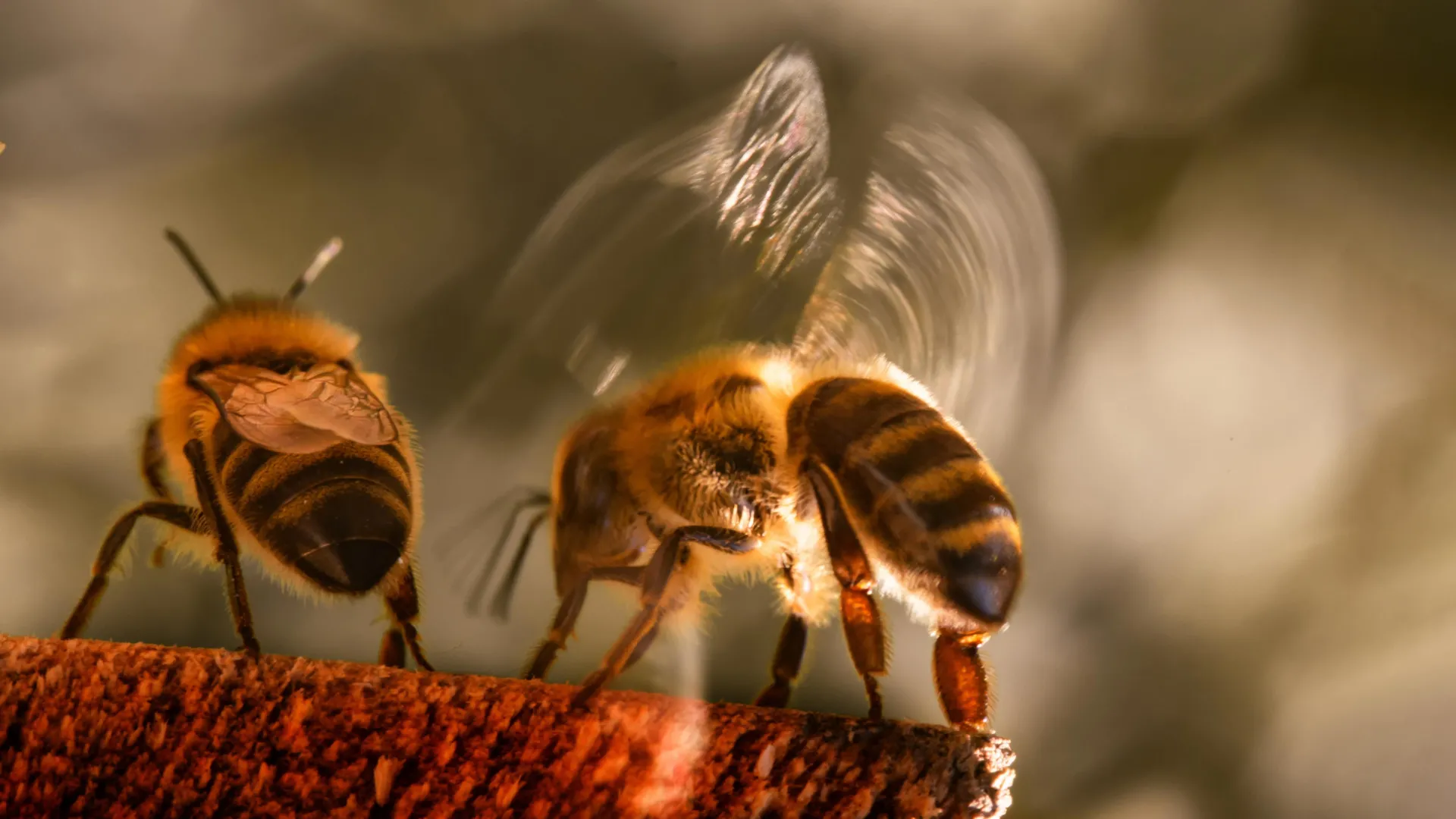
The British countryside is often imagined as a tranquil landscape of buzzing meadows and harmonious ecosystems, but a new scientific investigation reveals a much more aggressive reality unfolding at the petal level. Managed honey bees, widely celebrated for their vital role in agriculture and honey production, are proving to be formidable and often hostile competitors for food. According to groundbreaking research conducted by scientists at Anglia Ruskin University (ARU), honey bees routinely use physical intimidation, displacement, and aggressive chases to drive rival insects away from essential nectar and pollen sources.
Published in the academic journal Ecological Entomology, the study provides the first detailed empirical evidence of the extent to which managed honey bees interfere with the foraging abilities of wild pollinators. As the popularity of beekeeping surges across the United Kingdom, environmental scientists are raising alarms about the potential long-term consequences for native bumblebees, solitary bees, hoverflies, and other vulnerable insect species.
A Closer Look at the Cambridge Field Study
To better understand the microscopic battlegrounds taking place within local flora, a research team led by ARU PhD student Victoria Buckle designed a comprehensive observational study. Over a span of two years, scientists monitored pollinator activity across five distinct locations in and around Cambridge, England. Each chosen site shared a specific geographical characteristic: it was situated within 300 meters of an established, active honey bee colony, ensuring a high baseline presence of the managed insects.
The researchers focused their observations on two prolific flowering plant species: bramble (Rubus fruticosus) and ivy (Hedera helix). Both plants are ecological powerhouses, producing abundant supplies of nectar and pollen during their respective flowering seasons. Because they naturally attract a diverse multitude of insects, bramble and ivy serve as ideal natural laboratories for examining interspecies competition for food resources.
During 93 hours of meticulous field observation, the research team documented thousands of floral visits and direct encounters between different insect species. To quantify the dynamics of these interactions, the scientists categorized the visitors into five distinct groups: honey bees, bumblebees, solitary bees, hoverflies, and a residual "other" category comprising butterflies, beetles, and wasps.
Every recorded encounter was evaluated based on its outcome. An interaction was labeled a "win" if one insect successfully gained access to a flower while forcing a competitor out or depriving it of feeding opportunities. A "loss" denoted the forfeiture of a feeding site, while a "share" indicated that two insects successfully managed to feed side-by-side without behavioral conflict.
Quantitative Findings: Domination of the Floral Landscape
The data revealed a stark and undeniable pattern across all observed locations. Areas characterized by higher concentrations of honey bees consistently hosted lower populations of wild pollinators and suffered from vastly elevated levels of interspecies competition. Furthermore, honey bees emerged as the victors in a disproportionately high percentage of their encounters with other insect groups.
The statistical impact of honey bee density on wild populations was particularly striking. On bramble flowers, researchers observed that doubling the density of local honey bees correlated directly with a 14% decline in the abundance of competing bumblebees. On ivy flowers, similarly high concentrations of honey bees were linked to noticeable reductions in the populations of local solitary bees and hoverflies.
Rather than merely possessing superior speed or arriving at the blossoms first, honey bees actively dictated the terms of engagement. In 28% of observed interactions on bramble and 36% of those on ivy, rival pollinators actively avoided approaching flowers simply due to the presence of honey bees. Moreover, in at least one-fifth of the competitive encounters won by honey bees on either plant species, the insects went a step further by physically shoving or aggressively chasing their rivals off the petals.
The Exception to the Rule: The Rise of the Ivy Bee
While the overwhelming majority of aggressive behaviors observed in the study were initiated by honey bees, the researchers noted a fascinating ecological anomaly. Interspecies aggression is rarely initiated by insects other than honey bees; however, one solitary species demonstrated a distinct capacity to stand its ground.
The ivy bee (Colletes hederae), a solitary species that is not native to the British Isles and was first officially documented in the country in 2001, proved to be the sole pollinator capable of consistently challenging honey bee dominance. Unlike native bumblebees or hoverflies, which typically retreated or avoided conflict, ivy bees were occasionally observed defending their chosen feeding territory. They actively chased and displaced honey bees, successfully holding their own in contested interactions and securing essential floral resources.
Researchers point out that this competitive resilience in an immigrant species highlights the complex and shifting dynamics of modern British ecosystems, where native and non-native populations must negotiate increasingly crowded ecological niches.
The Broader Context: The UK Beekeeping Boom
The publication of this study arrives against the backdrop of a significant cultural and agricultural shift in the United Kingdom. Over the past decade and a half, beekeeping has experienced an unprecedented surge in popularity among hobbyists, urban farmers, and environmental enthusiasts.
According to agricultural and environmental tracking data, the number of registered beekeepers in the UK skyrocketed from approximately 19,000 in 2010 to an estimated 47,000 by last year. This sharp increase corresponds to a massive proliferation of managed honey bee colonies deployed across both rural countryside and densely populated urban centers.
While the growth of apiculture is often promoted as an ecofriendly response to global pollinator declines, conservation scientists increasingly emphasize that managed honey bees (Apis mellifera) are livestock. Just as introducing high densities of sheep or cattle to a pasture can strain local resources, concentrating large numbers of managed honey bees in a localized environment can exert intense pressure on wild, unmanaged fauna that rely on the exact same floral buffet.
Climate Change and the Threat of Heat Stress
Compounding the problem of high honey bee densities is the growing threat of global climate change. The ARU researchers warn that rising ambient temperatures and increasingly erratic weather patterns could significantly worsen the competitive disadvantage faced by wild pollinators in the coming decades.
Field observations during the two-year study indicated that aggressive encounters between honey bees and other insects became noticeably more frequent during warmer weather conditions. Scientists attribute this phenomenon primarily to the physiological and ecological impacts of heat on both plants and insects.
When flowering plants experience heat stress, their biological processes can falter, resulting in a marked reduction in nectar production. This creates a scarce-resource scenario where a greater number of hungry insects must fight over a diminished supply of food.
Furthermore, different pollinator species respond to temperature variations in vastly divergent ways. Wild insects such as bumblebees and hoverflies are physiologically sensitive to high thermal loads and tend to forage more efficiently during cooler morning or evening hours. Honey bees, conversely, exhibit a dramatic increase in activity as the thermometer rises. Previous scientific literature notes that a temperature increase of just 1.2 degrees Celsius can trigger a tenfold surge in the number of foraging honey bees exiting their hives.
Combined, these factors suggest that as the UK climate continues to warm, honey bees will enjoy an extended and intensified window of peak foraging activity, granting them an even greater upper hand over heat-stressed wild pollinators.
Balancing Conservation and Apiculture: Official Perspectives
As the debate over managed versus wild pollinators intensifies, lead author Victoria Buckle was quick to clarify the intended message of the research. The goal, she stresses, is not to demonize beekeepers or call for a reduction in honey production, but rather to inform more targeted, science-based conservation strategies.
"The aim of our study was not to discourage beekeeping, but to better understand how competition happens between wild and managed pollinator species with the aim of helping to conserve our wild pollinators, which play such an important ecological role," Buckle stated following the publication of the findings.
She emphasized that while honey bees are undeniably charismatic and economically valuable, the ecological health of the UK relies heavily on a diverse network of wild species, including solitary bees and hoverflies, which perform specialized pollination services that honey bees cannot fully replace.
"We found that most interactions when competing for food were instigated by honey bees and they had a greater number of ‘wins’, resulting in a loss of forage for other pollinators," Buckle explained. "Bumblebees, solitary bees and hoverflies would avoid, be displaced by, and on some occasions be chased off by honey bees."
Commenting on the resilience of the ivy bee, Buckle added, "An interesting exception was the ivy bee, which would win contests more often against honey bees. It is the first time, to our knowledge, such behaviors have been observed and shows ivy bees are able to ‘hold their own’ in such encounters."
Nevertheless, the overarching conclusion remains a cause for environmental vigilance. "Honey bees outcompeted all other wild pollinators, and based on our findings, future predicted warming in the UK is only likely to further exacerbate interference competition from dominant honey bees," Buckle warned. "Therefore, it’s important to find ways to ensure honey bees and wild pollinators can continue to coexist, particularly in locations with a high density of hives, such as urban areas."
Implications for Future Environmental Policy
The findings from Anglia Ruskin University are expected to influence future discussions among conservationists, urban planners, and agricultural regulators regarding the placement and density of beehives.
Urban beekeeping, while popular as a biodiversity initiative, may require tighter regulation or more strategic zoning to prevent the saturation of local green spaces. Environmental groups suggest that urban planners aiming to support local biodiversity should pair the installation of managed beehives with extensive planting of diverse, high-yield native wildflowers to ensure an adequate supply of forage for all species.
Additionally, conservation biologists advocate for increased funding and research directed toward wild pollinator monitoring programs. By tracking the localized impacts of managed colonies on native species, policymakers can better protect fragile ecosystems before competitive displacement leads to localized declines or extinctions of vulnerable wild insects.
Ultimately, the research serves as a reminder that nature management is a delicate balancing act. As the UK navigates an era of shifting climates and rising apicultural enthusiasm, safeguarding the future of Britain’s wild pollinators will require acknowledging the hidden conflicts playing out in the garden and ensuring that conservation policies account for the aggressive nature of our most famous buzzing insects.
