
Fifty years after Donald Griffin’s groundbreaking assertion that nonhuman animals possess consciousness and comparable levels of self-awareness, the scientific community continues to grapple with the profound implications of this idea. What was once a revolutionary proposition, challenging the prevailing view of animals as mere instinct-driven automatons or stimulus-response mechanisms, has evolved into a complex, multi-faceted scientific inquiry. While a growing consensus, underscored by the 2024 New York Declaration on Animal Consciousness signed by hundreds of scientists, posits "strong scientific support" for consciousness in mammals and birds, the ultimate validation—irrefutable proof—remains an elusive target, both for nonhuman and human subjects alike.
The scientific endeavor to understand animal consciousness is deeply rooted in the challenge of defining and measuring this elusive state. Early approaches often focused on sentience—the capacity to experience emotions and sensations—as a primary indicator. However, this metric itself presents significant hurdles. Even among humans, the introspection and articulation of one’s own emotional landscape can be fraught with difficulty, as noted by Robert Plutchik in his foundational work on the nature of emotions. This inherent complexity amplifies the challenge when attempting to interpret and evaluate the subjective experiences of nonhuman beings, particularly those with vastly different sensory and cognitive architectures.
While a focus on more easily discernible sensations, such as sensitivity to pain, offers a seemingly simpler pathway, researchers acknowledge that such a narrow focus would be insufficient to establish human-like consciousness. The ongoing quest necessitates more sophisticated methodologies, moving beyond basic physiological responses to explore higher-order cognitive functions.
Evolving Metrics and the Search for Evidence
The development of increasingly complex metrics for assessing animal consciousness, as seen in the work of researchers like Birch, Bayne, and their colleagues, represents a significant evolution in the field. However, these sophisticated frameworks are often criticized for their inherent bias towards human cognitive capacities, potentially overlooking unique forms of awareness that might be present in other species.
Decades ago, a collaborative effort between Dr. Irene Pepperberg and a graduate student proposed a paradigm shift, suggesting that consciousness exists in varying levels, intricately linked to quantifiable cognitive abilities within a species. This perspective posited that these cognitive levels are not arbitrary but are likely the product of evolutionary processes, including homologous or convergent brain development, shared perceptual structures, and common learning mechanisms. This line of inquiry inevitably led to the challenging question of whether parallels could be drawn between the cognitive processes of different species and whether a "neural correlate of consciousness" (NCC) could be identified across diverse biological lineages. The ongoing search for an NCC in humans, a complex undertaking acknowledged by entities like the Cognitive Consortium, further underscores the immense difficulty of extending such investigations to nonhuman subjects.

Adding another layer of complexity to this debate is the rapid advancement of artificial intelligence. While current AI systems demonstrate impressive processing power and the ability to perform complex tasks, their lack of self-awareness highlights a crucial distinction. This raises a fundamental question: does the ability to process information equate to consciousness, or does the focus need to return to sentience, as debated by philosophers like Ned Block? The absence of self-awareness in even the most sophisticated AI systems suggests that mere computational power is not a sufficient condition for consciousness.
The Grey Parrot: A Case Study in Cognitive Prowess
The study of Grey parrots, particularly through the pioneering work of Dr. Irene Pepperberg, offers compelling insights into the cognitive capabilities of non-avian species. The Grey parrot, Psittacus erithacus, has become a focal point for research into avian intelligence due to its remarkable capacity for vocal learning, problem-solving, and what appears to be sophisticated cognitive processing.
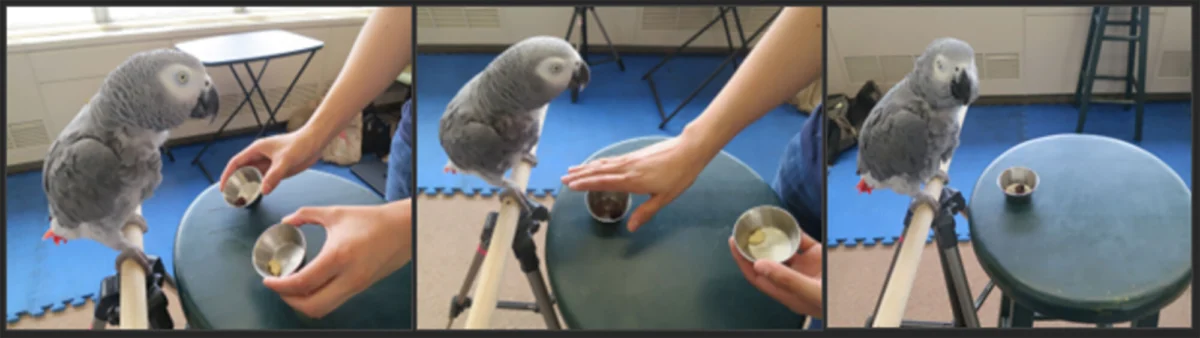
One area of intense investigation has been the Grey parrot’s ability to exhibit delayed gratification. This complex behavior, observed in studies by Koepke et al. (2015), Pepperberg and Hartsfield (2023), and Pepperberg and Rosenberger (2022), requires individuals to forgo an immediate, less desirable reward in anticipation of a larger or more appealing reward after a period of waiting. The success of Grey parrots in these tasks suggests a capacity for:
- Impulse Control: The ability to recognize, understand, and suppress immediate desires and impulses.
- Temporal Reasoning: Understanding the concept of time and the relationship between present actions and future outcomes.
- Working Memory: Maintaining the long-term goal in memory during the waiting period.
- Strategic Planning: Devising and executing a strategy to achieve the desired future reward.
The image accompanying this report depicts Griffin, a Grey parrot, engaged in a delayed gratification task. In panel (a), Griffin is presented with two distinct reward options. Panel (b) illustrates a crucial phase where one reward is removed, and the other is momentarily covered while Griffin is instructed to "wait." Panel (c) shows Griffin patiently enduring the delay, with the less appealing, though still desired, initial reward in front of him. This visual representation, courtesy of Dr. Irene Pepperberg, vividly captures the cognitive processes involved in overriding immediate urges for a future benefit.
While these demonstrations of delayed gratification are not definitive proof of avian consciousness, they provide significant suggestive evidence. They highlight behavioral patterns that, when observed in humans, are strongly indicative of self-awareness. The ability to conceptualize a future self, understand the trade-offs involved in temporal choices, and actively manage one’s own impulses are all hallmarks of conscious deliberation.
Navigating the Definitional Landscape of Consciousness
Full consciousness, as understood in human terms, encompasses a spectrum of abilities that extend beyond basic sensory perception and emotional experience. It includes the capacity for executive control over decision-making and voluntary action, and crucially, an awareness of one’s own thoughts—the meta-cognitive ability to be aware that one is aware. This latter aspect, self-awareness, remains the most challenging to probe in nonhuman animals. Even species with sophisticated communication systems often lack the symbolic linguistic tools necessary to articulate subjective experiences of self-awareness.

The scientific community faces a continuous challenge in developing robust methodologies that can accurately assess these nuanced aspects of consciousness across species. The development of the "New York Declaration on Animal Consciousness" in April 2024, building on foundational work such as Griffin’s 1976 book, signifies a concerted effort to synthesize current knowledge and guide future research. The declaration’s call for a reduction in the stringent evidentiary standards typically required for scientific proof of consciousness in favor of a more precautionary approach, guided by the principle of "do no harm," has significant implications for animal welfare and conservation efforts.
Implications for Welfare and Conservation
The ongoing debate surrounding animal consciousness, while intellectually stimulating, carries profound ethical and practical weight. As our understanding of animal cognition and potential sentience deepens, so too does our responsibility to consider their welfare. The precautionary principle, advocating for a lowered threshold of certainty when evaluating evidence indicative of consciousness, suggests that in matters of animal well-being, it is prudent to err on the side of caution.
This principle directly informs the design of protocols for humane treatment, welfare standards, and conservation strategies. If evidence, even if not definitively proving consciousness, points towards the capacity for suffering, emotional experience, or self-awareness, then ethical frameworks must adapt to reflect these possibilities. The implications extend to agricultural practices, the ethical treatment of companion animals, and the conservation of wild populations. Recognizing the potential for rich inner lives in nonhuman animals compels a re-evaluation of our interactions and our moral obligations.
The journey to definitively understand animal consciousness is far from over. It requires interdisciplinary collaboration, innovative research methodologies, and a willingness to challenge long-held assumptions. As the scientific dialogue continues, the evidence gathered from species like the Grey parrot will undoubtedly play a crucial role in shaping our understanding of the animal kingdom and our place within it. The legacy of Donald Griffin’s pioneering work is not just in the questions he posed, but in the enduring scientific pursuit to answer them, a pursuit that continues to push the boundaries of our knowledge and empathy.
