
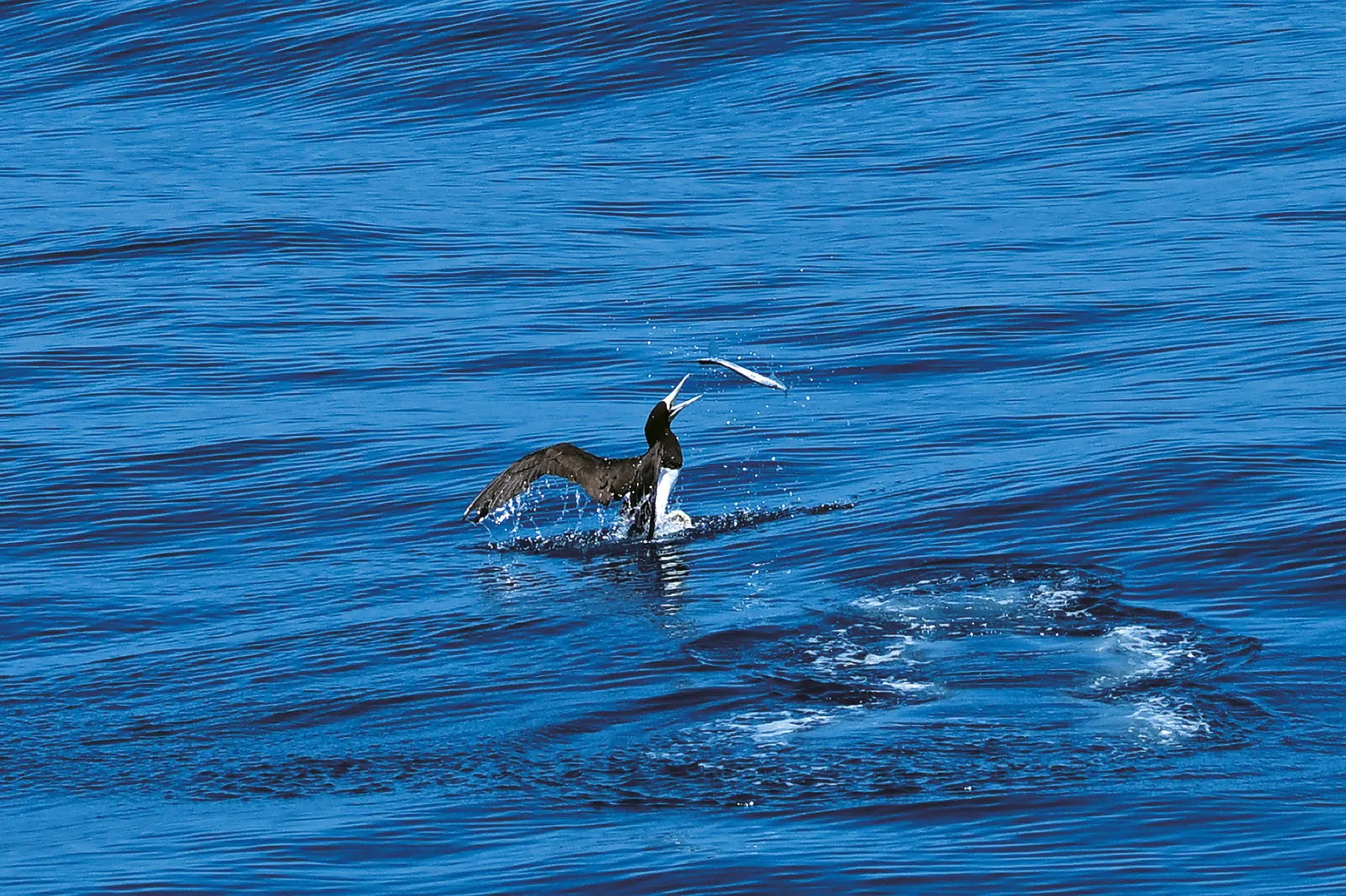
In the late summer of 2026, HIH Princess Takamado offered a rare and intimate glimpse into the avian biodiversity of the Ogasawara Islands, presenting a series of photographs and personal field observations in the August issue of Fujingahou Magazine. The feature, titled "Through the Lens," documents the intricate hunting behaviors and survival struggles of the Sulidae family, commonly known as boobies. These images, captured during a research-focused excursion in May 2026, provide both a scientific perspective on marine life and a narrative on the harsh realities of survival in one of Japan’s most remote and ecologically significant natural habitats.
The Ogasawara Ecosystem and Avian Significance
The Ogasawara Islands, a UNESCO World Heritage site often referred to as the "Galapagos of the Orient," serve as a critical breeding ground for various seabirds. The archipelago’s isolation has fostered a unique environment where species like the Brown Booby (Sula leucogaster) and the Red-footed Booby (Sula sula) thrive. The Princess’s documentation highlights the symbiotic, albeit competitive, relationship between these seabirds and the surrounding marine food web.
The Brown Booby, known in Japan as the Katsuo-dori or "Bonito Bird," serves as a biological indicator for fishermen. Contrary to the misconception that the birds consume large game fish, they act as opportunistic predators. They target smaller, surface-dwelling fish that are driven upward by the predatory activity of larger schooling fish such as bonito. This relationship provides fishers with vital data on the location of productive fishing grounds, demonstrating a historic link between maritime livelihoods and avian migration patterns.
Chronology of Observation: May 2026
The photographic expedition took place in May 2026, a peak time for observing the breeding and foraging behaviors of these seabirds. The timeline of the observations is as follows:

- Early May 2026: The research team, including nature photographer Koichi Fujiwara of NATURE’S PLANET, initiated field operations in the waters surrounding the Ogasawara archipelago.
- Mid-May 2026: Focused observation of hunting maneuvers, including high-speed plunging behavior, was conducted. Data collection centered on the interaction between multiple booby species, including white-morph and brown-morph Red-footed Boobies.
- August 2026: Publication of the findings in Fujingahou Magazine, with the English-language version facilitated by BirdLife International to ensure global reach and accessibility for conservation researchers.
Biomechanics of the Booby Dive
The study emphasizes the remarkable physiological adaptations of the Sulidae family. When hunting, boobies utilize a specialized hunting technique involving a vertical plunge at speeds reaching 100 km/h. To survive the impact with the water surface at such velocity, the birds have evolved several evolutionary safeguards:
- Streamlined Morphology: Their neck, head, and chest form a cone that minimizes air resistance during the descent.
- Impact Cushioning: Beneath the subcutaneous layers of the face and breast, air sacs act as biological airbags, absorbing the kinetic energy upon entry.
- Cranial Protection: An exceptionally thick skull functions as a natural helmet, shielding the brain from the shock of the high-velocity water entry.
- Wing Retraction: The birds fold their wings tightly against their bodies at the precise moment of impact to prevent injury and maintain a streamlined, arrow-like trajectory.
Despite these adaptations, the study notes that the risk of injury remains high. Collisions between birds during group feeding frenzies and miscalculated entry angles can result in severe trauma, illustrating the high stakes of marine foraging.
Competitive Foraging and Data Analysis
A significant portion of the article focuses on the "food theft" or kleptoparasitism observed among the birds. The photographic evidence captured by the Princess depicts a Brown Booby struggling to maintain its catch of a needlefish while being pursued by competitors.
Analysis of these behavioral patterns reveals that the abundance of food often portrayed in nature documentaries is frequently an anomaly. In the vast, nutrient-depleted waters of the open ocean, encounters with massive shoals of fish are rare. The footage and stills suggest that the competition for resources is fierce and constant. The high-speed burst photography utilized by the expedition team allowed for a frame-by-frame analysis of these interactions, which are often too rapid for the human eye to track.
Conservation Implications
The documentation provided by HIH Princess Takamado carries significant weight in the context of marine conservation. By highlighting the precariousness of the birds’ existence, the article draws attention to the health of the Ogasawara marine ecosystem. BirdLife International, which supported the English translation of these findings, frequently uses such data to assess the population health of seabirds in the Pacific region.

The implications for environmental policy are twofold:
- Habitat Protection: The Ogasawara Islands are essential for the survival of these species, and the preservation of the surrounding marine environment is paramount to maintaining the food sources required for breeding seasons.
- Climate Monitoring: As seabirds are highly sensitive to changes in ocean temperature and fish migration patterns, the observations made in 2026 serve as a baseline for measuring the long-term impact of climate change on marine biodiversity.
Reflections on the Expedition
Looking back at the year since the World Expo 2025 in Osaka, the Princess noted the contrast between the high-energy, human-centric environment of the Expo and the solitary, raw struggle for survival observed in the Ogasawara wilderness. The expedition underscores a shift in focus toward the natural world’s resilience and the necessity of scientific observation.
"Seabirds glide effortlessly over the boundless sea," the Princess observed, "yet this voyage reminded me once again how harsh life in the wild truly is, where survival depends solely on one’s own abilities."
This photographic essay serves not only as an artistic endeavor but as a contribution to the body of knowledge regarding the Sulidae family. By documenting the behavior of these birds in their natural state, the project provides a clearer understanding of the challenges facing maritime wildlife in the 21st century. The collaboration between the Imperial household, environmental organizations, and media outlets highlights the importance of public awareness in the global effort to protect fragile oceanic ecosystems. As the data is further integrated into existing ornithological databases, it will assist researchers in tracking long-term trends in avian health and foraging success in the Pacific.
