
The boundaries of contemporary nature and artistic photography are continually being pushed by practitioners who reject straightforward documentation in favor of intentional in-camera manipulation. Rather than relying heavily on post-processing software to alter reality, a growing movement of visual artists is utilizing vintage glass, specialized color filters, deliberate white balance adjustments, and advanced multiple-exposure techniques to recreate scenes at the moment of capture. This methodology transforms ordinary landscapes and everyday subjects into profound visual metaphors. By merging technical precision with abstract artistic vision, photographers are challenging traditional expectations of what nature photography can and should represent.

Evolution of In-Camera Artistic Techniques in Digital Photography
The shift toward in-camera manipulation marks a notable departure from the documentary style that has historically dominated nature photography publications. While historical nature photography prioritized absolute fidelity to the visual spectrum, modern digital sensors and legacy lenses offer unprecedented versatility. Photographers can now alter color temperature, construct double exposures, and manipulate bokeh directly in the field.
Industry analysts and photographic historians note that this resurgence of in-camera effects stems from a collective desire among artists to reclaim the tactile, deliberate pacing of analog techniques within a digital framework. By committing to creative parameters prior to pressing the shutter, photographers establish a direct, unfiltered connection between their internal psychological state and the physical environment. This approach reduces reliance on digital manipulation suites, ensuring that each final frame retains a cohesive, authentic identity rooted in a single geographical and temporal space.

Case Study Analysis: Transforming Ordinary Subjects into Extraordinary Narratives
To understand the mechanics and philosophical underpinnings of this artistic movement, an examination of five distinct photographic projects reveals the meticulous planning required to elevate ordinary moments into high-art compositions.
1. The Ephemeral Coastline: Sunrise at Skagsanden
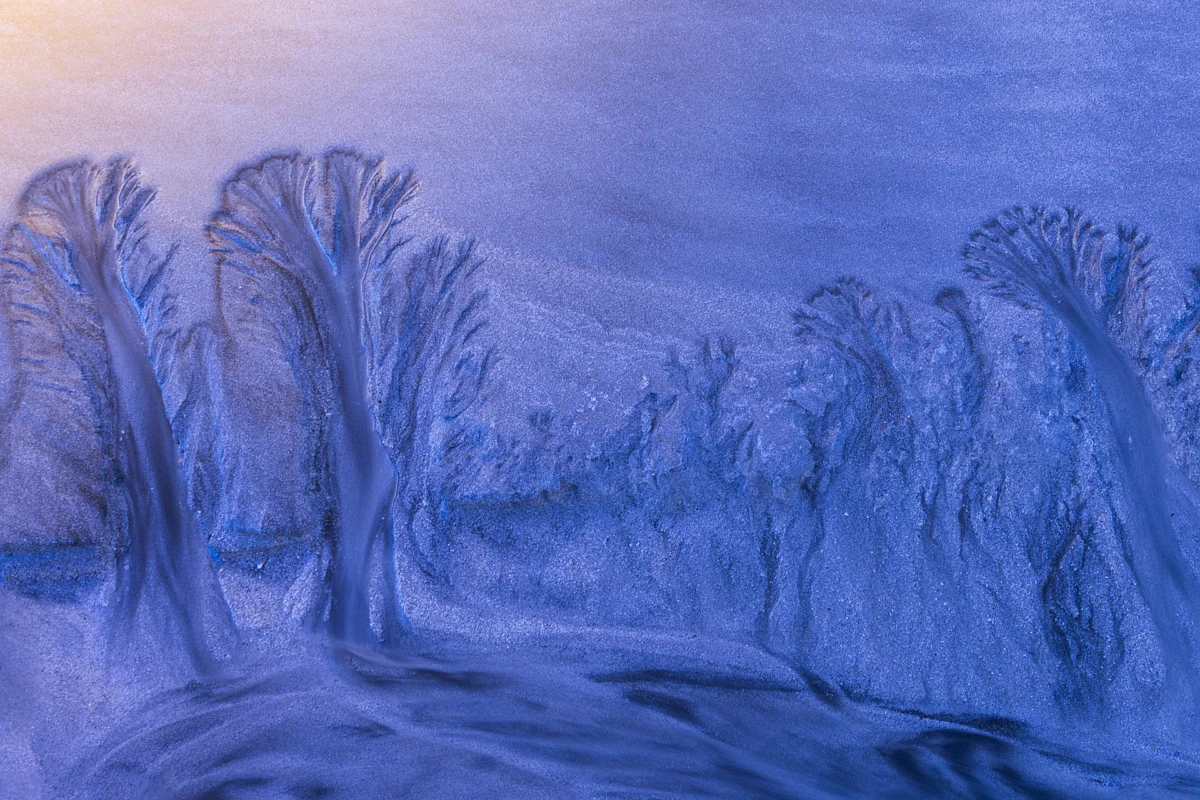
The coastal landscape of Skagsanden in Norway serves as a dynamic canvas for studying transient environmental formations. Working within the framework of a broader photographic essay dedicated to water as a fluid, temporary architectural medium, artists capture compositions that exist for mere minutes before tidal movements erase them permanently.

Operating at the break of dawn, practitioners utilize ultra-wide-angle lenses (such as 16mm focal lengths) to capture the intricate patterns of receding water cutting across dark sands, evoking the branching structures of terrestrial forests. Technical execution requires meticulous stabilization via heavy tripods and slow shutter speeds, typically around 0.8 seconds, to achieve a silky, frictionless blur in the moving water. This motion creates a deliberate textural contrast against the coarse, static granules of the surrounding beach.
Color theory plays a vital role in establishing the mood of these coastal scenes. By intentionally misadjusting the digital white balance to a cool 3500 Kelvin, photographers cast an ethereal blue hue across the landscape. To counteract this chill and introduce tonal complexity, specialized filters—such as the Singh-Ray Gold-N-Blue polarizer—are frequently deployed. These optical tools eliminate high-angle surface glare while infusing the upper register of the frame with rich golden tones, successfully marrying the opposing thermal sensations of a polar sunrise within a single composition.

2. Botanical Abstraction: Symmetries of Black Alders Along the Río Negro
Transitioning from marine environments to riverine ecosystems, artists often look to indigenous flora to construct complex geometric studies. Along the shaded, overcast banks of the Río Negro in Argentina, the native black alder (Alnus glutinosa) provides an ideal subject for exploring natural symmetry.
During overcast afternoons, telephoto lenses are employed to isolate small, pendant-like fruits hanging from branches against the bright, reflective backdrop of adjacent waterways. By engaging in-camera multiple exposure settings—specifically the "double exposure in the shadows" mode, which composites dark tonal values sequentially—photographers can rotate their framing by precisely 180 degrees using a lens collar ring between exposures.

Combined with an elevated white balance setting of 8000 Kelvin to maximize warmth, this technique yields an intricate, mirrored design. The resulting images transcend botanical documentation, transforming tangled riverbanks into rhythmic, abstract patterns that echo Islamic ornamentation or classical architectural motifs.
3. The Cinematic Jungle: Whirlwind of Ferns in Misiones
Rainforest environments present unique compositional challenges due to dense, chaotic undergrowths that often overwhelm primary subjects. Deep within the Misiones jungle of Puerto Iguazú, Argentina, fine drizzles illuminate delicate ferns against dark, cluttered floors of decaying foliage.

To isolate these plants visually without resorting to digital masking, practitioners employ additive double-exposure workflows paired with vintage glass. By mounting legacy optics—such as the Soviet-era Helios 44-2 lens known for its distinctive swirling bokeh—photographers first capture a diffuse, high-contrast background by focusing on sunlight filtering through dense overhead canopy leaves.
A second exposure is then registered with the crisp, centrally positioned ferns sharply focused in the foreground. Because additive exposure modes summate luminosity values, careful underexposure of individual frames is mandatory to prevent clipped highlights. The resulting fusion dissolves the chaotic jungle debris into a luminous, dreamlike vortex that frames the flora in an ethereal glow.

4. Coastal Dynamics: The Great Escape at El Cóndor
Wildlife behavior frequently serves as a psychological projection for human experiences of freedom and anxiety. At the El Cóndor beach resort in Argentina, towering fifty-meter coastal cliffs host the world’s largest colony of burrowing parrots (Cyanoliseus patagonus), comprising over 74,000 nesting birds whose constant motion fills the coastal atmosphere.
To capture the tension between avian flight and oceanic power, photographers employ complex multi-step field routines. The resulting imagery juxtaposes two distinct physical phenomena: the violent, crashing kinetic energy of coastal waves against high-velocity, backlit flocks of parrots navigating stormy skies.

Executing this vision requires sequential in-camera exposures shot at an elevated color temperature of 8000 Kelvin to impart a dramatic, ochre-tinted warmth. The initial frame records the ocean’s fury at a 400mm focal length during peak wave impact. The photographer then dismounts the camera, opens the aperture for maximum shutter speed, and freehands a second exposure of the backlit parrots positioned intentionally near the lower baseline of the frame. This technique creates a powerful narrative of escape, where the avian subjects appear to flee the rising chaos of the sea below.
5. Cosmic Macrocosm: The Moth in Its Galaxy
Artistic vision is frequently triggered by spontaneous domestic encounters rather than meticulously scouted wilderness locations. Upon arriving at a rainforest cabin near the Paraná River in Argentina, practitioners often observe native insects resting against dust-flecked windowpanes.

By conceptualizing a common moth as a solitary celestial body suspended within a vast galaxy, photographers can transform a mundane architectural detail into a cosmic landscape. This effect is achieved through cooperative field techniques: a secondary light source, such as a handheld flashlight directed through the glass by an assistant, illuminates particulate dust trapped on the surface.
Utilizing macro lenses and manual handheld operation, photographers intentionally underexpose the scene by three stops while anchoring the white balance at a cool 3000 Kelvin. The resulting imagery strips away contextual domestic markers, rendering the dust motes as distant star clusters and elevating an overlooked insect into a striking astronomical metaphor.

Broader Implications and Industry Impact on Nature Photography
The growing acceptance and celebration of in-house optical manipulation within prestigious nature photography networks signal a broader shift in industry standards. Critics and exhibition curators increasingly value conceptual depth and technical innovation over mere observational accuracy.
By demonstrating that profound artistic statements can be synthesized from ordinary subjects—such as window-dwelling moths, coastal foam, or suburban river flora—these photographers challenge the necessity of traveling to remote, pristine wildernesses to create compelling art. This democratization of artistic nature photography encourages practitioners to examine their immediate surroundings with heightened imaginative rigor, proving that the boundary between objective reality and personal mythology is defined entirely by the artist’s lens and intent.
